
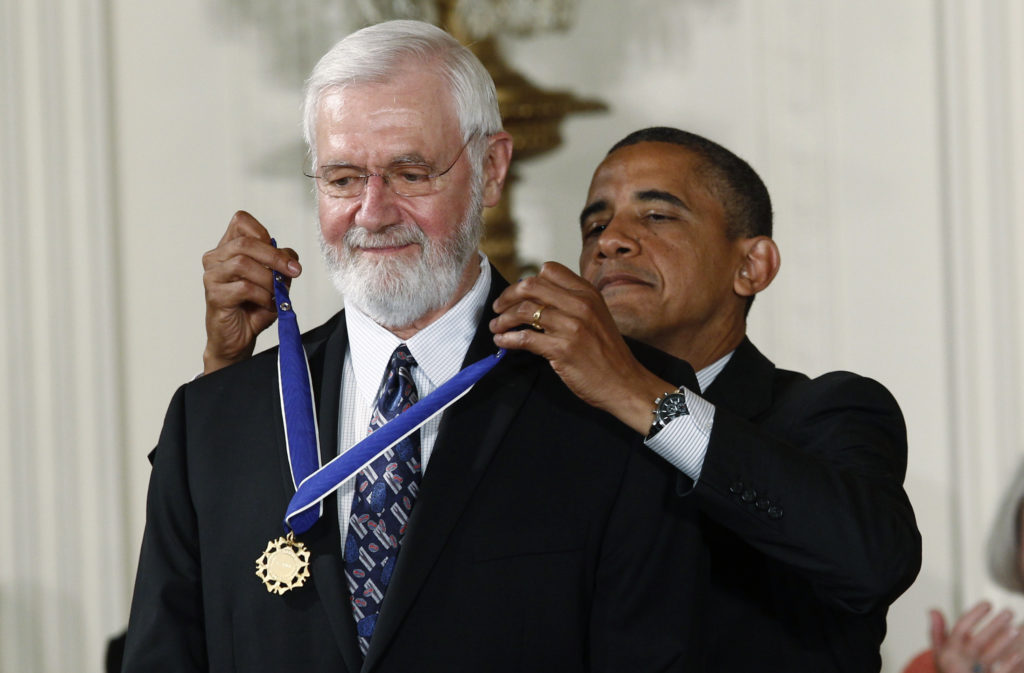
ATLANTA (AP) — Dr.William Foege, a leader of one of humanity’s greatest public health victories — the global eradication of smallpox — has died.
Foege died Saturday in Atlanta at the age of 89, according to the Task Force for Global Health, which he co-founded.
The 6-foot-7 inch Foege literally stood out in the field of public health.A whip-smart medical doctor wiht a calm demeanor, he had a knack for beating back infectious diseases.
He was director of the U.S. centers for Disease control and Prevention in the late 1970s and early 1980s, and later held other key leadership roles in campaigns against international health problems.
But his greatest achievement came before all that, with his work on smallpox, one of the most lethal diseases in human history. For centuries, it killed about one-third of the people it infected and left most survivors with deep scars on their faces from the pus-filled lesions.
Smallpox vaccination campaigns were well established by the time Foege was a young doctor. Indeed, it was no longer seen in the United States. But infections were still occurring elsewhere, and efforts to stamp them out were stalling.
Working as a medical missionary in nigeria in the 1960s, Foege and his colleagues developed a “ring containment” strategy, in which a smallpox outbreak was contained by identifying each smallpox case and vaccinating everyone who the patients might come into contact with.
READ MORE: The Day Doctors Began to Conquer Smallpox
The method relied heavily on swift detective work and was born out of necessity. There simply wasn’t enough vaccine available to immunize everyone, Foege wrote in ”House on Fire,” his 2011 book about the smallpox eradication effort.
It worked, and became pivotal in helping rid the world of smallpox for good. The last naturally occurring case was seen in Somalia in 1977. In 1980, the World Health Association declared smallpox eradicated from the Earth.
“If you look at the simple metric of who has saved the most lives, he is right up there with the pantheon. Smallpox eradication has
