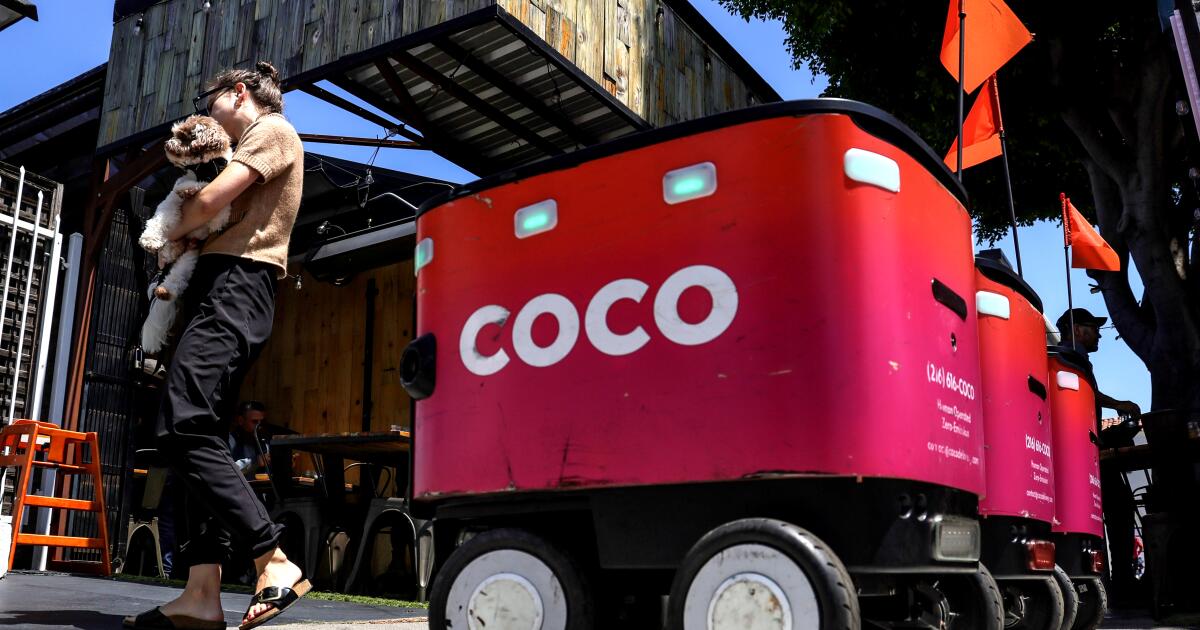
Delivery Robots: From Cute Innovation to Sidewalk Nuisance
The “cute” factor of sidewalk delivery robots is wearing off as the deployment phase hits the reality of urban congestion. What started as a novelty in a few LA neighborhoods has scaled into a sidewalk colonization effort that is currently crashing into the hard wall of edge-case autonomy and pedestrian friction.
The Tech TL;DR:
- Scaling Friction: Companies like Coco are targeting 10,000-unit deployments, but the “last-mile” solution is creating significant pedestrian bottlenecks.
- Autonomy Gap: Robots continue to struggle with “negotiation” at complex intersections, necessitating human-in-the-loop overrides.
- Regulatory Pushback: Municipalities, starting with San Francisco, are shifting from laissez-faire adoption to strict permit-based frameworks to protect accessibility.
The industry is currently grappling with the “last-mile” delivery bottleneck—the most expensive and inefficient leg of the supply chain. While the promise was a seamless, autonomous transition from hub to doorstep, the actual deployment reality is far messier. According to a report from Policy Options, these units frequently impede pedestrian flow and amplify navigation challenges for people with disabilities and older adults. We are seeing a classic case of shipping a Minimum Viable Product (MVP) into a complex, uncontrolled production environment without a sufficient safety framework.
The Autonomy Gap: Intersections as the Ultimate Edge Case
The primary technical failure isn’t the straight-line navigation; it’s the negotiation. As detailed in the ACM Digital Library research on delivery robot interactions, intersections require a level of social negotiation that current autonomous stacks cannot fully replicate. The robots aren’t just calculating distance and velocity; they are failing to communicate intent to human road users.
This lack of full autonomy is not just a theoretical limitation. Reports as recent as April 2026 indicate that robots are still stalling at intersections, requiring external intervention or causing pedestrian frustration. This suggests a reliance on remote teleoperation—essentially a human operator taking the wheel when the onboard AI hits an unhandled exception. When a fleet scales to 10,000 units, the latency and bandwidth requirements for this human-in-the-loop system grow a massive IT bottleneck.
“My Neighborhood Is Pushing Back Against Sidewalk Delivery Robots. The Fight’s Coming To Your Town Next.” — Ainsley Harris, Fast Company
For enterprises attempting to integrate these fleets, the instability of the autonomous stack creates a liability nightmare. This is why firms are increasingly hiring specialized AI software development agencies to refine path-planning algorithms and improve the sensor fusion required for complex urban navigation.
The Fleet Matrix: Deployment Realities vs. Projections
The gap between venture-backed projections and operational reality is widening. While some firms are pushing for aggressive expansion, others have failed to hit their basic deployment benchmarks.
Comparative Deployment Analysis
| Company | Key Markets | Deployment Status/Goal | Primary Friction Point |
|---|---|---|---|
| Coco | Chicago, LA, Miami, Helsinki | Targeting 10,000 units | Urban sidewalk colonization/Public backlash |
| Serve Robotics | LA, Chicago, others | Active Deployment | Intersection navigation/Pedestrian interaction |
| Starship Technologies | Washington D.C. (est. 2017) | Early Mover/Established | Regulatory permit requirements |
| Tiny Mile | Toronto | Failed 200-unit goal by 2023 | Scaling and operational execution |
The failure of Tiny Mile to meet its 200-unit goal by 2023 serves as a cautionary tale for the industry. Scaling a robot fleet isn’t just about hardware production; it’s about the underlying infrastructure and the legal framework. San Francisco’s move to require permits for roaming robots proves that the era of “move fast and break things” is over for sidewalk hardware.
Managing the Sidewalk Stack: The Implementation Mandate
From an architectural perspective, managing a fleet of these robots requires a robust API layer to handle state changes, especially when a unit enters a “stuck” state at an intersection. A typical fleet management request to diagnose a stalled unit would look like this:
curl -X Receive "https://api.fleetmanager.io/v1/robots/robot_id_8829/status" -H "Authorization: Bearer ${API_TOKEN}" -H "Content-Type: application/json" # Expected Response: # { # "robot_id": "robot_id_8829", # "state": "STALLED", # "location": {"lat": 34.0522, "lng": -118.2437}, # "error_code": "ERR_INTERSECTION_NEGOTIATION_FAIL", # "teleop_status": "PENDING_OPERATOR_ASSIGNMENT", # "battery_level": 64 # }When the ERR_INTERSECTION_NEGOTIATION_FAIL trigger hits, the system must hand off control to a human operator. If the operator latency is too high, the robot becomes a physical obstacle. This is the exact point where the “cute” box becomes a nuisance. To mitigate these operational risks, companies are turning to Managed Service Providers (MSPs) to ensure the low-latency connectivity required for real-time teleoperation.
The Regulatory Bottleneck and the Path Forward
The trajectory of this technology is no longer determined by the hardware specs, but by municipal legislation. The tension in cities like LA and Chicago isn’t about the robots themselves, but about the appropriation of public space. When a company like Coco aims for 10,000 units, they aren’t just deploying a service; they are claiming sidewalk bandwidth.
We are likely heading toward a “zoning” model for autonomous delivery, where specific corridors are designated for robot traffic, similar to bike lanes. Without this, the friction between robots and pedestrians—particularly those with mobility challenges—will lead to more restrictive legislation. For firms navigating these waters, engaging legal compliance auditors is now as critical as the engineering phase.
the delivery robot is a solution looking for a sustainable environment. Until the autonomy stack can handle the social nuance of a crowded city intersection without a human tether, these robots will remain expensive, rolling liabilities.
Disclaimer: The technical analyses and security protocols detailed in this article are for informational purposes only. Always consult with certified IT and cybersecurity professionals before altering enterprise networks or handling sensitive data.