Czech mortgage rates hit 5.79% in October, says Swiss Life Hypoindex
Average Czech Mortgage Rates Climb to 5.79 Percent in October
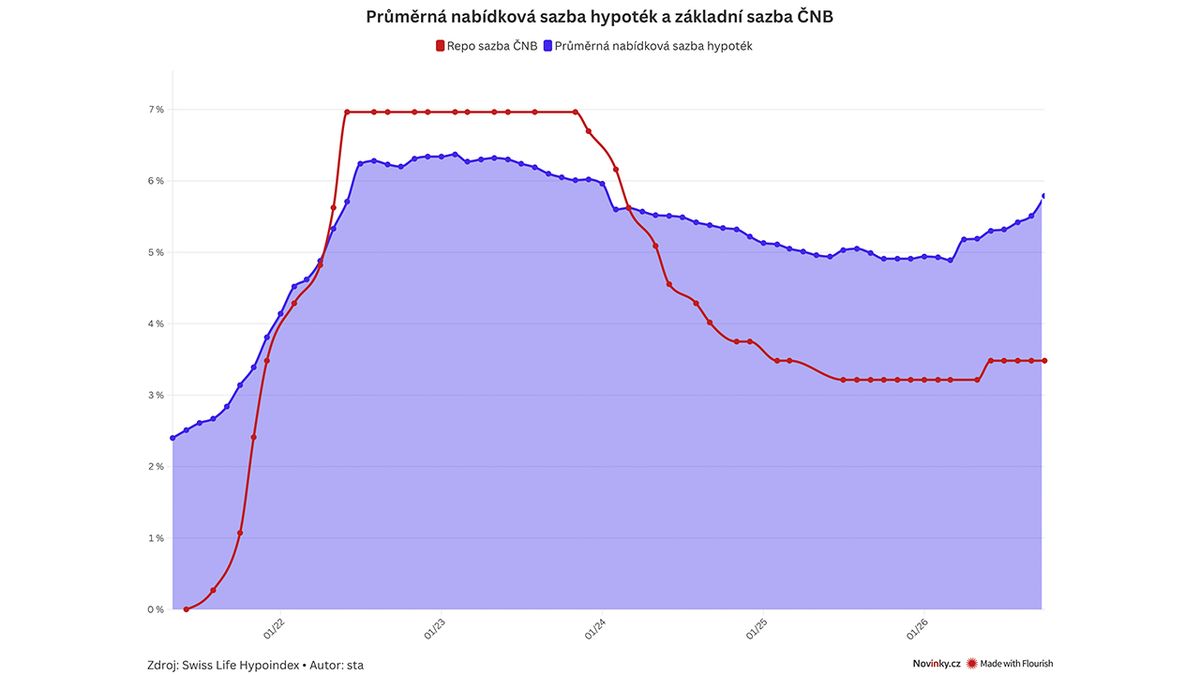
The average offered interest rate on Czech mortgages reached 5.79 percent at the beginning of October, climbing by 0.28 percentage points from the previous month, according to the Swiss Life Hypoindex. Borrowing costs have now risen for seven consecutive months, marking the highest level recorded since January 2024.
The acceleration in borrowing costs matches the rapid upward trajectory banks deployed shortly after the start of the war. The baseline rate has increased by 0.90 percentage points since hitting a low point in March, driven largely by rates at which banks lend to each other. Rates for popular three-year fixations, which sat at approximately 3.4 percent before the war, now hover around 4.8 percent.
Diverging Rates Across Fixation Periods
Financial institutions have structured their pricing to encourage shorter commitments while penalizing long-term certainty. Borrowers opting for shorter one-year fixations can secure lower initial rates, whereas extended terms face steeper pricing structures. Lenders have pushed rates past the six percent threshold for longer-term agreements. For mortgages with loan-to-value ratios up to 80 percent, average rates for a one-year fixation stand at 5.42 percent, while a ten-year fixation climbs to 6.35 percent. Borrowers securing higher LTV ratios face even steeper figures, with one-year fixations averaging 5.71 percent and ten-year commitments reaching 6.61 percent.

Choosing a shorter fixation exposes consumers to immediate refinancing risks if market conditions deteriorate further. Tom Kadeřábek of Swiss Life Select noted that while rapid rate hikes have started cooling down property price appreciation, a sudden drop in borrowing costs remains unlikely in the near term. Umím si představit, že změnu ani nezaznamenáme,
uvedl Michal Skořepa, ekonom České spořitelny.
Impact on Monthly Budgets and Property Valuations
The rising interest environment directly inflates household debt servicing costs. A model mortgage of 3,5 million korun with a 25-year maturity now requires a monthly payment of 22,095 crowns. That figure represents an increase of 1,854 crowns since the end of February.
This financial pressure has begun cooling the broader residential real estate market. Asking prices for apartments across most regions remained flat between the second and third quarters of the year, with marginal increases hovering around 0.5 percent where growth persisted. Year-over-year price growth decelerated from 15 percent last summer down to 2.9 percent by August. In Prague, average asking prices for a 70-square-meter apartment dipped by 0.5 percent between the second and third quarters to just under 11,5 milionu korun in September. According to the Prosperity and Financial Health Index compiled by Česká spořitelna and Evropa v datech, housing in the Czech Republic remains the least affordable in the European Union.

The Refinancing Wave Ahead
Households face forced refixation over the coming months as legacy loans secured during periods of lower interest rates expire. Czech National Bank data indicates that approximately 470 miliard korun in mortgages will undergo refixation or refinancing this year alone, carrying an average legacy rate of 3.2 percent. Additional waves are scheduled for subsequent years, with the central bank projecting 530 miliard korun in 2027 and at least 600 miliard korun in 2028. Analysts advise borrowers to evaluate competing bank offers several months before their current fixation periods expire to get better rates from lenders.
Fio Banka a Moneta Money Bank Drží Procenty
Even amid an environment of rising borrowing costs, competitive pressures persist among specific financial institutions. Pod pěti procenty zůstávají jen Fio Banka a Moneta Money Bank. Dalším faktorem zdražování je i rostoucí počet lidí, kterým končí stará fixace. Jiří Sýkora, hypoteční analytik Swiss Life Select, upozorňuje na to, že klient sice může získat nižší počáteční úrok, zároveň však na sebe bere větší riziko, že při další refixaci budou sazby vyšší.