Code Sharing Practices in Healthcare Multivariable Prediction Model Research: A Scoping Review
Just a Fraction of Clinical Prediction Studies Share Analytical Code
Analytical code availability remains limited across published multivariable prediction model studies, despite widespread formal endorsement of specialized reporting guidelines. According to a scoping review, only a fraction of research papers developing or evaluating diagnostic and prognostic prediction models provide accessible and verifiable code repositories to ensure computational reproducibility.
-
Key Clinical Takeaways:
- Analytical code sharing sits at a low baseline among clinical prediction model studies, even within cohorts explicitly citing established reporting standards.
- An automated language model pipeline evaluated repository structures, identifying widespread gaps in software dependency specifications, version control, and documentation.
- Evaluating reproducibility barriers requires systematic audits of computational assets linked to clinical research papers.
Scoping Review Targets PubMed-Indexed Articles Citing TRIPOD
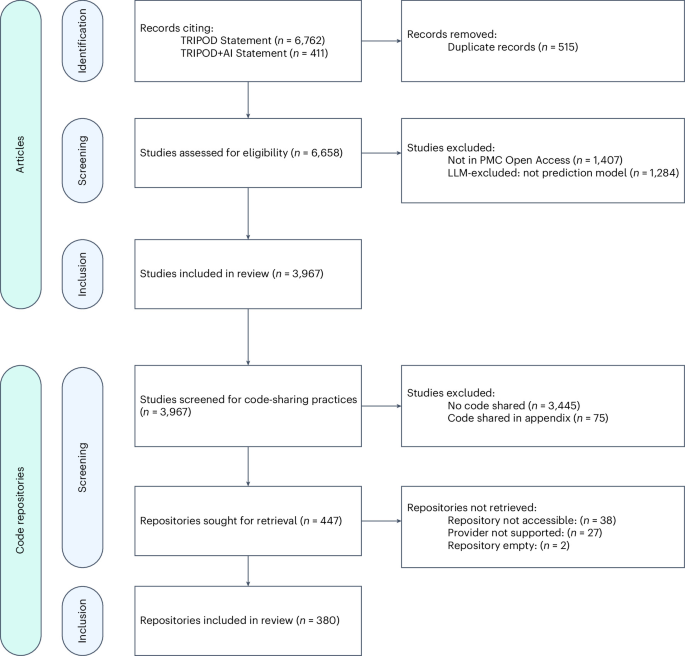
The scoping review evaluated PubMed-indexed articles citing the TRIPOD or TRIPOD+AI statements as of August 11, 2025. By focusing on studies already attentive to transparent reporting guidelines, the analysis established a conservative estimate of code sharing practices across the field of clinical prediction research. The study protocol was formally registered under INPLASY202620080.
To capture repository contents without subscription barriers, researchers restricted the inclusion criteria to primary articles retrievable through the PubMed Central Open Access API.

Automated Pipeline Evaluates Fourteen Distinct Repository Features
Repositories identified during the screening phase were processed through a custom utility to compile file trees and documentation into structured text formats. These features examined computational reproducibility markers including README documentation, licensing information, software dependency declarations, test frameworks, whether a repository is empty, whether it contains usage or structure instructions, whether a README provides an overview of repository purpose and expected outputs, whether software dependencies are specified in a dedicated file or README, whether dependencies include version constraints, whether a license file describes usage permissions, whether code contains sufficient inline comments or docstrings explaining key components, whether code is organized into modular and reusable components rather than long scripts, whether tests or assertions verify expected behavior, whether fixed random seeds are set for stochastic processes, whether hardware requirements are stated, whether a link to the associated paper is included, whether a citation is provided, whether original or sample datasets are included, additional comments on repository quality, and programming languages used such as python
, r
, or sql
where the pipeline dictates that if there is no code in the repository, nothing is returned.
Urgent Need for Stricter Academic Verification Protocols
The discrepancy between clinical prediction model publication rates and transparent code sharing highlights ongoing challenges in computational validation. Without accessible analytical scripts, independent researchers cannot verify complex machine learning algorithms or statistical models intended for individualized diagnostic and prognostic estimation.

Disclaimer: The information provided in this article is for educational and scientific communication purposes only and does not constitute medical advice. Always consult with a qualified healthcare provider regarding any medical condition, diagnosis, or treatment plan.