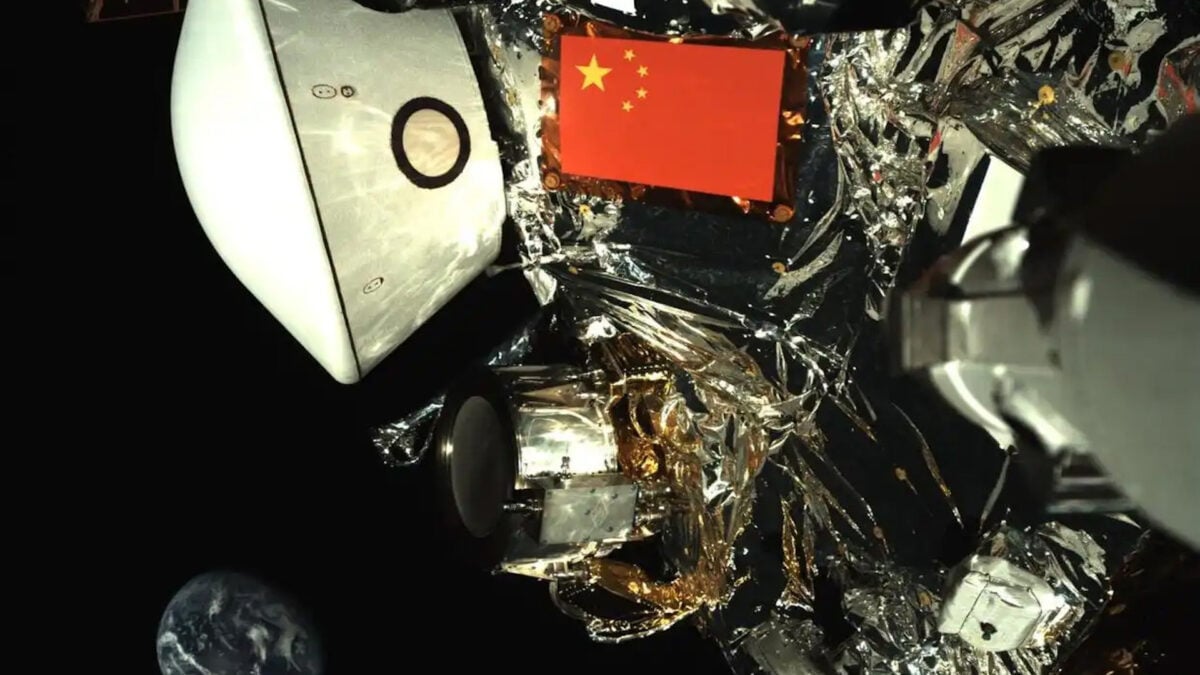
China’s Tianwen-2 Mission Prepares to Land on Earth’s Mini-Moon
China is preparing to execute the first landing on a “quasi-moon,” a small asteroid captured in a complex orbit around Earth, via the Tianwen-2 mission. According to reports from Gizmodo and Forbes, the probe is currently positioning itself to collect samples from a near-Earth object, marking a significant shift in deep-space navigation and robotic sampling capabilities.
The Tech TL;DR:
- Mission Objective: First landing and sample return from a quasi-satellite (quasi-moon) of Earth.
- Operational Phase: The probe has reportedly arrived at the target; sample collection sequences are initiating.
- Strategic Impact: Validates high-precision autonomous landing systems on low-gravity bodies, critical for future asteroid mining and planetary defense.
The primary technical bottleneck in this mission is the “quasi-satellite” orbital mechanics. Unlike the Moon, which is gravitationally bound to Earth, a quasi-moon is an asteroid in a heliocentric orbit that happens to synchronize with Earth’s movement. This creates a highly unstable “relative” orbit, requiring constant delta-v adjustments and high-frequency telemetry to maintain a lock on the target. For engineers, this is less about raw thrust and more about the precision of the Guidance, Navigation, and Control (GNC) software.
How the Tianwen-2 Landing Architecture Works
According to the Planetary Society, the mission involves a complex rendezvous where the probe must match the velocity of the asteroid without drifting into a collision or missing the capture window. This requires an onboard computer capable of real-time image processing to identify landing sites on a body with negligible gravity. The “mini-moon” lacks a significant gravitational well, meaning the probe cannot rely on traditional orbital decay to land; it must use a controlled descent, likely utilizing cold-gas thrusters or a touch-and-go (TAG) sampling mechanism similar to NASA’s OSIRIS-REx.
From a systems architecture perspective, this mission pushes the limits of autonomous edge computing. Due to the signal latency between Earth and the quasi-moon, the probe cannot be remote-controlled in real-time. It relies on an onboard SOC (System on a Chip) designed for radiation hardening, managing the transition from cruise phase to the landing sequence via a pre-programmed state machine.
For organizations managing similar high-stakes telemetry or remote sensor deployments, the risk of signal loss is a critical failure point. Enterprises often mitigate these “black box” risks by partnering with [Relevant Tech Firm/Service] to implement redundant communication protocols and fail-safe data recovery systems.
Comparing Quasi-Moon Missions to Standard Asteroid Sampling
The technical requirements for a quasi-moon landing differ significantly from traditional asteroid missions. While a standard asteroid mission targets a known body in a stable orbit, the quasi-moon’s “pseudo-orbit” around Earth introduces unique perturbations.
| Metric | Standard Asteroid Mission | Tianwen-2 (Quasi-Moon) |
|---|---|---|
| Orbital Stability | High (Heliocentric) | Low (Synchronized with Earth) |
| Slew Rate Req. | Moderate | High (Dynamic Relative Motion) |
| Latency | Variable/High | Lower (Proximal to Earth) |
| Landing Logic | Gravity-Assisted/TAG | Precision Autonomous Descent |
The Software Stack: Automating the Descent
The landing sequence is governed by a series of “Go/No-Go” polls executed by the probe’s flight software. To simulate the logic used in these autonomous descent triggers, developers often use a state-based approach in C++ or Python to handle sensor inputs (LIDAR/Optical) and trigger actuators.
// Simplified Logic for Autonomous Landing Trigger
if (current_altitude < THRESHOLD_METERS && velocity_vector == TARGET_VECTOR) {
 execute_sample_collection();
 if (sample_confirmed == true) {
 initiate_ascent_burn();
 } else {
 retry_sampling_sequence();
 }
} else {
 adjust_trajectory(delta_v_correction);
}
This level of autonomy is mirrored in terrestrial industrial automation. When deploying autonomous robotics in unpredictable environments, firms frequently engage [Relevant Tech Firm/Service] to conduct rigorous penetration testing and safety audits on the control software to prevent catastrophic mechanical failure.
What Happens Next for Space-Based Data Infrastructure?
As China moves toward sample collection, the focus shifts to the "return" leg of the mission. This involves a high-velocity reentry vehicle that must withstand extreme thermal loads. According to Geo News, the sample collection phase is the immediate priority. If successful, the mission proves that Earth's "mini-moons" can serve as accessible laboratories for studying the early solar system without the fuel costs associated with deep-space travel.

The broader implication for the tech sector is the acceleration of autonomous GNC (Guidance, Navigation, and Control) systems. These advancements in "edge" autonomy—where the device makes critical decisions without a round-trip to a central server—will eventually trickle down into terrestrial drones and autonomous logistics. Companies looking to integrate these high-reliability systems into their own stacks often seek out specialized software development agencies like [Relevant Tech Firm/Service] to build robust, low-latency API integrations.
The Tianwen-2 mission isn't just a scientific curiosity; it is a benchmark for the precision of autonomous systems in the most unforgiving environment possible. If the landing succeeds, the "quasi-moon" becomes the new frontier for rapid-iteration space exploration.
Disclaimer: The technical analyses and security protocols detailed in this article are for informational purposes only. Always consult with certified IT and cybersecurity professionals before altering enterprise networks or handling sensitive data.
Worth a look