China’s Expanding Satellite Surveillance Sparks US Military Concerns
China has released a series of radar images depicting the Towa Maru, a Japanese-flagged oil tanker, as it traversed disputed waters off the northern boundary of the Spratly Islands.
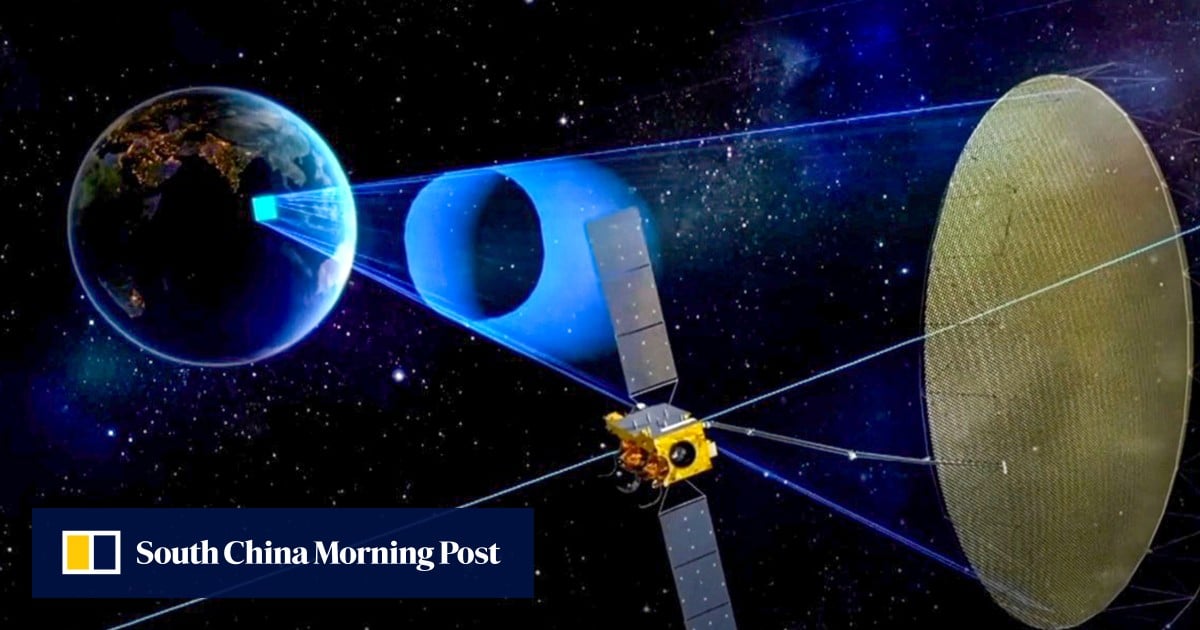
The images were captured by a synthetic aperture radar (SAR) satellite operating in geosynchronous orbit (GEO), marking the first recorded instance of a GEO SAR satellite successfully maintaining long-term tracking of a moving maritime target. The Towa Maru, which measures approximately 340 metres in length and 60 metres in width, was monitored from an altitude of 35,800 kilometres.
Analysis of this capability suggests that a constellation of just three such satellites could enable China to maintain global, 24/7, all-weather reconnaissance of high-value targets, including naval fleets. To achieve a comparable level of coverage, other nations may be required to deploy hundreds or thousands of satellites.
Military Infrastructure in the South China Sea
This orbital surveillance capability exists alongside a 3,200-hectare network of island military bases constructed by China across the South China Sea. According to intelligence and satellite imagery tracked by the Asia Maritime Transparency Initiative (AMTI) at the Center for Strategic and International Studies (CSIS), China has established 20 outposts in the Paracel Islands and seven in the Spratly Islands, four of which are fully operational naval and air bases.
The infrastructure on these islands was created through the fastest mass dredging and landfill operations in human history, transforming coral reefs into a sprawling military complex. These bases now feature deepwater ports and 3,000-metre runways designed to support long-range aircraft.
Deployment of Nuclear-Capable Assets
Satellite imagery has confirmed the presence of H-6K nuclear-capable bombers stationed on Woody Island in the Paracel archipelago. The availability of 3,000-metre runways across the island network allows these aircraft to operate within striking distance of northern Australia and U.S. Forces based in the region.
At Mischief Reef, the military installations include advanced radar systems, missile storage facilities, and hangars for fighter planes. Across the three primary island bases, China has constructed more than 72 fighter jet hangars, as well as emplacements for anti-ship cruise missiles and surface-to-air missiles.
Gregory Poling, director of the Asia Maritime Transparency Initiative, has described the scale of this military infrastructure as alarming for regional allies, including Japan, Australia, and the United States.
The expansion of the island network and the deployment of nuclear-capable bombers continue to place regional U.S. Forces and northern Australia within striking distance.