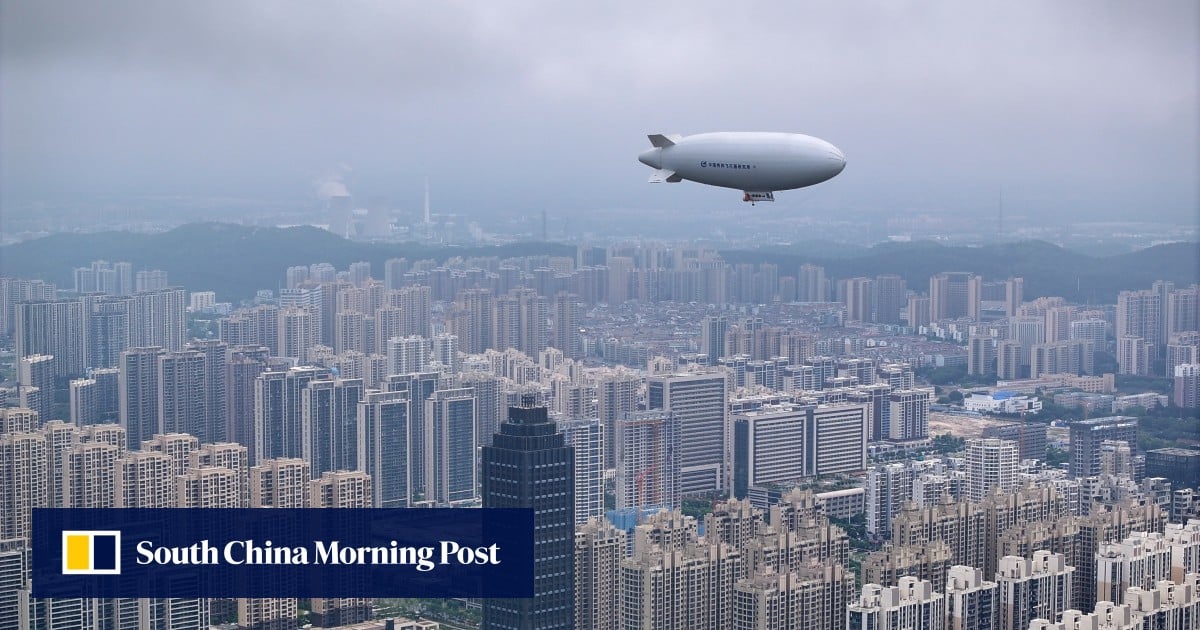
China Licenses First Domestic Commercial Airship Pilots to Boost Low-Altitude Economy
China has issued its first four domestic commercial airship pilot licenses via the Civil Aviation Administration of China (CAAC). This milestone, announced by the state-owned Aviation Industry Corporation of China (AVIC), aims to eliminate a critical talent vacuum and catalyze the nation’s expanding low-altitude economy through specialized operator training.
For years, the ambition of a “low-altitude economy”—a sprawling vision of drones, eVTOLs, and heavy-lift airships—has been hampered by a fundamental, human bottleneck. You can build the most advanced aircraft in the world, but they are nothing more than expensive sculptures if there is no one qualified to fly them. Until now, the ability to certify and train commercial airship pilots within China’s own borders was a missing link in the industrial chain.
The reality is that aviation is a game of certifications. Without a domestic pipeline for licensure, the industry remained tethered to foreign standards or stunted by a lack of qualified personnel. By bridging this gap, China is effectively moving from the “prototype” phase of its low-altitude ambitions to the “operational” phase.
Closing the “Talent Vacuum” in Aviation
The language used by AVIC is telling. In a statement released this week, the organization noted that these licenses “signify a breakthrough that addresses the vacuum.” That word—vacuum—is the key to understanding why this event matters. In the context of aviation, a vacuum isn’t just a shortage; it is a systemic failure that prevents an entire sector from scaling.
When a nation lacks the capability to certify its own pilots for a specific class of aircraft, it creates a dependency loop. Operators must either look abroad for training or operate in a regulatory gray area that limits commercial viability. By establishing a domestic certification process through the Civil Aviation Administration of China (CAAC), the state is ensuring that the growth of the airship sector is independent and controllable.
This is a strategic pivot. It transforms pilot training from a bottleneck into a scalable service.
As this sector expands, the demand for specialized education will skyrocket. This shift will likely force a realignment in how specialized aviation training academies structure their curricula, moving away from traditional fixed-wing or rotary-wing focus to include the unique buoyancy and navigation requirements of commercial airships.
Defining the Low-Altitude Economy
To the casual observer, an airship might seem like a throwback to the early 20th century. In the eyes of modern industrial planners, however, it is a cornerstone of the “low-altitude economy.” This economic framework focuses on the airspace below 1,000 meters, utilizing aircraft for tasks that are too sluggish for ground transport and too expensive or inefficient for traditional aviation.
The potential applications for these newly licensed pilots are vast:
- Urban Maintenance: Using airships as stable platforms for inspecting skyscrapers, bridges, and power lines without the need for scaffolding.
- Emergency Response: Deploying heavy equipment or medical supplies to disaster zones where runways are destroyed or non-existent.
- Environmental Monitoring: Conducting long-endurance aerial patrols for forestry, pollution tracking, and mapping.
- High-End Tourism: Creating low-impact, slow-speed aerial sightseeing experiences that differ fundamentally from helicopter tours.
But scaling these services requires more than just pilots. It requires a legal framework that can handle the intersection of commercial airships and existing urban airspace. Companies entering this space are increasingly relying on aviation law firms to navigate the complex web of CAAC regulations and municipal zoning laws.
The Push for Strategic Autonomy
This move by AVIC and the CAAC is not an isolated event; it is part of a broader trend toward industrial self-reliance. For the Aviation Industry Corporation of China (AVIC), the ability to train and license pilots domestically removes a layer of geopolitical risk. In an era of fluctuating trade relations and technology sanctions, owning the entire lifecycle of the product—from the blueprints of the airship to the license of the pilot—is the only way to ensure long-term stability.
It is a vertical integration of human capital.
When you control the training, you control the safety standards. When you control the safety standards, you can accelerate the rollout of new technologies. By removing the reliance on external certification bodies, China can iterate on its airship operations much faster than it could previously.
This speed, however, brings its own set of risks. Rapid expansion into low-altitude airspace inevitably leads to friction with existing ground-based infrastructure and noise ordinances. As airships begin to integrate into cityscapes, municipal governments will need to engage urban infrastructure consultants to design “vertiports” and mooring stations that do not disrupt city traffic or violate safety codes.
The Long-Term Industrial Ripple Effect
The certification of these first four pilots is a symbolic start, but the industrial ripple effect will be felt across multiple sectors. We are looking at the birth of a new professional class. The “commercial airship pilot” will soon be a recognized career path, requiring a blend of traditional piloting skills and a deep understanding of aerostatics.

this development signals to the private sector that the regulatory path is now open. Investors who were previously hesitant to fund airship ventures due to the “pilot problem” now have a clear signal that the state is committed to providing the necessary human infrastructure.
The transition from a “vacuum” to a “system” is rarely overnight. There will be growing pains. There will be disputes over airspace priority between delivery drones and commercial airships. There will be the grueling work of writing the textbooks for a new generation of flyers.
But the foundation is now laid. The sky is no longer just a space to pass through; it is becoming a place to work.
As the low-altitude economy matures, the complexity of managing these assets will grow. Whether it is securing insurance for unconventional aircraft or navigating the liability laws of urban aerial operations, the need for verified, professional expertise has never been higher. For those looking to navigate this new frontier, the World Today News Directory remains the essential resource for connecting with the legal, technical, and educational professionals equipped to handle the challenges of a world in flight.