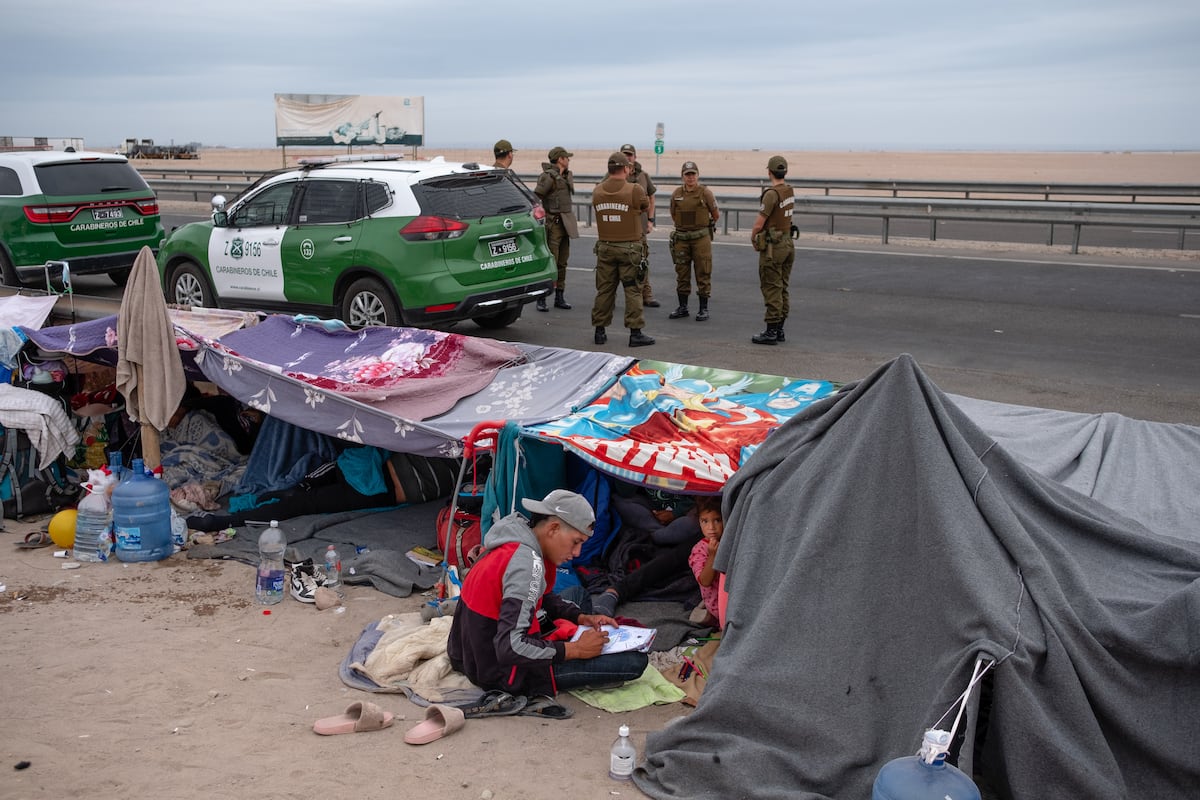
Chile Faces Major Hurdle in Expelling Venezuelan Migrants as PDI Confirms 6,000 Cannot Be Deported
On April 21, 2026, Chile’s Investigative Police (PDI) confirmed that approximately 6,000 Venezuelan nationals residing in the country cannot be deported under the government’s current expulsion plan due to the absence of diplomatic relations with Venezuela, creating a humanitarian and logistical impasse that strains local resources, challenges municipal capacities and leaves thousands in legal limbo across urban centers from Santiago to Antofagasta.
The announcement by the PDI, made during a press briefing in Santiago, directly follows President José Antonio Kast’s recent directive to accelerate expulsions of undocumented migrants as part of a broader national security agenda. Yet, without functioning consular channels to issue travel documents or coordinate with Venezuelan authorities, the state faces a legal barrier that halts removals despite completed administrative procedures. This gap between policy intent and operational reality has left migration offices overwhelmed, shelters at capacity, and advocacy groups scrambling to fill the void left by state inaction.
The Human Toll Behind the Statistics
Behind the figure of 6,000 are individuals like María González, a former nurse from Valencia who has lived in Santiago’s Peñalolén commune for three years. Speaking to EL PAÍS, she described the psychological toll of indefinite uncertainty: “Todos los días quiero regresar a Venezuela, pero no tengo papers, no tengo dinero, y ahora ni siquiera puedo ser deportada. Estoy atrapada.” Her testimony, echoed in community centers across Estación Central and Maipú, reveals a population not resisting removal but trapped by bureaucratic collapse.
Local officials confirm the strain. In an interview with Radio Bío-Bío, Hernán Fuentes, mayor of Lo Prado, stated bluntly: “We are not equipped to house or support long-term populations that the national government cannot remove. Our clinics, our schools, our emergency services — they were designed for transient pressure, not permanent displacement.” He emphasized that municipal budgets in Santiago’s western communes have absorbed a 22% increase in demand for basic health and housing services over the past 18 months, with no corresponding increase in state transfers.
“Deportation without diplomatic channels is not enforcement — it’s abandonment. We need regional cooperation, not unilateral decrees.”
— Patricia Méndez, Director of the Santiago-based NGO UNHCR Chile, speaking at a migrant rights forum in Concepción on April 18, 2026
A Regional Crisis with Municipal Consequences
The inability to deport is not evenly distributed. In the northern tarapacá region, where Venezuelan migrants constitute over 18% of the foreign-born population according to Chile’s National Institute of Statistics (INE), cities like Iquique and Alto Hospicio report surges in informal settlements and increased pressure on water and sanitation systems. The Regional Health Directorate confirmed a 31% rise in outpatient visits at public clinics in the first quarter of 2026 compared to the same period in 2025, attributing much of the increase to untreated chronic conditions among undocumented residents who fear seeking care.
Meanwhile, in the biobío region, Concepción’s municipal government has reported a 40% increase in requests for food aid from migrant households since January, overwhelming the capacity of local food banks. Social workers in Coronel and Lota describe a growing population of Venezuelan families living in overcrowded rental units, often sharing single rooms with three or more families — a situation that raises fire safety and sanitation concerns noted by the Regional Housing Ministry in its April 2026 audit.
These localized pressures are compounded by the absence of a national integration strategy. Unlike countries such as Colombia or Peru, which have implemented regularization programs for Venezuelan migrants, Chile lacks a coherent pathway to temporary residency or work authorization for those who cannot be removed. This leaves thousands in a state of perpetual illegality — unable to access formal employment, open bank accounts, or enroll children in school without risking exposure.
The Diplomatic Impasse and Its Limits
Efforts to break the deadlock have so far foundered. The government’s attempt to restore consular relations with Venezuela, reported by Cooperativa.cl on April 15, remains stalled due to ideological differences over recognition of the Maduro regime. Kast’s administration insists on preconditions tied to human rights guarantees, while Caracas demands unconditional reinstatement of diplomatic ties — a stalemate that shows no sign of breaking.
Legal experts warn that pursuing expulsions without diplomatic cover risks violating international non-refoulement principles. According to the UN Human Rights Committee, removing individuals to a country where they face persecution or inhuman treatment — even if deportation is the stated goal — may constitute a breach of Chile’s obligations under the International Covenant on Civil and Political Rights, to which it is a signatory.
In a written statement to the Chamber of Deputies, constitutional lawyer and former judge Elena Ríos cautioned: “The state cannot outsource its legal responsibilities through inaction. If deportation is impossible, the obligation shifts to providing a legal status that respects dignity and due process. Ignoring that shift is not sovereignty — it’s negligence.”
The Cost of Inaction
Beyond human costs, the fiscal implications are mounting. A preliminary analysis by the University of Chile’s Institute of Public Affairs estimates that the annual cost of providing emergency health, education, and shelter services to the 6,000 stranded Venezuelans exceeds CLP 18 billion (~$19 million USD), a figure not accounted for in the 2026 national budget. Municipalities, already constrained by property revenue limits, are bearing the brunt — a dynamic that fuels local resentment and undermines public trust in national immigration policy.
the lack of work authorization pushes many into the informal economy, where labor protections are absent and exploitation risks rise. In Santiago’s informal textile workshops and construction sites, labor inspectors have documented cases of wage theft and unsafe conditions among Venezuelan workers — incidents that rarely surface in official statistics due to fear of denunciation.
Where Solutions Begin — Not with Deportation, But with Dignity
This crisis demands more than policy reversal — it requires practical, on-the-ground responses from institutions equipped to manage displacement, legal vulnerability, and community integration. Cities facing acute pressure need access to vetted emergency housing coordinators who can rapidly scale shelter capacity without compromising safety standards. Simultaneously, overwhelmed municipal clinics require partnerships with low-cost medical providers who specialize in serving undocumented populations, offering preventive care and chronic disease management without requiring proof of status.
For those navigating the legal labyrinth of statelessness, access to trusted immigration rights attorneys is not a luxury — it is a necessity. These professionals can help individuals explore humanitarian visas, apply for asylum where eligible, or seek protective orders that prevent detention while long-term solutions are pursued. In cities like Valparaíso and Antofagasta, where migrant legal aid desks have seen demand triple in the past year, such services are no longer peripheral — they are central to municipal stability.
The path forward does not lie in doubling down on expulsion rhetoric, but in recognizing that when removal is impossible, the state’s duty shifts to protection, not punishment. Until diplomatic channels are restored — or a national regularization framework is enacted — the burden will continue to fall on the shoulders of mayors, social workers, and community organizers who are being asked to manage a national failure with local resources.
As the sun sets over the Plaza de Armas in Santiago, and families prepare another meal in cramped kitchens from Cerro Navia to San Antonio, the question is no longer whether Chile can deport 6,000 Venezuelans — it is whether it can afford not to see them as part of its present, and its future.