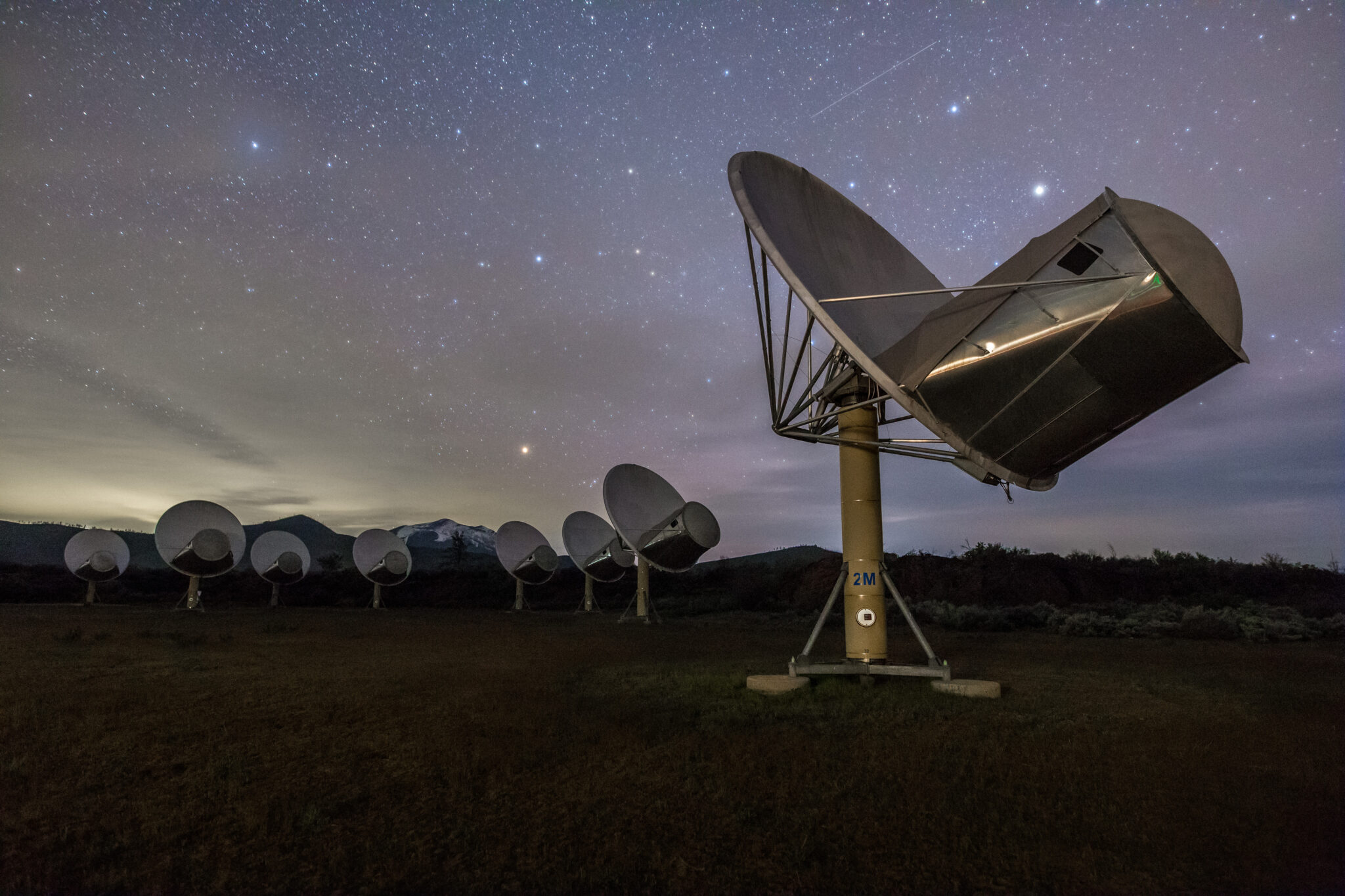
Breakthrough Listen Integrates Agentic AI Into SETI Operations
Agentic AI Joins the Search for Extraterrestrial Signals at the Allen Telescope Array
The search for extraterrestrial intelligence (SETI) is shifting its focus toward listening for artificial intelligence created by civilizations billions of years older than humanity. Breakthrough Listen and the SETI Institute are now integrating agentic AI directly into daily operations at the Allen Telescope Array in Northern California. This evolution reframes the cosmic search from a human-centric endeavor into a technological translation exercise.
The Tech TL;DR:
AI agents are now helping scientists search for alien signals.The SETI Institute and Breakthrough Listen have integrated agentic AI into the Allen Telescope Array in Northern California.Researchers can give the system a natural-language request, and AI agents can coordinate… pic.twitter.com/EZKHacLStD
- Agentic AI deployed at the Allen Telescope Array can autonomously steer instruments, correct incoming data, and apply complex models in real time via natural language prompts.
- The NVIDIA Holoscan platform uses the DAQIRI library to ingest 2.4 terabits per second of sensor data straight into GPU memory on NVIDIA RTX PRO 6000 Blackwell GPUs for in-flight processing.
- The pipeline has already achieved the first real-time AI detection of a pulsar in the Crab Nebula.
Processing Terabits in Flight with NVIDIA Holoscan and CUDA-X
Radio telescopes generate vast volumes of data that traditionally overwhelm storage infrastructure and slow down observation timelines. At the Allen Telescope Array, the DAQIRI library on the NVIDIA Holoscan platform pulls terabits of sensor data directly into GPU memory, bypassing the need to write raw packets to disk first. CyberEther, a signal-processing framework developed at the SETI Institute, executes calculations using NVIDIA CUDA-X libraries including cuFFT and cuBLAS. This hardware-software integration allows agents to execute tasks in hours that previously consumed weeks or years of human analysis.
To coordinate these high-throughput pipelines, Nexus acts as a web-based observatory orchestrator and agent harness. Nexus provides a single source of truth for instrument states, compute resources, and data pipelines, allowing researchers to monitor packet loss, read live spectrograms, and modify signal-processing blocks through natural language. Operating on premises next to the instrument, the system handles 2.4 terabits per second using NVIDIA RTX PRO 6000 Blackwell GPUs.
SETI and Breakthrough Listen deploy agentic AI at the Allen Telescope Array to steer instruments via natural language requests while processing 2.4 terabits per second in flight.Source: https://t.co/4uiZkknvyP pic.twitter.com/BYYz7wxu9j
Real-Time Pulsar Detection and the Road to Lunar Observatories
The newly deployed pipeline has moved past theoretical benchmarks by securing the first real-time AI detection of a pulsar—a rapidly spinning stellar remnant acting as a cosmic lighthouse—in the Crab Nebula. Building on this operational milestone, the research team is evaluating open models such as NVIDIA Nemotron. These models are targeted for deployments where data locality and rapid turnaround are critical, including potential future observatories operating offline on the far side of the moon.
“As our new agentic observatories reach out into the universe, what they find may have much more in common with themselves than with the humans who created them,” Andrew Siemion, Bernard M. Oliver chair for SETI at the SETI Institute and principal investigator of Breakthrough Listen, stated. Siemion added that this development represents a fundamental breakthrough in translation rather than a threat.
Frequently Asked Questions About Agentic AI in SETI
How fast does the Allen Telescope Array AI system process data?
The system processes up to 2.4 terabits per second using NVIDIA RTX PRO 6000 Blackwell GPUs with inference executed on premises next to the instrument. This high throughput is achieved via the DAQIRI library on the NVIDIA Holoscan platform, which pulls sensor data directly into GPU memory for in-flight processing.
What specific discovery has the new AI pipeline achieved?
The system achieved the first real-time AI detection of a pulsar in the Crab Nebula. This detection utilized the agent-driven observation system powered by NVIDIA Holoscan, CyberEther, and the Nexus orchestrator at the Allen Telescope Array.
AI agents are now helping humanity search for extraterrestrial intelligence.NVIDIA, the SETI Institute, and Breakthrough Listen have developed a system that lets AI agents operate the Allen Telescope Array using natural language instructions.The agents can steer antennas,…