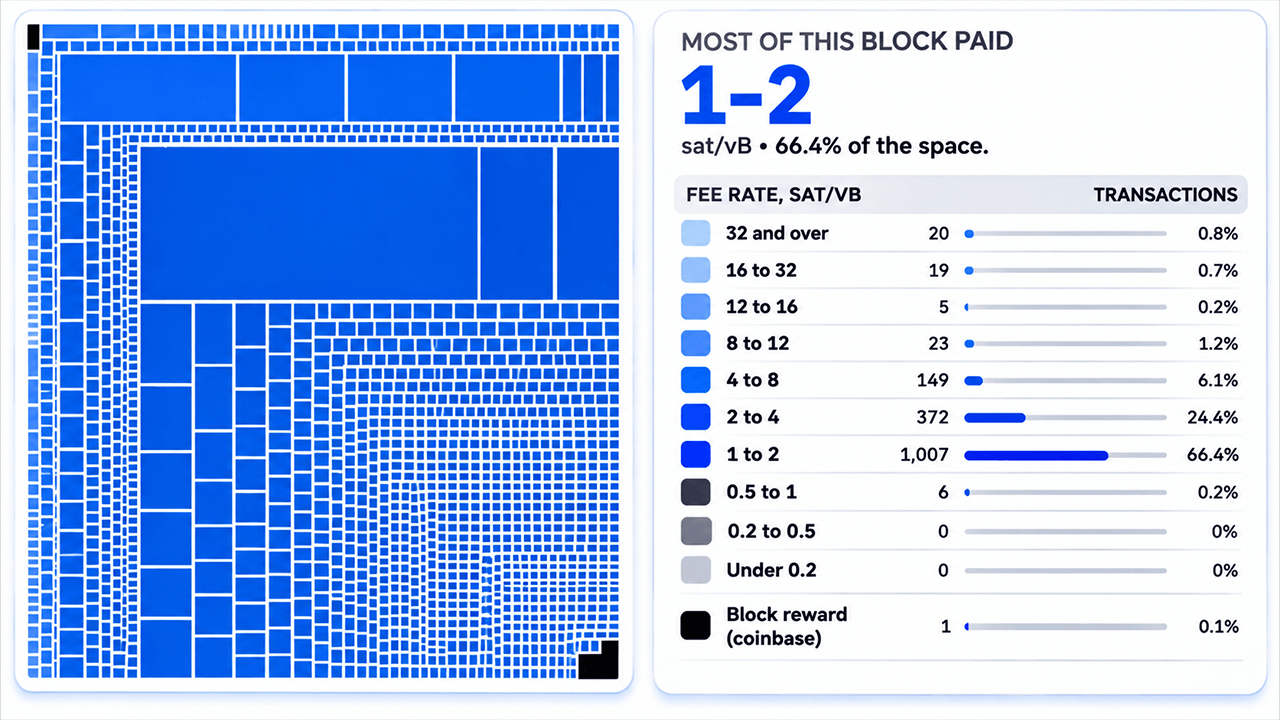
Bitcoin Block Capacity Drives Competitive Transaction Fee Market
Bitcoin transaction fees fluctuated significantly as the network’s fixed capacity creates a competitive market for limited block space.
The Bitcoin network produces a new block approximately every ten minutes, but each block is restricted to a maximum weight of 4 million units. This limit, established through Segregated Witness in August 2017, translates to roughly 1 million virtual bytes (vB).
When demand for these slots exceeds available capacity, transactions remain unconfirmed in a memory pool, known as a mempool. This congestion forces a competitive environment where users bid for priority via transaction fees. Miners maximize revenue by selecting transactions with the highest satoshi per virtual byte (sat/vB).
The fee mechanism often rewards smaller, higher-rate transactions over larger, lower-rate ones. For example, a 150 vB transaction paying 1,500 satoshis offers a 10 sat/vB rate, making it more attractive to a miner than a 200 vB transaction paying 1,000 satoshis at 5 sat/vB. Block 840,000 displayed a median transaction fee rate of approximately 200 sat/vB.
Individual nodes manage their own mempools rather than relying on a single central waiting area. When a node’s memory reaches its limit, such as the default 300 megabytes in Bitcoin Core, it performs “eviction” by removing the least economically interesting transactions.
Mining pools generally prioritize transactions based on the fee rate instead of the total payment amount or the time of arrival. The fundamental difference is that Bitcoin does not operate on a “first come, first served” principle.
While Bitcoin Core sets a default transaction expiration of 336 hours, or 14 days, transactions may disappear from a specific node’s mempool much sooner during periods of high competition, according to Bitcoin News. An evicted transaction does not mean the funds are lost, as the sender can retransmit the transaction or create a replacement if the coins remain unspent.