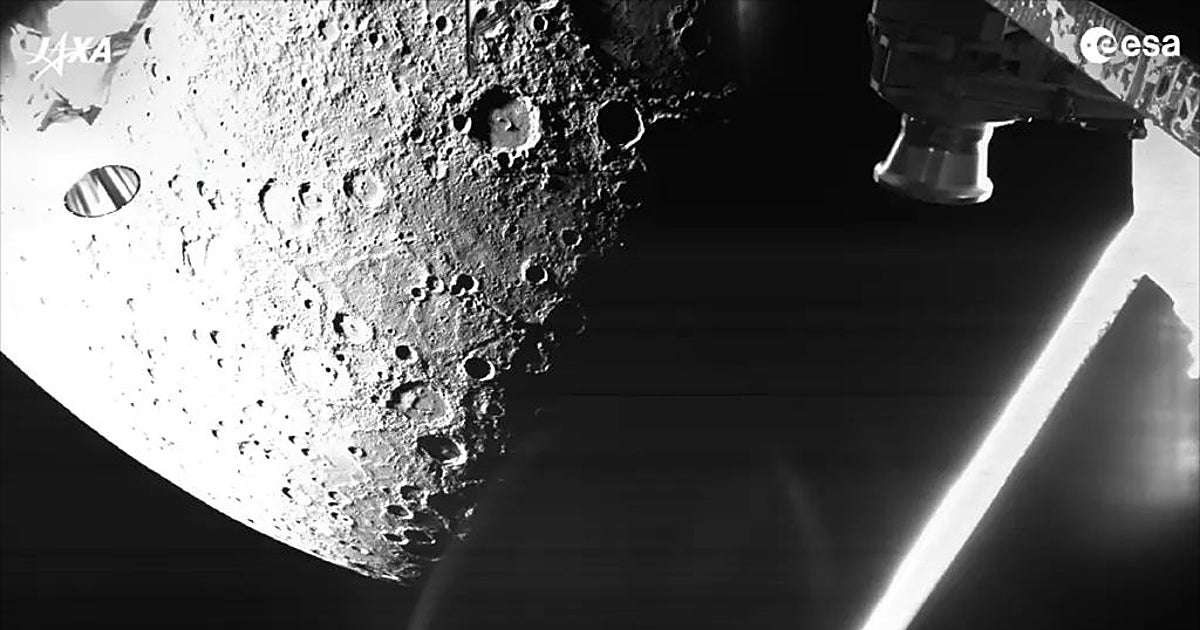
BepiColombo Attempts Mercury Orbit Insertion After Eight-Year Journey and Delay
Four propulsion thrusters are scheduled to ignite for 37 minutes on Saturday evening to insert the BepiColombo mission into orbit around Mercury after an eight-year journey spanning 9.9 billion kilometers.
The joint undertaking by the European Space Agency and the Japan Aerospace Exploration Agency aims to tackle the planet’s extreme temperatures and intense solar gravity. Only two previous spacecraft have visited the innermost planet of the solar system. The mission, developed jointly by the European Space Agency and the Japan Aerospace Exploration Agency, faced its most critical maneuver since launch on Saturday, November 21, 2026, according to the European Space Agency.
Javier Armentia, an astrophysicist and science communicator, noted on the 14 Hours Weekend news broadcast that expectations are massive because only two earlier missions have approached the planet so closely. The spacecraft launched on October 20, 2018, from the European spaceport in French Guiana, according to ABC.
The European Space Agency scheduled the ignition of the four mission propellors for 18.24 GMT, which is 19.24 hours in Spain, to ensure the two component orbiters were captured jointly in Mercury’s orbit.

During the transit, the composite spacecraft completed nine planetary flybys using gravity assists from Earth, Venus, and Mercury itself, as reported by La Vanguardia. An electrical system malfunction discovered in April 2024 delayed the scheduled arrival by nearly a year, according to the same report.
Only NASA’s Mariner 10, in 1973, and Messenger, in 2004, have reached small Mercury, leaving much still to discover before BepiColombo begins its scientific mission in April 2027, according to La Vanguardia.
Bilbao-engineered technology developed by Sener designed several onboard instruments, while Spanish industry contributions account for roughly 8 percent of the European platform developments, El Debate reported. The mission relies on two separable orbiters: the European Mercury Planetary Orbiter built by the European Space Agency and the Japanese Magnetospheric Orbiter developed by the Japan Aerospace Exploration Agency.

“BepiColombo not only will study Mercury,” said Giulio Maria Piantadosi of Sener, according to El Confidencial. The mission will map the surface, analyze the iron core, examine the magnetosphere, and test general relativity.
Following Saturday’s orbital insertion, control teams from the European Space Agency and the Japan Aerospace Exploration Agency sought to confirm that BepiColombo successfully achieved gravitational capture around Mercury after eight years and billions of kilometers traveled. The two orbiters are scheduled to separate between December 9 and December 10, Espacio Tech reported. Full scientific operations are scheduled to begin in April 2027.
Earlier coverage: BepiColombo Scheduled to Enter Mercury Orbit in November 2026