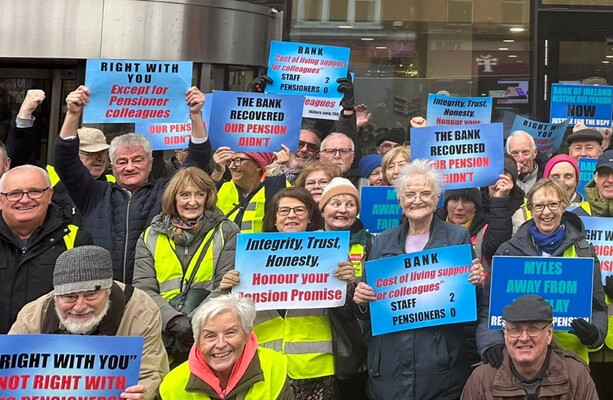
Bank of Ireland Pensioners Protest Demanding Reversal of Crash-Era Restrictions
About 100 Bank of Ireland pensioners protested outside the bank’s Dublin head office on Thursday, demanding the reversal of pension restrictions imposed after the financial crash — restrictions the bank says would cost at least €500 million to lift.
The retirees, members of the bank’s defined-benefit Bank Staff Pension Fund, hand-delivered a letter to chairman Akshaya Bhargava demanding a meeting, thejournal.ie reported.
The protest on Upper Baggot Street centered on a promise the pensioners say was made and never kept. They accepted caps on their pension increases in 2010 and 2013, when the fund faced a €1.6 billion deficit, on the understanding — they maintain — that the restrictions would be lifted once the bank recovered. The bank has since made approximately €13.5 billion in pre-tax profits, thejournal.ie reported.
The bank sees it differently.
That gap — between what the retirees say was promised and what the bank says it can afford — is now a live dispute involving a Sinn Féin call for government intervention, a campaign group of former rank-and-file staff, and a pension scheme closed to new entrants since 2006.
What the protesters are demanding
The retirees are members of BOI’s defined-benefit Bank Staff Pension Fund, which closed to new entrants in 2006 but still operates for existing members.
Former staff travelled from across the country for the demonstration, thejournal.ie reported.
“We’re the only people who haven’t been looked after.”
Thursday carried personal weight for Beaumont. It marked the 50th anniversary of his first day working at the bank — on the same street as the head office where he delivered the letter.
The bank’s position on fund stability
BOI says lifting the restrictions would add at least €500 million to its future funding obligations.
The bank points to its record of support for the scheme: more than €1 billion in additional funding paid in since 2010, and a stated priority of protecting all 17,000 members rather than one cohort.
The pensioners reject the framing. Marita Ward, a former member of the Financial Services Union who worked at the bank for 38 and a half years before taking early retirement in 2018 when her husband became terminally ill, hand-delivered a letter to Bhargava describing the restrictions as “very harsh” but “temporary”.
“We are the only cohort stuck in a ‘temporary agreement’ negotiated over thirteen years ago. All other restrictions have been lifted or renegotiated, but the pensioners have been ignored,” Ward wrote.
“I’m just now getting my pension, and it isn’t what it should be. It’s unjust what is happening, to be honest with you,” Ward told thejournal.ie.
Political pressure on the government
Sinn Féin finance spokesperson Pearse Doherty said the pensioners deserved to be treated fairly, arguing the bank survived the financial crisis because of the public bailout.
“Bank of Ireland only survived the crisis because the Irish public bailed it out.”
From crisis deal to standoff
The dispute traces a line through Ireland’s post-crash recovery. In 2010 and 2013, with the scheme facing a €1.6 billion deficit, staff accepted restrictions they understood to be temporary. The fund closed to new entrants in 2006.
By the bank’s own account, it has poured more than €1 billion into the scheme since 2010. The retirees say the bank’s roughly €13.5 billion in pre-tax profits since 2014 — and its dividend payments to shareholders — stand in contrast to pensions capped while inflation runs.
Harty, addressing the crowd from a bench outside the bank’s offices, framed the demand as a call for engagement rather than confrontation.
Pensioners await meeting with bank chairman
The letter delivered to Bhargava requests a meeting between the pensioners and the bank’s chairman. Whether that meeting takes place — and on what terms — remains unanswered.
The institution at the centre of the dispute has long roots in Irish public life. Bank of Ireland was established by royal charter in 1783 and is the oldest bank in continuous operation in Ireland, opening for business on 25 June 1783.
One of the traditional Big Four Irish banks, it was appointed banker to the Government of Ireland in 1922, and in 1980 installed its first ATM. In 2009, at the height of the crisis that frames the pensioners’ grievance, the Irish government announced a €7 billion rescue package for the bank and Allied Irish Banks. Since late 2014 it has been directly supervised by the European Central Bank.
The open question is a simple one, put by the pensioners themselves: the bank asked staff for a temporary sacrifice to save it from “total meltdown during the crash”, and the bank says the sacrifice must stand. Thirteen years on, neither side has moved.