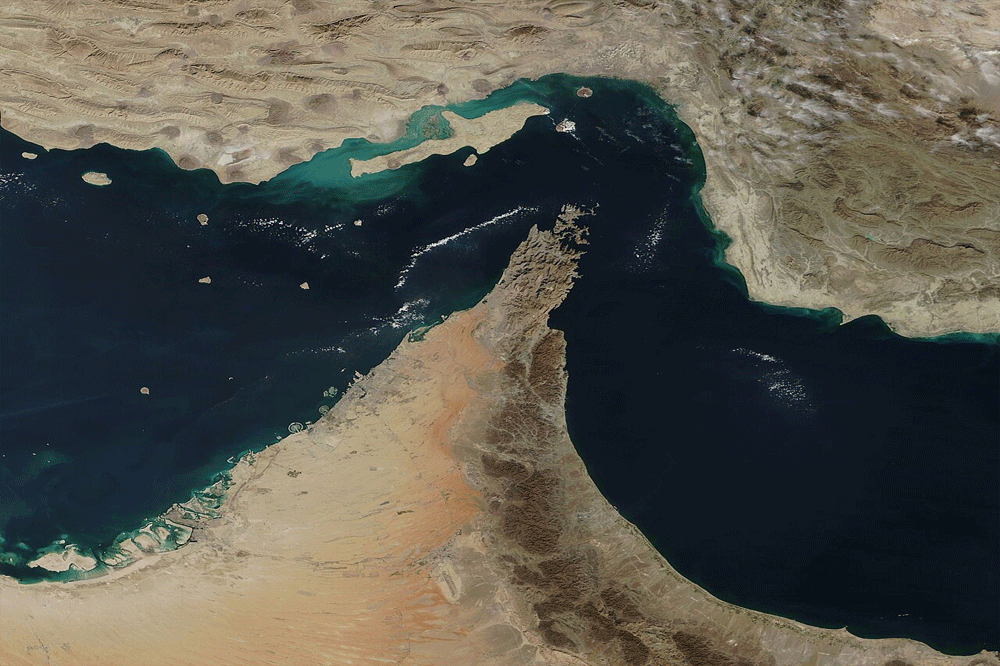
Bahrain and US Propose Joint Resolution on Strait of Hormuz
Bahrain and the United States have tabled a United Nations Security Council resolution seeking to secure freedom of navigation through the Strait of Hormuz. Supported by 112 nations, the initiative aims to protect international energy supplies and commercial shipping lanes from ongoing Iranian attacks, representing a significant test of global maritime security.
As of May 24, 2026, the global maritime order faces its most precarious inflection point in decades. The Strait of Hormuz—the world’s most critical maritime chokepoint—has become the epicenter of a high-stakes diplomatic and strategic standoff. The resolution, which has gained the backing of two-thirds of the UN General Assembly, is not merely a call for safe passage; it is an attempt to formalize a multilateral coalition against the disruption of global energy security.
The Macro-Economic Ripple Effect
The closure or even the systemic harassment of traffic in the Strait of Hormuz translates directly into immediate inflationary pressure on global energy markets. With a substantial portion of the world’s seaborne oil and liquefied natural gas passing through this narrow passage, any disruption forces a catastrophic recalculation of global energy logistics. For multinational firms, the volatility is not limited to the spot price of crude; it extends to insurance premiums, maritime security costs, and the fundamental reliability of just-in-time supply chains.
When the arteries of global trade are threatened, the cost of uncertainty becomes a permanent line item on the balance sheet. Corporations are currently facing a dual challenge: protecting physical assets while hedging against the inevitable surge in logistics expenses. The current geopolitical friction is driving a surge in demand for specialized advisory services. Firms are increasingly turning to global risk consultants to map out alternative routing, stress-test supply chain resilience, and mitigate the exposure of their maritime assets to regional state-sponsored aggression.
The resolution is a clear signal that the international community can no longer treat the security of the Strait as a localized regional dispute; it is a systemic vulnerability that threatens the architecture of global commerce.
The Diplomatic Chessboard: A Multilateral Pivot
The breadth of support for this resolution is telling. With Saudi Arabia, Qatar, and Kuwait joining Bahrain and the United States as principal sponsors, the coalition represents a rare alignment of regional powers. The inclusion of Japan, South Korea, and the majority of the European Union indicates that the security of these waterways is viewed as an existential requirement for the world’s major economies.
However, the path to implementation remains fraught with diplomatic friction. The memory of the previous resolution, which faced vetoes from China and Russia, looms large over the current proceedings. While diplomatic sources suggest that reservations persist among permanent Security Council members, the sheer volume of co-sponsorship—spanning three full pages of the UN record—creates a powerful, if not entirely binding, normative pressure.
For international trade lawyers and corporate legal departments, the shifting legal environment is complex. Navigating the intersection of UN mandates, regional enforcement actions, and domestic maritime law requires a high degree of expertise. Organizations operating in the Gulf are currently seeking guidance from maritime law specialists to ensure that their operations remain compliant with rapidly evolving international protocols and sanctions regimes.
Strategic Infrastructure and the Corporate Response
The geopolitical reality of 2026 dictates that “business as usual” is a strategy for failure. As states leverage critical infrastructure to exert influence, the private sector must respond with hard-coded resilience. This involves more than just diversifying suppliers; it involves a deep integration of security into the logistical footprint of the firm.

- Supply Chain Redundancy: Developing multi-modal transport strategies that reduce reliance on single-point-of-failure maritime chokepoints.
- Digital Hardening: As physical threats escalate, so too does the risk of state-sponsored cyber warfare targeting logistics and port management systems.
- Financial Hedging: Utilizing sophisticated derivative instruments to protect against energy price spikes caused by regional instability.
The necessity for robust supply chain optimization has never been more apparent. Firms that fail to account for the “Hormuz Variable” in their long-term planning are essentially operating with a blind spot that could result in multi-million dollar disruptions.
The Kicker: Navigating the New Normal
The Strait of Hormuz has long been a barometer for the health of the international rules-based order. Today, it is the frontline of a struggle between regional power projection and the global imperative for open, secure trade. The 112 nations backing the current resolution are essentially betting that collective diplomatic pressure can hold the line where individual deterrence has failed. Whether or not the Security Council succeeds in passing the resolution, the underlying volatility is here to stay.
For the leadership of multinational corporations, the takeaway is clear: regional geopolitics is no longer a peripheral concern; it is the primary driver of operational risk. To navigate the coming months, firms must move beyond reactive measures and build a proactive strategic foundation. Whether you require expert insight into geopolitical risk analysis, specialized legal counsel, or advanced supply chain logistics, the World Today News Directory serves as your gateway to the partners required to maintain continuity in an increasingly fractured global landscape.