
Australia to Recognize Palestinian State in September
New Zealand Considers Similar Move Amid Growing International Pressure
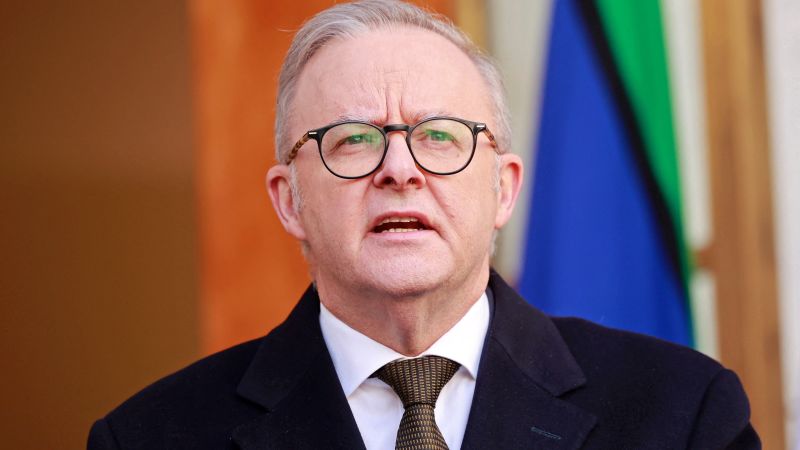
Australia will formally recognize a Palestinian state in September, Prime Minister Anthony Albanese announced Monday, aligning the nation with an increasing number of Western allies amidst escalating international condemnation of Israel’s actions in Gaza. The announcement comes as New Zealand’s Foreign Minister Winston Peters stated his country is also considering a similar recognition, with a decision expected at a cabinet meeting next month.
Diplomatic Shift Signals Shifting Global Stance
Prime Minister **Albanese** confirmed the recognition will occur at the United Nations General Assembly in September. He indicated that Australia’s decision is contingent on commitments received from the Palestinian Authority regarding the formation of a future Palestinian state.
New Zealand’s **Peters** echoed sentiments from Australian officials, stating, “New Zealand has been clear for some time that our recognition of a Palestinian state is a matter of when, not if.”
Prime Minister **Christopher Luxon** of New Zealand described the humanitarian situation in Gaza as an “absolute human catastrophe,”
emphasizing the need for careful deliberation on the decision.
Key Allies Align on Palestinian Statehood
Australia’s move places it alongside the United Kingdom, France, and Canada, all of which have announced plans to recognize a Palestinian state in September. This developing diplomatic alignment leaves the United States increasingly isolated on the issue, as it continues to defend Israel’s military campaign in Gaza.
Should New Zealand also proceed with recognition, four of the “Five Eyes” intelligence-sharing partners—the United States, United Kingdom, Canada, Australia, and New Zealand—will have acknowledged Palestinian statehood. This signifies a significant shift in international diplomatic approaches to the long-standing Israeli-Palestinian conflict.
Australian Foreign Minister **Penny Wong** informed U.S. Secretary of State **Marco Rubio** of Australia’s impending announcement. While the U.S. read-out of the call did not mention Palestinian statehood, **Rubio** previously characterized such declarations as largely symbolic, arguing they embolden Hamas and hinder peace efforts.
“This is about much more than drawing a line on a map. This is about delivering a lifeline to the people of Gaza.”
—Anthony Albanese, Prime Minister of Australia
Conditions for Recognition and Gaza Crisis
Prime Minister **Albanese** stated that Australia sought and received assurances from Palestinian Authority President **Mahmoud Abbas**. These assurances include commitments that Hamas will not participate in a future Palestinian state, along with demands for demilitarization, general elections, and reforms to payments for prisoners and martyrs’ families.
Additional conditions stipulated by Australia involve governance and education reforms, as well as international oversight to prevent incitement to violence. **Albanese** stressed that a two-state solution is crucial for breaking the cycle of violence and addressing the suffering in Gaza.
On Monday, the UN Office for the Coordination of Humanitarian Affairs (OCHA) head in Geneva, **Ramesh Rajasingham**, stated, “what is unfolding in Gaza ‘is no longer a looming hunger crisis – this is starvation, pure and simple.’”
This stark assessment underscores the severity of the humanitarian situation, with hunger-related deaths, particularly among children, on the rise. As of July 1, 37 children have died from severe acute malnutrition, bringing the total to 98 since October 2023, according to Gaza health authorities.
Israel’s planned military operation in Gaza City, involving the potential forced evacuation of up to a million people, has drawn widespread international condemnation. United Nations officials and Security Council members have warned that the plan could result in “another calamity” and constitute further violations of international law.
International Reaction and Protests
Israeli Prime Minister **Benjamin Netanyahu** criticized the move by Western nations to recognize a Palestinian state as “shameful.”
He lamented that European countries and Australia were falling into what he called a “rabbit hole,”
asserting that such actions would not alter Israel’s stance and that the nation would not commit “national suicide.”
Foreign Minister **Wong** articulated Australia’s rationale, stating, “we cannot keep doing the same thing, and hoping for a different outcome. We can’t keep waiting for the end of a peace process that has ground to a halt.”
She framed the decision as an opportunity for Australia to foster momentum towards a two-state solution, which she identified as “the only prospect for peace.”
The humanitarian crisis in Gaza has ignited significant protests globally. In London, over 460 people were arrested at a large demonstration. Last week, an estimated 90,000 people marched across Sydney Harbour Bridge to protest the situation, with organizers claiming the figure was closer to 300,000. These demonstrations reflect growing public horror and anger over the conditions in the Gaza Strip, with further protests planned this month.
