
Madrid is experiencing an unconventional art surge, as contemporary works spill out of galleries and museums and into public spaces. The shift coincides with the opening of the 45th edition of ARCO, Spain’s international contemporary art fair, this week at Ifema, but extends far beyond the exhibition halls.
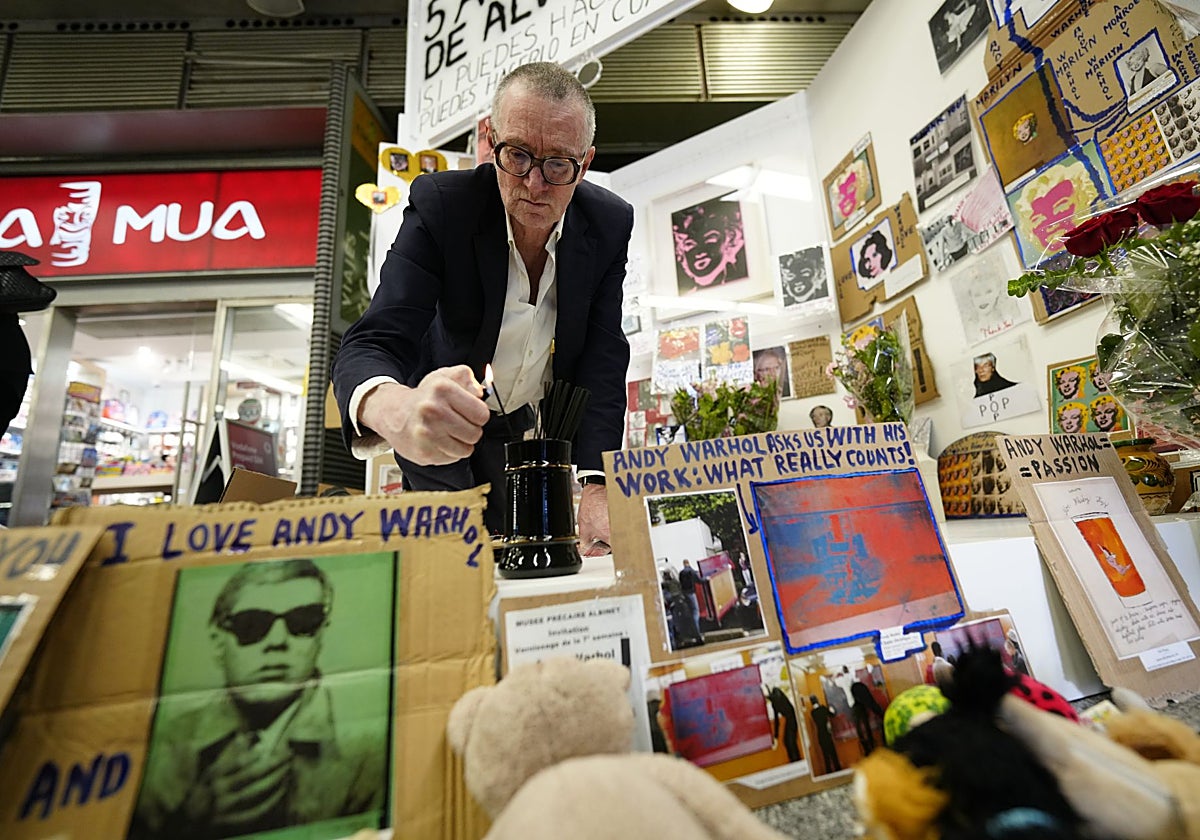
On Tuesday, a temporary installation by Swiss artist Thomas Hirschhorn, titled ‘Pop-up-Marilyn,’ materialized in the -1 level of Madrid’s Atocha train station. The ephemeral artwork, a vibrant altar dedicated to Marilyn Monroe based on Andy Warhol’s 1986 acrylic on canvas, was constructed with cardboard, golden and silver paper, Campbell’s soup cans, flowers, and even Mickey and Minnie Mouse plush toys. Hirschhorn, accompanied by Sandra Guimarães, director of the Helga de Alvear Museum in Cáceres, assembled the piece before dismantling it just seven hours later. The installation was repeated on Thursday at the Oriente station in Lisbon, as part of a celebration of the Helga de Alvear Museum’s fifth anniversary.
Guimarães explained the project aimed to connect Lisbon and Madrid, positioning Cáceres as a central hub for art. “The idea was to think that Cáceres can be a center of art, strategic, that is situated between two capitals, Madrid and Lisbon,” she said. “There is no center of art, there are several; there are no peripheries, there are places where you can work.” She emphasized the museum’s desire to move beyond traditional gallery walls and engage with artists and the public in new ways, noting that Helga de Alvear, the museum’s founder, would have embraced the initiative.
Hirschhorn himself stated, “This work, ‘Pop-up-Marilyn,’ is dedicated to Marilyn Monroe. We brought this work here to tell people that art can move and that it can travel. We invite people to go to Cáceres and enjoy the museum and its collection. Warhol is a very important artist. I love him since I was a student.”
Elsewhere in Madrid, Spanish-American artist Elena del Rivero presented ‘Canto para un monumento funerario’ at the Panteón de España. The installation features a gilded cage containing antique bottles filled with ashes from her previously burned artworks. This act of destruction, carried out in October 2024 in the small village of San Pedro Fiz de Vilar in Orense, was described by del Rivero as a ritual of healing and a reflection on the decline of rural Spain and the changing nature of contemporary art. She spared one work based on Saint Teresa of Avila, donating it to the local community.
Del Rivero’s project extends to the nearby Museum of Anthropology, showcasing collages from her ‘Ensamblajes’ series, a wall reminiscent of the Arte Povera movement, and traditional Spanish objects. She drew inspiration from the unconventional cathedral built by Justo Gallego in Mejorada del Campo, constructed entirely from recycled materials.
Del Rivero, whose studio was destroyed in the September 11th attacks in 2001 and later damaged by Hurricane Sandy, spoke critically of the art world’s commercialization. “We have been turned into producers of luxury items. We see a reflection of society,” she said. She expressed a preference for recognition in the United States, stating, “I feel more loved in the United States. But it doesn’t matter, I like to go against the current, I don’t have a gallery.”
A separate exhibition, ‘Zodiac Machine’ by Japanese artist Justin Caguiat, has taken over the parish of Santa Ana y la Esperanza in the Moratalaz district. Organized by the Sandretto Re Rebaudengo Foundation, the present incorporates painting, sculpture, graphic work, film, and sound, extending into surrounding plazas and storefronts, including the Mercado de Moratalaz. The exhibition is scheduled to move to the Serpentine Gallery in London this fall. Caguiat’s work, inspired by the self-built cathedral of Justo Gallego, explores themes of creative freedom and sustainability, according to Hans Ulrich Obrist.
