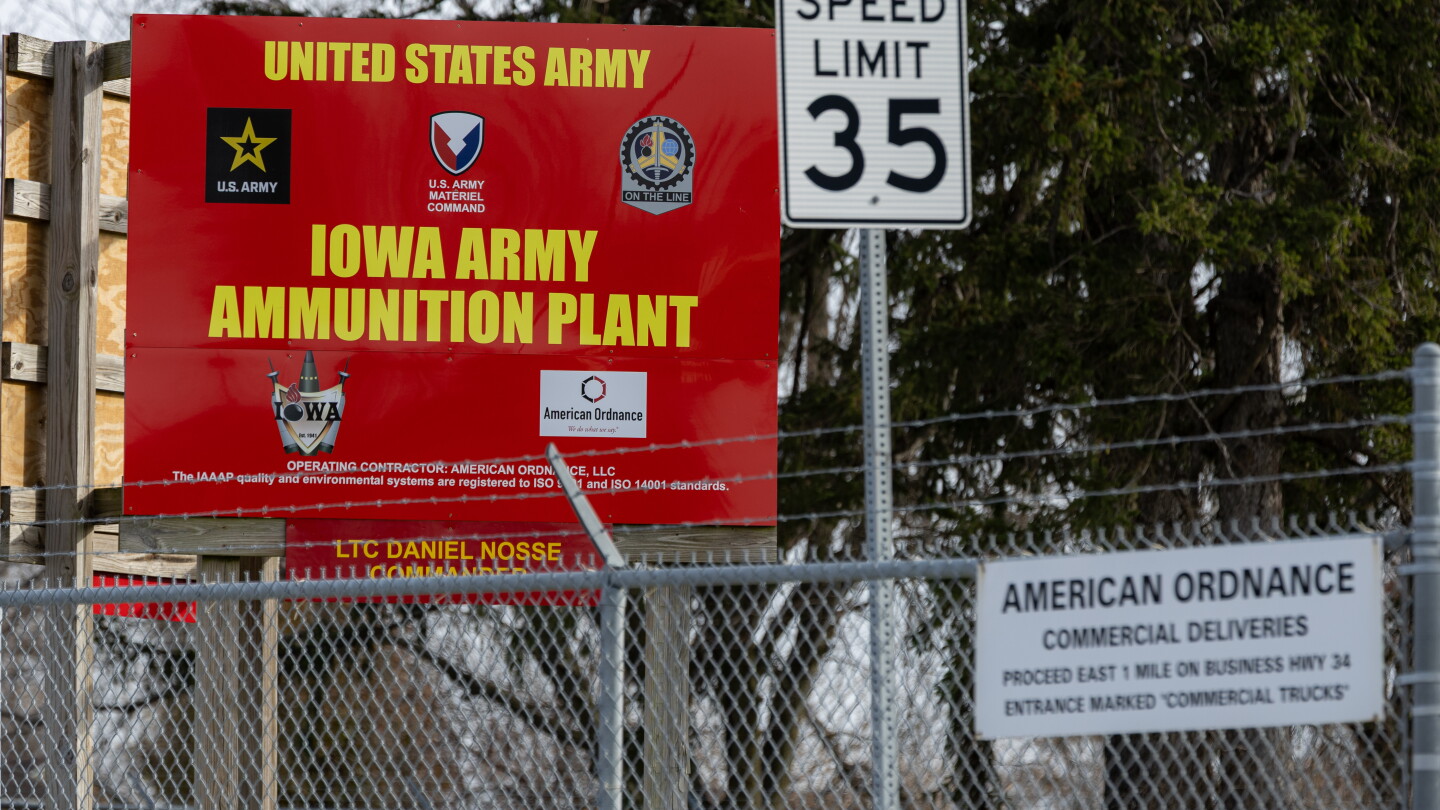
Army Detonates 5 Tons of Lead Azide in Iowa; EPA Reports Zero Airborne Lead
“Every indication is that all of the munitions that were employed absolutely reduced the lead azide threat,” Maj. Gen. Eric Shirley, commanding general of the U.S. Army Sustainment Command, said in a video statement Wednesday after the blast.
The Army detonated nearly five tons of degraded lead azide in two simultaneous controlled explosions at 9 a.m. CT at the Iowa Army Ammunition Plant in Middletown, eliminating a stockpile officials said had become unstable and risked an uncontrolled detonation. Real-time EPA air monitors reported zero detection of airborne lead throughout the event, the agency said in a statement.
The Environmental Protection Agency will continue monitoring air, water, and soil “for as long as it takes that we have the comfort that the levels are back to safe levels,” Tom Croci, associate administrator for national security and operations coordination, told reporters Tuesday, ABC News reported.
Mitigation measures included a water wall, foam barriers, and gel blocks designed to drive the explosion into the ground along a planned blast channel.
At 9:00am CT, @USArmy Sustainment Command executed the controlled mitigated detonation at the Iowa Army Ammunition Plant in Middletown, Iowa. ALL EPA real-time air monitors are reporting ZERO detection of airborne lead throughout the region. EPA monitors never stopped collecting…
Governor declares disaster emergency
Iowa Gov. Kim Reynolds issued a disaster emergency proclamation for several counties, and up to 100 federally activated Iowa National Guard soldiers assisted with outreach to approximately 150 households, ABC News reported.
Alec Patterson, a Middletown resident, told ABC News ahead of the detonation that he and his pregnant wife planned to leave: “We just want to do everything we can to make sure that she’s safe and the baby is safe. It’s terrifying. The lead dust stuff is the biggest concern, I think for everybody.”
Court lifts stay allowing detonation
The Eighth Circuit Court of Appeals granted an administrative stay Thursday night but ultimately denied the emergency motion and lifted the stay Monday, allowing the operation to proceed. “We are mindful of the very real risks presented by the Army’s planned detonation… However, we must acknowledge the realities of the situation: the degraded explosives present a risk of an uncontrolled and unplanned explosion,” the court wrote.
The controlled, mitigated detonation of the lead azide stored at the Iowa Army Ammunition Plant has taken place. Initial analysis shared with us by federal partners and Iowa Homeland Security and Emergency Management indicates that the mitigation measures appear to have been…
President Donald Trump said Monday the “proper course is to get rid of this long term problem.” After the blast, Trump posted on Truth Social that “the Army’s mitigation efforts have far exceeded expectations.” Sand, a Democrat, said he was grateful for the experts who made the explosion as safe as possible but called the lead-up “chaotic and unclear.”
“There must be immediate transparency to understand how and why this situation became what it did. “And any Iowans who have been impacted in any way must be taken care of fully, right away,” Sand posted on X.”
Officials confirm explosion followed planned blast channel
Acting Army Secretary Adam Telle said the threat of an uncontrolled spontaneous detonation had been eliminated and called the operation a huge success that exceeded all expectations, adding that the EPA sensor array showed no readings above 0.0. ATF Director Robert Cekada confirmed the blast followed the designed blast channel 100 percent as planned to minimize any dispersion of lead into the atmosphere.

EPA Administrator Lee Zeldin told CNN the agency’s sensory array was reporting “nothing above 0.0” in airborne lead and that the lead levels were coming in so low they equaled no detection, describing the blast as having caved inward perfectly. Maj. Gen. Eric Shirley said the visible signature from the explosion was primarily aqueous foam, noting more than 3,600 gallons were applied by fire trucks as part of the mitigation measures.
Government pledges testing and remediation for affected residents
Iowa Gov.-elect Rob Sand called for immediate transparency on how the situation reached the point of requiring detonation and said any Iowans affected must be taken care of fully and right away.
The Iowa Army Ammunition Plant (IAAAP) is a 19,011-acre government-owned, contractor-operated facility in Middletown that produces medium- and large-caliber ammunition for the Department of Defense under the U.S. Army Joint Munitions Command. Established in November 1940 as the Iowa Ordnance Plant, it began production in 1941 for World War II, paused in 1945, and resumed manufacturing in 1949 before dramatically increasing output for the Korean conflict in 1950.
In 1989, the plant was placed on the National Priorities List after explosives caused surface water contamination beyond its boundaries, and a Restoration Advisory Board now oversees long-term cleanup.
Ongoing monitoring
The Army has not issued an all-clear for evacuees to return home. The EPA, Army, and outside researchers will continue collecting air and soil samples to measure any lead dust that may have settled.
The government has pledged to offer testing to anyone who wants it and to remediate areas if lead concentrations exceed federally acceptable levels, The Washington Sun reported. Missouri Gov. Mike Kehoe said initial analysis from federal partners indicated “the mitigation measures appear to have been successful and the explosion was well-contained.”
More on Eric Shirley
Related reading
- Na Hong-jin’s “Hope” Wins Best Picture at 47th Blue Dragon Film Awards
- Israeli Film ‘A Man Walks Down the Street’ Streams Globally Dec. on Apple TV, Amazon, Fandango, Google; Theatrical Runs Open Friday in NYC, LA
- Median Net Worth Peaks at 75+ in the Fed's Survey, but the Lead Is Thin (daybreakwire.com)