
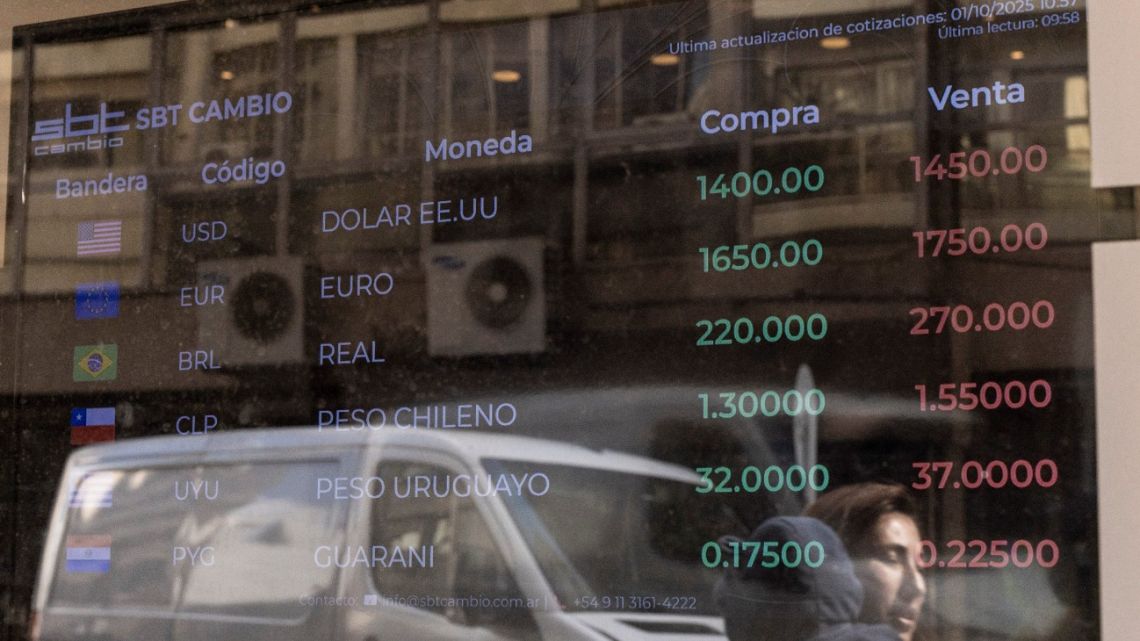
Argentina‘s central bank intervened in foreign exchange markets for the fifth consecutive day on Monday, selling an estimated $450 million to $480 million in an effort to bolster the peso, according to sources familiar with the operation. The continued intervention signals ongoing pressure on the argentine currency despite recent measures to stabilize it, including capital controls and pledges of assistance from the United States.
The Central Bank’s sales, conducted at approximately 1,430 pesos per dollar, are likely being executed on behalf of the Treasury, further depleting the government’s dollar reserves. As last Tuesday, the governance of President Javier Milei has sold an estimated $1.3 billion, drawing down reserves that stood at $1.8 billion as of October 1. While the peso closed at 1,430 per dollar-a 0.4 percent weakening-the Central Bank is restricted by its International Monetary Fund (IMF) agreement from utilizing its reserves unless the exchange rate falls outside a band of 943 to 1,484 pesos per dollar.
prior to a financial lifeline pledged by the U.S.last month, the government had already sold $1.1 billion to defend the peso. Economy Minister Luis Caputo and Central Bank President Santiago Bausili recently concluded talks with U.S. treasury Secretary Scott Bessent and the IMF in Washington on Friday.
President Milei downplayed concerns about the cost of defending the peso during a Sunday interview with LN+ television, stating that gross reserves have increased from $21 billion to $43 billion as his administration took office. “That’s it. The discussion is over,” he said.
A central bank spokesperson declined to comment,and the economy ministry did not promptly respond to a request for details.
-Ignacio Olivera Doll, Bloomberg
