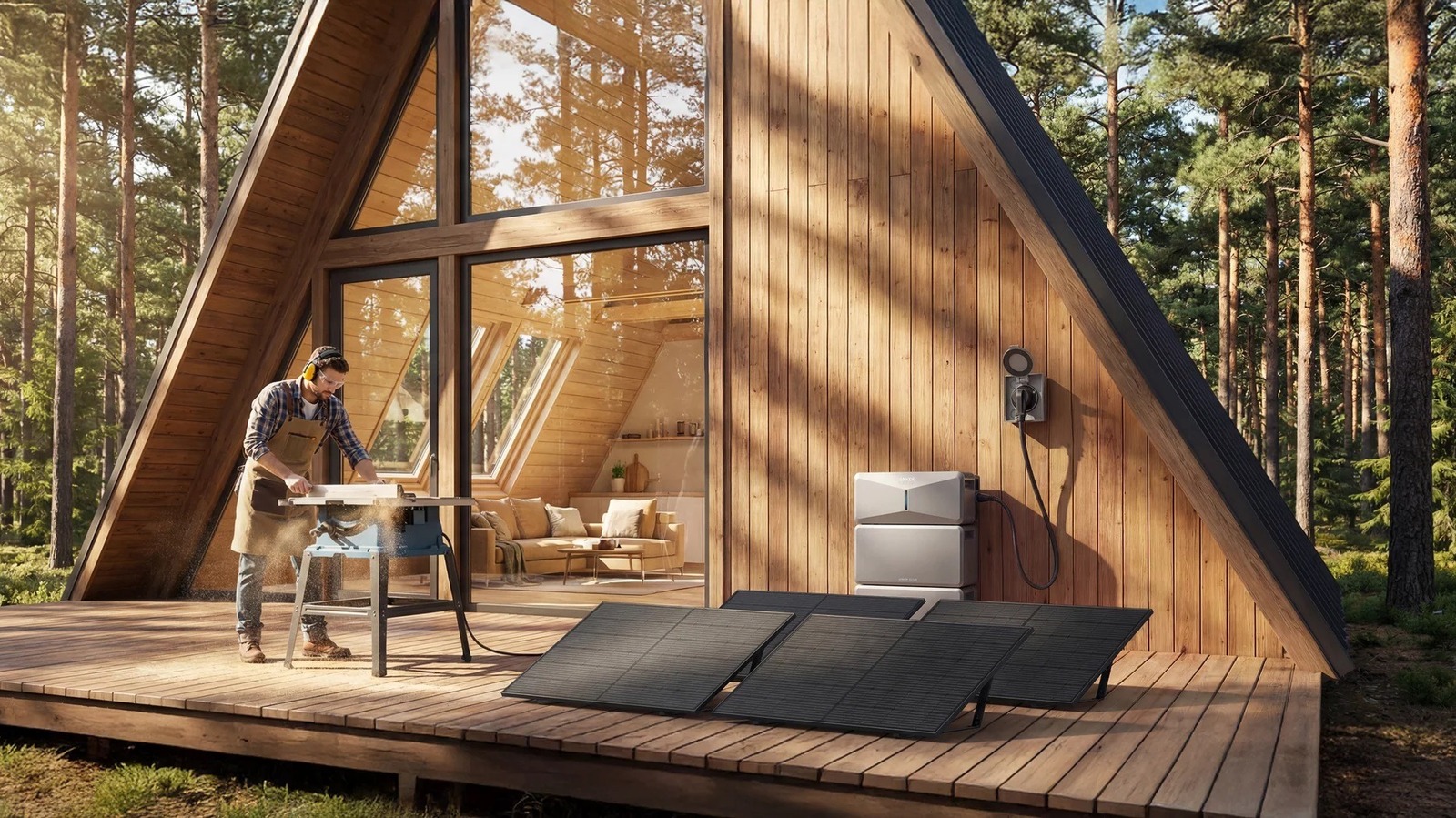
Anker Solix E10 offers modular residential energy storage
Anker SOLIX Home Backup Capacity Against Average Daily US Electricity Demand
Anker home backup battery installations and portable power stations offer various capacities, though powering an entire house depends heavily on total daily electricity consumption. slashgear.com reported that in 2022, the average United States household used approximately 30 kWh of electricity per day according to data from the Energy Information Administration. A mid-range portable Anker PowerHouse battery stores roughly 1.2 kWh, which provides enough energy to run a typical home for about an hour. To cover larger loads, Anker offers the Solix E10 modular home backup system, starting with a 6 kWh capacity per single battery unit, which scales up to 30 kWh when combined into a five-battery setup.
The Tech TL;DR:
- An average US home consumes 30 kWh daily, while basic mid-range portable batteries like the 1.2 kWh PowerHouse units can only sustain full-house loads for roughly one hour.
- Scaling up to the modular Solix E10 configuration provides 6 kWh per unit, expandable up to 30 kWh across five battery modules to match daily household usage.
- Portable options like the 2 kWh Solix C2000 keep essential appliances running, powering a standard refrigerator for 12 hours or a Wi-Fi router for 200 hours.
Modular Capacity Scaling and Financial Costs of the Solix E10 System
The Solix E10 platform provides a modular approach to residential energy storage, allowing homeowners to build out their system architecture based on specific capacity requirements. According to technical specifications from Anker SOLIX US, a single E10 unit delivers a 7.6kW continuous output alongside a 10kW turbo output for up to 90 minutes. Connecting three units expands the system output to 22.8kW continuous and 30kW turbo. Each individual module provides 6 kWh of energy storage, and stacking up to five units reaches a total capacity of 30 kWh. Solar integration is supported through up to 9kW of solar input on the base model, enabling extended runtimes when paired with compatible high-efficiency solar arrays.
Hardware acquisition costs vary significantly depending on the scale of the deployment. A basic single-battery setup is listed on the official Anker website at $3,999, while the extensive E10 ultra off-grid kit scales the investment up to $20,796. For smaller-scale deployment, the portable Solix C2000 system stores 2 kWh of power and is listed at $699.99, reduced from its original $999.99 retail price. This smaller 2 kWh station provides enough stored energy to keep an average household refrigerator running for approximately 12 hours or a standard internet router operational for roughly 200 hours.
Solix F3800 Plus Supports Whole-Home Lighting and Cooling
For mid-sized households requiring reliable backup without a full whole-home architectural overhaul, the Solix F3800 Plus offers dual-voltage 120V/240V AC output capabilities. As detailed in product documentation from Anker SOLIX US, the F3800 Plus delivers a 6,000W output per unit and supports whole-home lighting, extended refrigerator cooling, and window air conditioning units. The base system starts at 3.84kWh capacity and can scale up to 53.8kWh for multi-day or week-long outages.

| Anker SOLIX Model | Base Storage Capacity | Max Scaled Capacity | Continuous Power Output |
|---|---|---|---|
| PowerHouse (Mid-Range) | 1.2 kWh | Not Modular | Standard Portable |
| Solix C2000 | 2 kWh | Not Modular | Standard Portable |
| Solix F3800 Plus | 3.84 kWh | 53.8 kWh | 6,000W AC |
| Solix E10 (Single) | 6 kWh | 30 kWh (5 Modules) | 7.6kW (10kW Turbo) |
Deployment flexibility allows these units to integrate with existing manual transfer switches or smart inlet boxes. The F3800 Plus supports dual MPPT solar inputs up to 3,200W, achieving a full recharge in under two hours under optimal sunlight conditions. EV-grade LFP batteries power these systems, carrying safety certifications including UL9540 and UL9540A while engineered for a 10-plus year operational lifespan.
Disclaimer: The technical analyses and security protocols detailed in this article are for informational purposes only. Always consult with certified IT and cybersecurity professionals before altering enterprise networks or handling sensitive data.