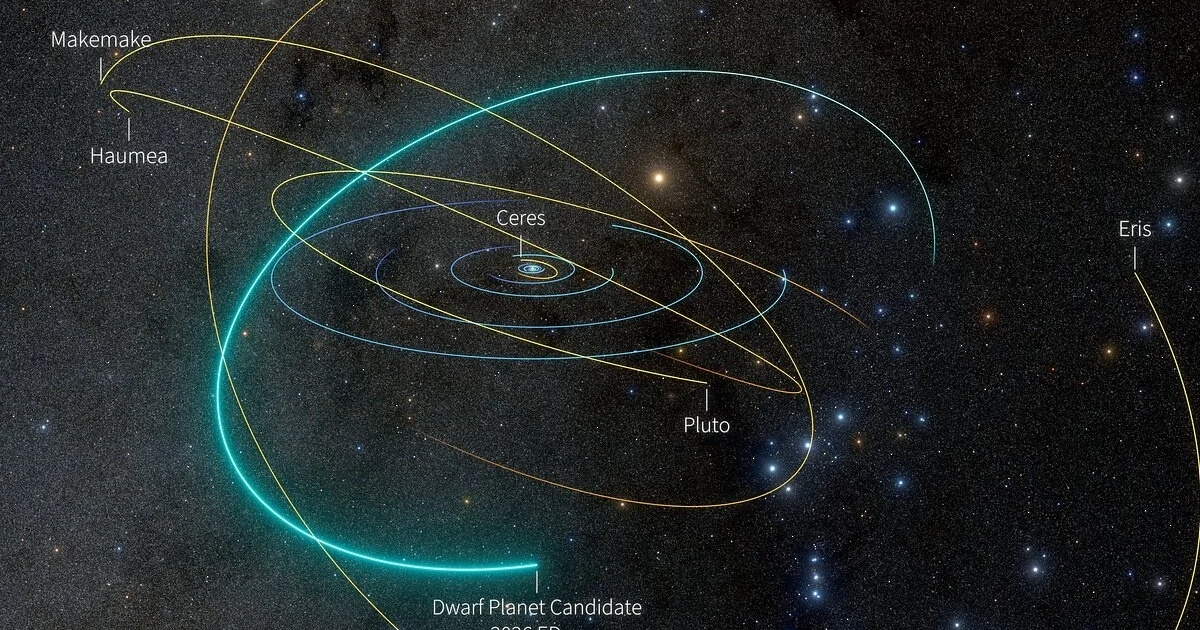
New Dwarf Planet Candidate 2026 ED138 Discovered Beyond Pluto
<>
An expansive new dwarf planet candidate measuring between 600 and 1,500 kilometers across has been discovered orbiting the Sun beyond Neptune, according to the Vera C. Rubin Observatory. Designated 2026 ED138, the icy body sits at a distance of roughly 46 astronomical units from the Sun, placing it further out than Pluto’s average orbit of 40 astronomical units, as reported by ntdtv.com.
The discovery marks one of the largest trans-Neptunian objects found in the outer solar system in two decades. Matthew Holman of the Harvard-Smithsonian Center for Astrophysics first identified the object on October 13 while analyzing data collected earlier this year by the Rubin Observatory, which is situated atop Cerro Pachón in northern Chile. Holman used a specialized search algorithm designed to sift through billions of motion detections to link observations of the same moving body across multiple datasets.
Initial detections of the object span from March 4 through July 11, with archival images from the Dark Energy Camera tracking its path back as far as 2016. Because 2026 ED138 shares an orbital inclination tilted nearly 25 degrees relative to the solar system plane, astronomers classify it as a "hot classical Kuiper belt object." This inclined orbit indicates the body was previously disrupted by the gravitational influence of Neptune, pulling it away from its original pathway and placing it on a roughly 281-year orbit around the Sun.
Rubin Observatory Survey Detects Rare Space Object
The discovery emerged shortly after the Rubin Observatory officially commenced its ten-year Legacy Survey of Space and Time in June, a mission that repeatedly photographs the entire southern sky every few nights. Holman’s search code coordinates billions of light points to map space objects, but the initial detection of 2026 ED138 prompted immediate scrutiny to rule out software errors.
"My first reaction was a mix of excitement and disbelief," Holman said, noting that such bodies are exceptionally rare and required checking the codebase to verify the signals.

Overcoming Background Star Density
Locating 2026 ED138 required overcoming significant observational hurdles. The object resides near the Galactic plane in a densely crowded star field where millions of background light sources typically obscure distant, slow-moving bodies from standard telescopes.
The combination of the Rubin Observatory’s continuous southern sky monitoring and automated screening algorithms allowed the research team to pinpoint the candidate.
Meet our Solar System's newest dwarf planet candidate: 2026 ED138!Orbiting past Pluto, scientists found it in NSF–DOE Rubin Observatory data from earlier in 2026. Early analysis suggests it's 600–1500 km across, one of the largest found past Neptune!🔗 https://t.co/wTOg898zBu pic.twitter.com/hEgnk597rl
Classification and Next Steps for Astronomers
While preliminary calculations place the object’s absolute magnitude at around 3, its final classification depends on confirming its physical dimensions. To be designated a dwarf planet by the International Astronomical Union, an object must possess sufficient mass and self-gravity to pull itself into a nearly round shape, distinguishing it from standard trans-Neptunian objects that cannot clear their orbital paths.
Researchers indicate that the brightness of 2026 ED138 is sufficient to allow ground-based light curve and spectroscopy observations. Further confirmation will require infrared measurements to verify whether its size meets the criteria to join the solar system’s recognized dwarf planets, which currently include Pluto, Haumea, Makemake, Eris, Ceres, and Vesta.
