
Arm’s SME2 Tech Boosts AI on Mobile Devices
To handle the growing demands of generative AI, **Arm** is introducing Scalable Matrix Extension 2 (SME2) technology, promising faster and more efficient AI processing on mobile devices.
SME2: Revolutionizing Mobile AI
The rising sophistication of generative AI on mobile platforms goes beyond simple chatbots. Tasks now include advanced mathematical reasoning applied to text, sound, images, and video. These complex operations need more powerful hardware.
Enhanced Capabilities and Integration
SME2, which initially appeared in the **Armv9** architecture, serves as a CPU extension designed to speed up matrix math. The updated 2022 version brings new functionalities, enabling real-time mobile inference for tasks such as image generation and natural language processing. Developers can integrate SME2 into existing systems without altering code.

Performance Boost
**Arm**’s data indicates that hardware enhanced with SME2 runs **Google**’s Gemma 3 model six times faster than systems without it. For instance, a single CPU core can summarize an 800-word text in just one second, though the specific CPU model used in testing remains unspecified.
Android Integration
The announcement highlights the future inclusion of SME2 hardware capabilities in Android devices. Previously, SME was primarily for server and workstation-level processors. The expanded SME2 design now allows for deployment on laptops, tablets, and even smartphones.
Current Support
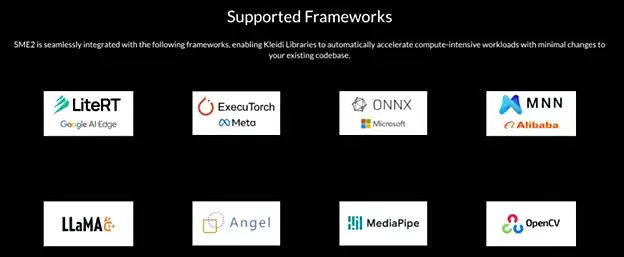
Android already supports SME2, with enablement in **Google**’s XNNPACK library. This support extends to frameworks like llama.cpp, **Alibaba**’s MNN, and **Microsoft**’s ONNX. According to Statista, Android holds approximately 70% of the global mobile operating system market share as of 2024, making this integration potentially impactful for a significant number of users. (Statista)
