
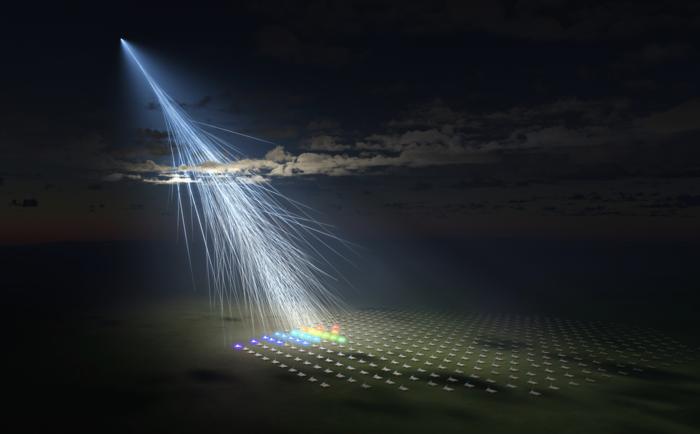
Astronomers are a step closer to pinpointing the source of one of the most energetic particles ever detected, a cosmic ray dubbed “Amaterasu” after the Japanese sun goddess. Analysis led by researchers at the Max Planck Institute for Physics (MPP) suggests the particle’s origin may lie not in the vast emptiness of space previously suspected, but within a nearby star-forming galaxy.
The Amaterasu particle was first detected in May 2021 by the international Telescope Array Project (TAP) in Utah. Its energy, exceeding 240 exa-electronvolts (EeV), is roughly 40 million times greater than that of particles created in the Large Hadron Collider (LHC). Such ultra-high-energy cosmic rays are exceptionally rare and are believed to originate from the most extreme environments in the universe.
Initial observations left scientists uncertain about the particle’s composition – whether it was a proton, a light atomic nucleus, or a heavier one. The initial search for its origin pointed toward the Local Void, a relatively empty region of space bordering the Local Group of galaxies. This presented a puzzle, as the Local Void lacks the powerful sources typically associated with generating such high-energy particles.
Francesca Capel and Nadine Bourriche of the MPP tackled this challenge by combining advanced simulations with statistical methods, specifically Approximate Bayesian Computation. This allowed them to create three-dimensional maps of cosmic-ray propagation and how these particles interact with magnetic fields within the Milky Way. Their work, published January 28th in The Astrophysical Journal, offers a new approach to tracing the origins of these elusive particles.
The analysis indicates that the Amaterasu particle is more likely to have originated in a nearby star-forming galaxy, specifically M82, also known as the Cigar Galaxy, located approximately 12 million light-years from Earth. “Our results suggest that, rather than originating in a low-density region of space like the Local Void, the Amaterasu particle is more likely to have been produced in a nearby star-forming galaxy such as M82,” stated Bourriche.
Cosmic rays are high-energy particles that travel through space at nearly the speed of light. They originate both within and outside the Milky Way galaxy, and even from the Sun. Upon entering Earth’s atmosphere, they create showers of secondary particles, with most being deflected by the Earth’s magnetosphere and heliosphere. Direct measurement of cosmic rays began with the launch of satellites in the late 1950s, utilizing particle detectors similar to those used in nuclear and high-energy physics.
According to Capel, who leads the “Astrophysical Messengers” group at the MPP, understanding ultra-high-energy cosmic rays is crucial for comprehending the universe’s ability to accelerate matter to such extreme energies and for studying the behavior of matter under those conditions. “Our goal is to develop advanced statistical analysis methods to exploit the available data to its full potential and gain a deeper understanding of the possible sources of these energetic particles,” she explained.
The researchers’ method combines physics-based simulations with observational data, bridging a gap between theory and observation and complementing existing efforts to understand the origins of ultra-high-energy cosmic rays. The Telescope Array Project continues to collect data, and further analysis is expected to refine the understanding of Amaterasu’s origin and the broader landscape of cosmic-ray sources.
