
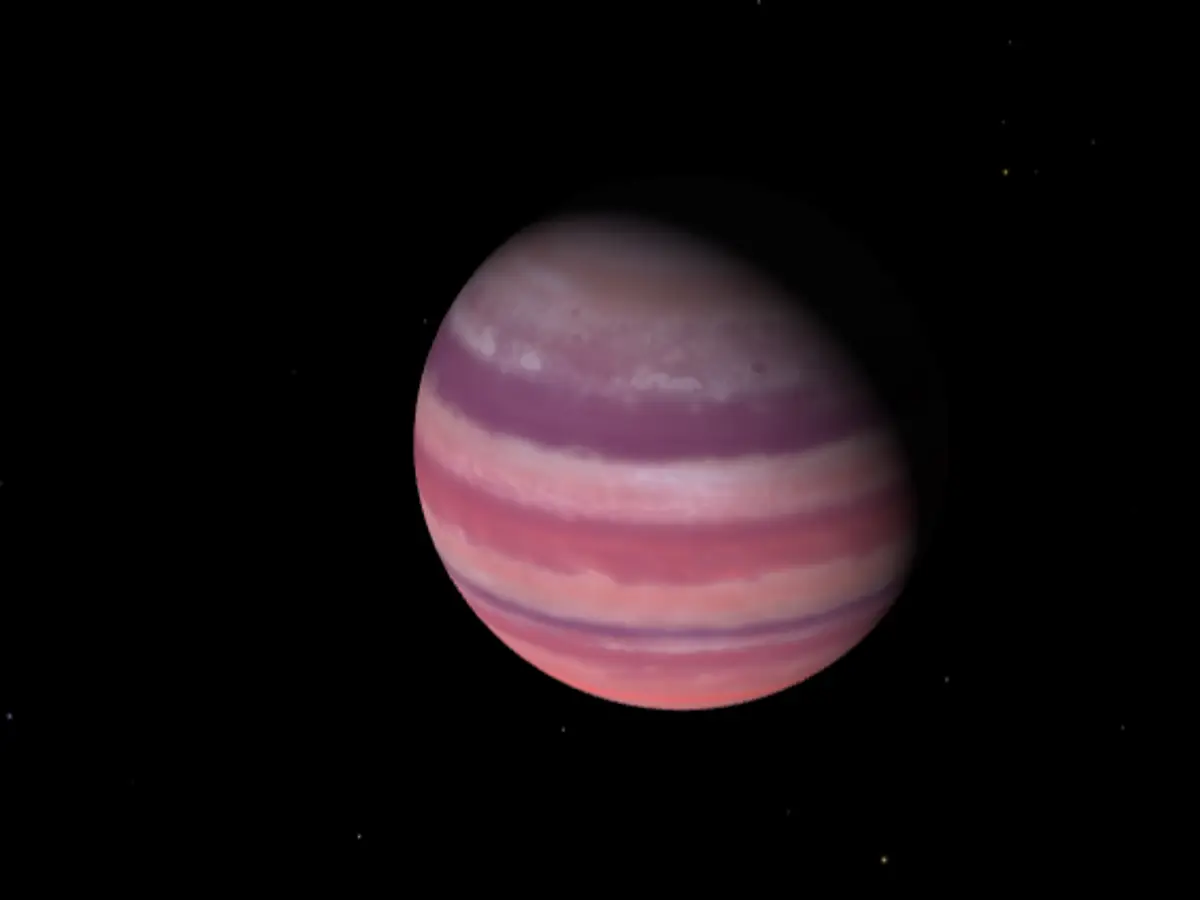
Massive ‘Super-Earth’ Kepler-139f Discovered by NASA
Giant Planet Remained Hidden Due to Orbital Peculiarities
NASA scientists have unveiled a colossal exoplanet, Kepler-139f, orbiting the Kepler-139 star. This “super-Earth” is a behemoth, weighing in at approximately twice the mass of Neptune and significantly dwarfing our own planet. Despite its immense size and powerful gravitational pull, the planet eluded detection for millions of years until its discovery in 2025.
A Giant Unseen for Millennia
Kepler-139f is estimated to be a staggering 36 times the mass of Earth. It embarks on an orbital journey around its sun-like “G-type star” every 355 Earth days, according to a report from Space.com. Its prolonged invisibility stemmed from its specific orbital alignment, which prevented it from being easily observed by traditional methods.
Unmasking Hidden Worlds
The breakthrough in discovering Kepler-139f utilized NASA’s Kepler Space Telescope and the transit method. This technique identifies planets by detecting minute reductions in a star’s brightness as an object passes in front of it. However, Kepler’s focused view meant planets outside its direct “line of sight” were only detectable if their gravitational influence on other celestial bodies became measurable.
The primary method for identifying new worlds like Kepler-139f often involved ground-based observations. Using radial velocity (RV) measurements, astronomers could gauge the subtle tugs a planet exerts on its star, thereby calculating the planet’s mass. This technique was instrumental in uncovering even more distant giants, such as Kepler-139e.
The universe’s planets constantly interact gravitationally. These subtle pulls can alter a planet’s transit timing, creating “transit timing variations” (TTVs). These variations can signal the presence of unseen worlds that do not directly cross their star from our perspective.
“When you observe TTVs that cannot be attributed to the known planets, you can be fairly confident that there is an unseen body in the system,” explained Caleb Lammers, a researcher from Princeton University and co-author of the study.
Lammers and his colleague Joshua Winn, a participating scientist on the Kepler team, meticulously searched for anomalies within established planetary systems. The Kepler team later combined RV and TTV data to pinpoint missing planets, revisiting existing TTV measurements in light of the 2023 discovery of Kepler-139e.
Context: The Ever-Expanding Exoplanet Census
The discovery of Kepler-139f highlights the ongoing progress in exoplanet detection. As of early 2024, scientists have confirmed over 5,500 exoplanets, with thousands more awaiting confirmation. The sheer number of discoveries underscores the vast diversity of planetary systems in our galaxy.
