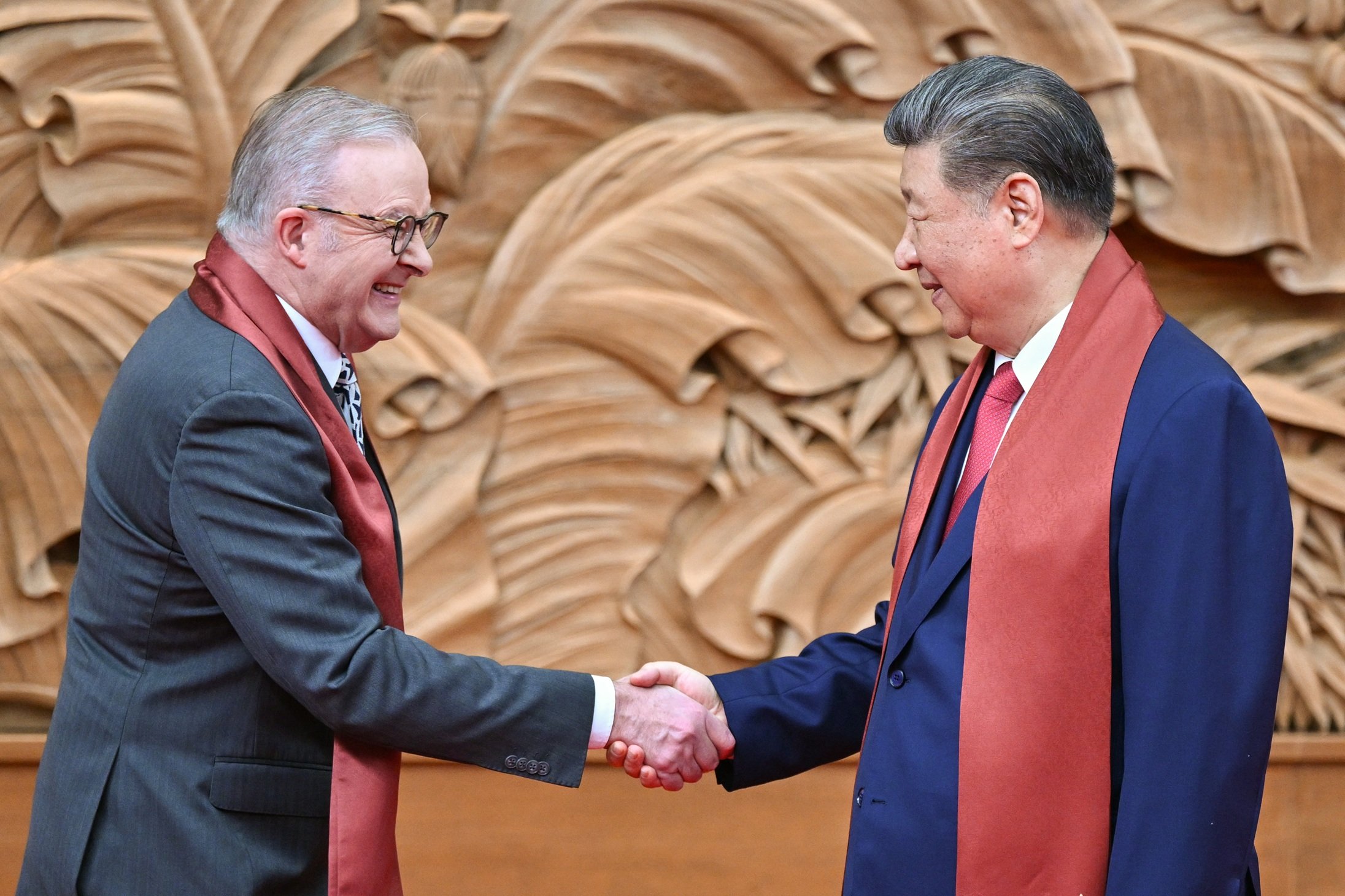
Albanese Meets Xi Seeking Beef Quota Relief After China Hosts Trump and Putin
SHENZHEN — Australian Prime Minister Anthony Albanese met Chinese President Xi Jinping in Shenzhen, hunting trade concessions for Australian beef exporters as the fifth formal Albanese-Xi meeting unfolded in the shadow of the Trump-Putin-Xi trilateral summit the day before.
The setting said much about the hierarchy of this APEC summit. The Kylin State Guesthouse talks came the morning after Xi hosted Donald Trump and Vladimir Putin for the first trilateral meeting of the leaders of China, the United States and Russia — a session that pushed Australia’s agenda to the margins of world attention, according to IL GLOBO. Albanese also met Chinese Premier Li Qiang during the visit.
For Canberra, the calculation is blunt. Middle-power diplomacy on the wars in Iran and Ukraine has gained little traction, while the beef quota dispute with Beijing is costing exporters real money now — an estimated $1 billion a year, according to the Australian Meat Industry Council. Trade access, not geopolitics, is where Albanese can bring something home.
A quota emptied by June
The problem is arithmetic. From 2026, Beijing has imposed for three years a quota on beef imports from Australia and other countries, a measure designed to shield Chinese cattle farmers. The quota runs to 205,000 tonnes a year. Australia and its fellow suppliers hit that ceiling in June, and everything shipped above it since has carried a 55 percent customs tariff.
Demand has not slowed. During a visit to a Shenzhen supermarket on Wednesday, Albanese pointed to the speed with which the quota emptied as evidence that Chinese consumers want Australian beef. Rabobank analyst Angus Gidley-Baird told the outlet the pattern points one way: at the current pace, the 2027 quota could be exhausted by May.
Beef has no seat at the round table
The industry bearing the cost will not be in the room. A round table with chief executives is scheduled for this evening in Beijing, and the beef sector has no representation there. The Business Council of Australia, which is attending, intends to press for greater market access for exporters regardless.
That leaves Albanese carrying the sector’s case himself, through both the Xi meeting and his talks with Li. He plans to raise the concerns of Australian businesses about access to the Chinese market, with beef the sharpest example.
Where the middle powers lost ground
Albanese tried to use the APEC podium for bigger questions. In his address to the summit, he called for an end to the wars in Iran and Ukraine, directing his words at Putin with the appeal to “end it now.”
It did not land the way Canberra hoped. Australia, Canada and New Zealand had sought to keep Moscow at the margins of the diplomatic process. That effort was compromised by the reception Trump gave the Russian president: on the eve of the trilateral, the US leader criticized globalism and questioned the credibility of the International Criminal Court, which has issued an arrest warrant for Putin over alleged war crimes.
The contrast between the two days captures Australia’s position. On one, a middle power watching the three largest nuclear-armed states meet as guests of Beijing, with limited influence over the outcome. On the other, a prime minister in a supermarket aisle, holding up a beef quota as the clearest proof of his argument.
What Beijing decides next
The immediate question is whether China’s leadership signals any relief on the quota during or after these meetings. The 55 percent tariff remains in force on every tonne shipped above the ceiling.
Exporters watching from Australia are left with the Rabobank timeline as their working assumption: another quota race that ends in May, and another year of paying the penalty rate for the privilege of selling beef that Chinese shoppers keep buying.
Albanese, born in Sydney in 1963, has led the Labor Party since 2019 and served as Australia’s 31st prime minister since 2022, winning re-election in a 2025 landslide that produced one of the largest Labor governments in Australian history.
He has held the seat of Grayndler in inner-west Sydney since entering Parliament at the 1996 election, and earlier served as a minister in the Rudd and Gillard governments, including a brief stint as deputy prime minister in 2013. His first term included overseeing an easing of the trade restrictions China had placed on Australia — the diplomatic groundwork that makes this week’s beef quota push possible.
The trilateral in Shenzhen will be remembered in the communiqués. Albanese’s measure of success is more modest, and more measurable: whether the 2027 quota lasts past May.
- CDU-SPD Coalition Keeps 2038 Coal Exit to Allow Gas Expansion Plans, Tracker Says
- Turkey Court Upholds Imamoglu Degree Revocation, Blocks 2028 Presidential Bid
- Trump's Beef Quota Filled About 37% in Month One; Ground Beef Fell 13 Cents (daybreakwire.com)
- Phoebe Bridgers Covers Adrianne Lenker’s “Anything” for Palestine Children’s Relief Fund (archyde.com)