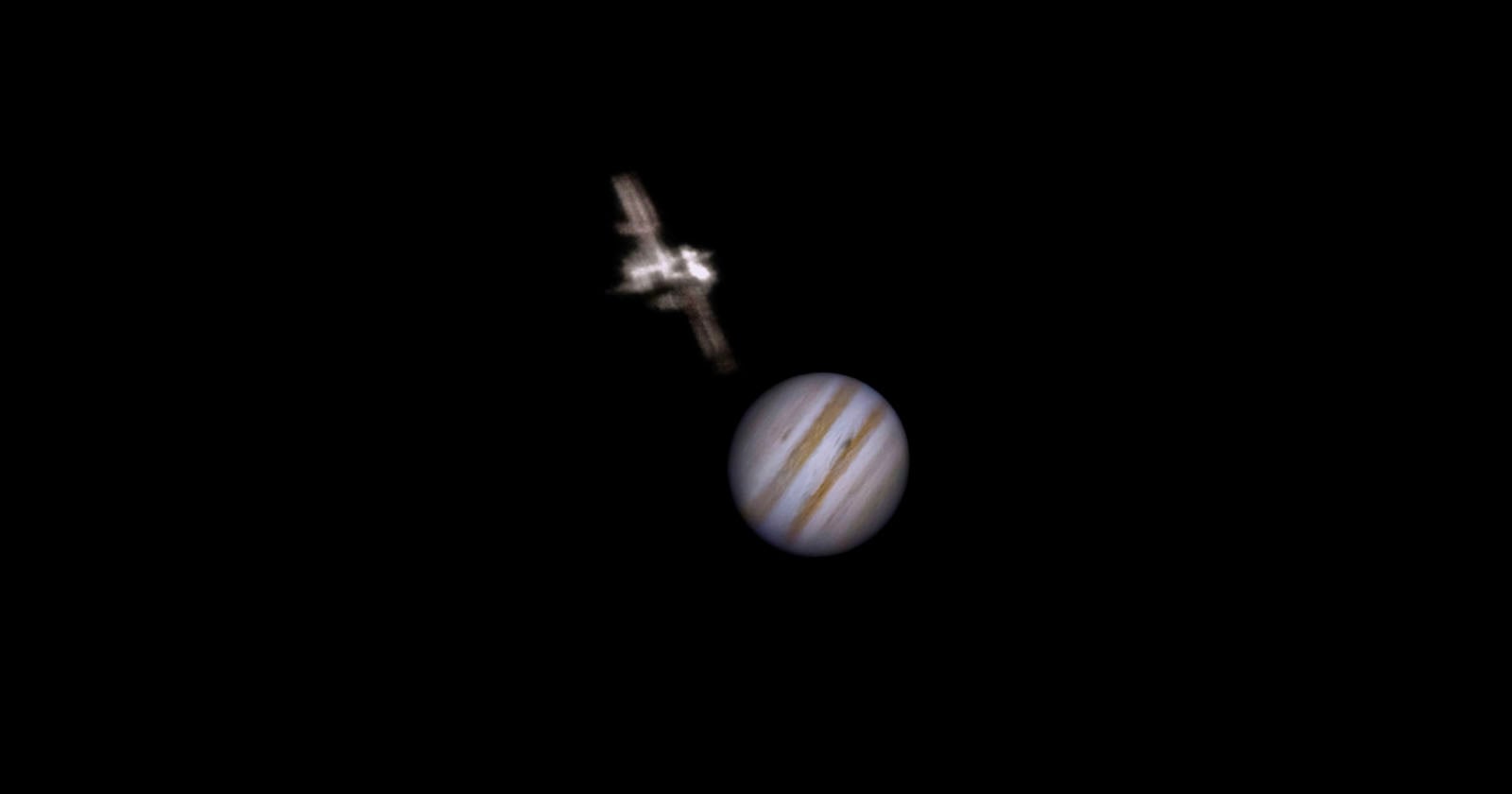
AJ Smadi Captures Rare ISS Transit Across Jupiter
Photographer AJ Smadi Captures ISS and Jupiter in Single Frame Over Washington
Photographer AJ Smadi captured a rare shot of the International Space Station as it whizzed past Jupiter at precisely 6:03 AM PDT this past Sunday, according to a report published by PetaPixel. Smadi drove over an hour north of Seattle to Burlington, Washington, just before sunrise to bring the project to life after having it on his radar for nearly two years.
The Tech TL;DR:
- AJ Smadi photographed the ISS and Jupiter in a single frame from Burlington, Washington, on a Sunday morning at 6:03 AM PDT.
- The visual alignment occurred because Jupiter was approximately 1.3 million times wider than the ISS and simultaneously 1.3 million times farther away from the camera.
- The gear setup included a 9.25-inch Celestron Schmidt-Cassegrain Telescope, a ZWO ASI662MC camera featuring Sony’s IMX662 sensor, and a UV/IR filter.
Two-Year Calculation Yields Rare Orbital Alignment
Smadi tracked the orbital path of the space station over a multi-year period to secure the alignment. “Every month or so for the past couple years, I would check the ISS’s path across the sky and see if it would be close enough to any planets that I could align them from within Washington State,” Smadi told PetaPixel. “At precisely 6:03 AM PDT, the International Space Station zipped directly past the gas giant Jupiter. After I carefully calculated the exact location from which to observe the transit, I managed to capture both objects in a single frame.” The resulting image displays an exact angular size match between the orbital laboratory and the gas giant.
Detailed View of Seven Astronauts and Jovian Moons
The captured frame contains seven human beings aboard the ISS: Jessica Watkins, Luke Delaney, Joshua Kutryk, Sergey Teteryatnikov, Pyotr Dubrov, Anil Menon, and Anna Kikina. Behind the orbiting structure, the shot resolves Jupiter’s storms and belts alongside all four Galilean moons: Io, Europa, Ganymede, and Callisto. The image belongs to an ongoing series titled “ISS Meets,” through which Smadi has previously photographed Venus, Saturn, and Mars alongside the station. “As far as I’m aware, I have the only known ISS-Venus transits ever recorded, and have also captured it alongside Saturn and Mars,” Smadi stated to PetaPixel. Mercury remains the sole inner or outer planet in the Solar System that Smadi has not yet captured, excluding the distant ice giants Uranus and Neptune.
Celestron Telescope and Sony Sensor Specifications
To resolve the fast-moving orbital target alongside deep-space celestial bodies, Smadi utilized specialized hardware. The optical assembly centered on a 9.25-inch Celestron Schmidt-Cassegrain Telescope featuring a focal length of 2,350mm. Imaging duties were handled by a ZWO ASI662MC camera equipped with Sony’s IMX662 sensor. A UV/IR filter was mounted to block out ultraviolet and infrared wavelengths, maintaining clarity through the atmosphere before sunrise. Additional work from the ongoing series is hosted on Smadi’s Instagram and Reddit accounts.
The ISS and Jupiter look nearly the same size in AJ Smadi's photo because Jupiter was about 1.3 million times wider than the space station but also 1.3 million times farther away.https://t.co/wQM9FRJ9UD pic.twitter.com/CESNsg7964