
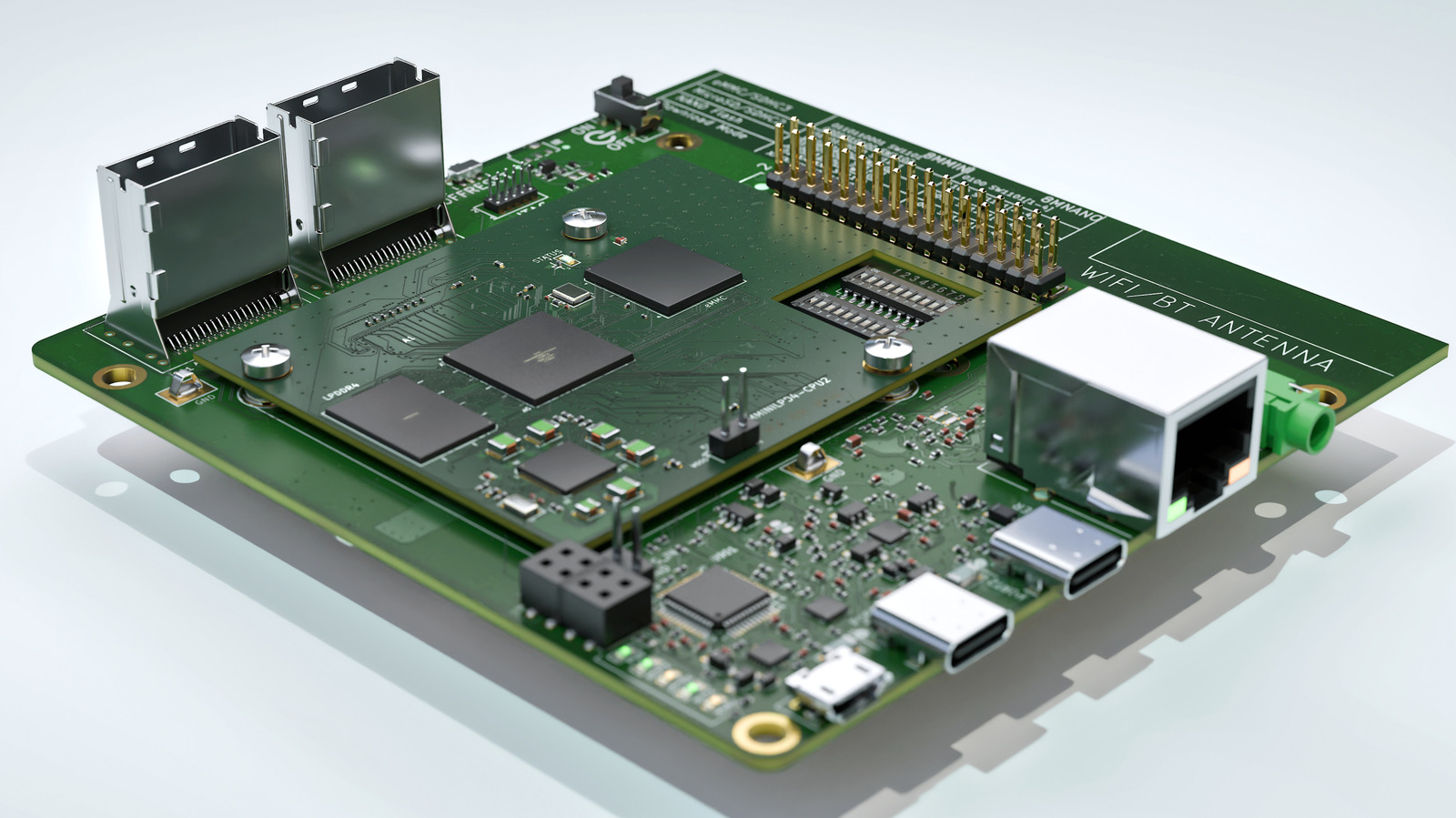
Artificial intelligence is rapidly evolving, moving beyond quirky applications too tackle complex engineering challenges. A prime example of this shift is the work being done by Quilter AI, a company pioneering the use of AI in hardware design. They’ve successfully demonstrated that AI can not only assist in designing components, like CPUs as previously achieved, but can now design an entire computer system capable of booting and running on its first attempt.
Project Speedrun, as it’s known, resulted in a fully functional computer comprised of 843 individual components, built in under a week – a process that traditionally takes around three months. This wasn’t a mere proof-of-concept; it was a fully operational, Linux-based computer constructed on two printed circuit boards, designed by a single engineer leveraging Quilter’s AI platform. The key wasn’t replacing the engineer, but augmenting their abilities by automating the time-consuming and repetitive tasks inherent in hardware design.
This breakthrough signifies a potential paradigm shift in how hardware is developed, promising faster innovation cycles and reduced growth costs. It’s a testament to the growing capabilities of AI and its potential to revolutionize traditionally human-dominated fields.
How AI revolutionized Computer Design and Construction
The process began with a human engineer defining the system’s schematic, selecting components, and establishing electrical, physical, and manufacturing constraints. The AI didn’t operate in a vacuum; it responded to a clearly defined set of parameters. This approach mirrors the mechanics of interacting with tools like ChatGPT, where specific prompts yield targeted results, albeit with considerably greater complexity in this case.
The AI then took over the intricate task of layout design and routing, a process notorious for its complexity and time consumption. Once the AI completed the layout, standard PCB fabrication and assembly techniques were used to bring the design to life. A subsequent “clean-up” phase involved engineers making minor adjustments, but Quilter emphasizes that this wasn’t a major overhaul.The AI-generated layout remained largely intact, requiring only 38.5 hours of refinement – a stark contrast to the 428 hours typically needed for a non-AI-assisted build.
The resulting computer boasts an NXP i.MX 8M Mini Quad processor, 2 GB of RAM, 32 GB of storage, and includes audio, video output, Ethernet, and a PCIe slot. This demonstrates the AI’s ability to handle a complex system with a variety of integrated components.
Beyond first Boot: Demonstrating Usability and Reliability
While achieving a successful first boot is a significant milestone in hardware development, the Quilter team went further. They wanted to prove that the AI-designed computer wasn’t just functional, but genuinely usable. To that end, they installed a full Linux habitat and subjected the system to sustained workloads.
This testing phase is crucial, as it often reveals hidden issues related to power delivery, signal integrity, and thermal management. Early-revision boards are notably susceptible to these problems. Though, the AI-assisted design performed admirably, operating as was to be expected under stress. This suggests that the AI’s design process effectively mitigated potential weaknesses.
The computer’s capabilities were further validated by successfully running everyday applications like YouTube, the game AngryBots, and productivity suites such as Google Meet and LibreOffice. This comprehensive testing demonstrates that AI-driven hardware design isn’t just a theoretical possibility, but a practical reality. while the data comes directly from Quilter, the results strongly indicate a future where AI plays an increasingly prominent role in computer design and beyond.
The Broader Implications for the Tech Industry
The success of Project Speedrun has far-reaching implications for the technology industry.by significantly reducing design and development time, AI has the potential to accelerate innovation across a wide range of hardware applications. this could lead to faster product cycles, lower costs, and more specialized hardware tailored to specific needs.
Moreover, the ability of a single engineer to design a complex computer system with the aid of AI democratizes hardware development. It lowers the barrier to entry for smaller companies and individual innovators, potentially fostering a new wave of creativity and entrepreneurship.
Key Takeaways
- Accelerated development: AI reduced the computer design and build time from three months to less than a week.
- Human-AI Collaboration: The project wasn’t about replacing engineers, but empowering them with AI tools.
- Reliable Performance: The AI-designed computer booted successfully on the first try and performed reliably under stress.
- Democratization of Hardware Design: AI lowers the barrier to entry for hardware development, enabling smaller teams and individuals to innovate.
- future of Hardware: This project signals a significant shift towards AI-assisted hardware design as the norm.
