
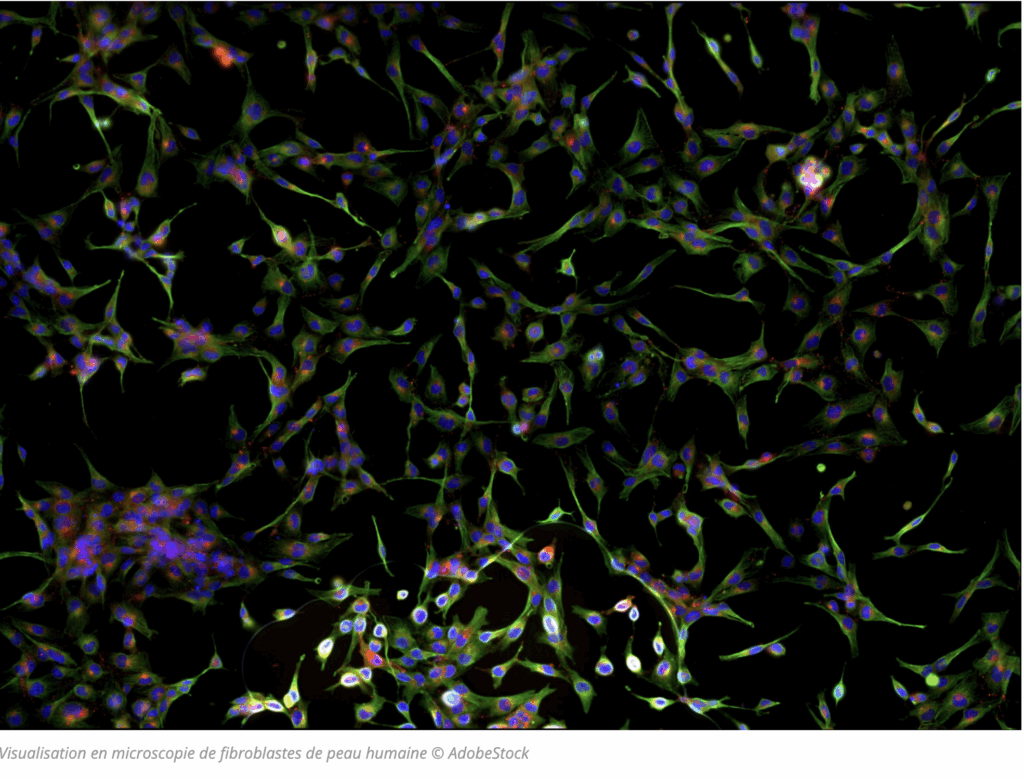
What if, well before the appearance of the first signs of fragility, our cells brought in them the clues of how we were going to age? Thanks to the analysis of skin cells, fibroblasts, from biopsies made in the participants of the Inspire-T cohort, researchers from Inserm, the University of Toulouse, the CNRS, the French Blood Establishment (EFS)[1]in collaboration with the IHU Healthage, discovered that these cells would provide precious clues to the overall state of health of individuals. Their work shows that certain organic markers testifying to the proper functioning of fibroblasts would make it possible to detect and anticipate signs of fragility or decrease in physical and mental capacities, regardless of the age of people. Their results, published in Aging Cell, Open perspectives in personalized preventive medicine to support health better.
While aging represents a major societal challenge, health research has long focused on biological markers linked to chronological age, often by disconnecting them from the overall or functional state of health of individuals[2].
To better understand the place of cellular aging in the global aging process, fibroblasts, present themselves as a privileged study target. Present in all the tissues of the organism, they are found in the skin dermis where they provide an essential structural role by secreting the extracellular matrix – a network of proteins that supports the tissues and allows the cells that reside to carry out their functions. Fibroblasts are also involved in the regeneration and healing of the skin as well as in its immunity. Easily accessible via simple skin biopsies, they constitute precious models to identify new organic markers linked to aging.
A team of researchers, led by Isabelle Ader, Inserm researcher, and Louis Casteilla, professor at the University of Toulouse, within the Geroscience and Rejuvenation Research Center – Restore laboratory (Inserm/University of Toulouse/CNRS/EFS) and in collaboration with the Ihu Health Age, was thus interested in the way in which fibroblasts could inform During aging, thanks to the identification of specific organic markers.
Their study relied on the analysis of fibroblasts taken from skin biopsies carried out in 133 women and men aged 20 to 96, with various health profiles. These participants, included in the French cohort Inspire-T (see box)were classified as being more or less fragile or robust depending on their age and their relative state of health.
Scientists have subjected these fibroblasts to different stress factors mimicking those encountered during life (metabolic stress, infectious, chemotherapy, etc.). They then evaluated their global functionality through three of their major functions: structural, immune/inflammatory and metabolic. The objective was to identify biological markers associated with the general and functional state of health of donors, in connection with the different stages of aging.
Two markers of the functional state of health caught the attention of the team: fibroblasts from pre-fragile or fragile people presented a reduced activity of their mitochondria-the “energy power plants” of the cells. These cells also secreted less periostine, a protein from the extracellular matrix. The decrease in the latter was also observed in people with low intrinsic capacity, an unfavorable aging indicator of the lower general state of health.
“These two biological markers, linked to the metabolic and structural functionality of fibroblasts and independent of chronological age or sex, appear as indicators of the cellular fragility of an individual, even when fibroblasts are cultivated in laboratory after biopsyindicates Isabelle Ader. In this, they reflect what could be described as a “health memory” at the cellular level et present a interesting potential for early detection of fragility and poor health before any clinical sign “Adds the researcher.
The periostine also appears for the first time as a key biological marker associated with intrinsic capacity as defined by WHO, and therefore as a potential indicator of the functional health of individuals.
These results highlight the reliable signals that our body cells could provide on an individual’s overall state of health.
“Our work opens up concrete perspectives in the early detection of signs of fragility or decrease in physical and cognitive capacities in preventive medicine”, complete Isabelle Ader. “Early identifying cellular health alterations could make it possible to develop targeted personalized medicine strategies to better preserve functional health and prolong autonomy throughout life”, concludes the researcher.
These works are the subject of a patent filed with Inserm Transfer in 2024.
À propos de la cohorte Inspire-TInspire-T est une étude longitudinale française dédiée au vieillissement en bonne santé, impliquant plus de 1 000 participants âgés de 20 à plus de 100 ans. Pilotée par l’IHU Health Age, elle vise à identifier les facteurs biologiques, cliniques et environnementaux influençant les trajectoires de santé au cours du temps. Les participants sont suivis régulièrement pour évaluer l’évolution de cinq grandes fonctions – cognitives, locomotrices, sensorielles, psychosociales et de vitalité – dont l’ensemble constitue le score de capacité intrinsèque.
L’IHU Health Age est porté par l’Inserm, le CHU et l’université de Toulouse au sein du Gérontopôle de Toulouse
[1]Also in collaboration with teams from INRAE and Columbia University in New York
[2]The functional health corresponds to a person’s ability to carry out everyday activities while maintaining their health and well-being. It depends on two variables: the living environment and the intrinsic abilitya concept developed by the WHO and which designates all the physical and mental capacities specific to the person, regardless of their environment. A decrease in intrinsic capacity score is associated with an alteration of overall health, which can lead to loss of autonomy and dependence.
