
Agentic AI Poised to reshape Enterprises, Focus Initially on Operational Enhancement
NEW YORK – A new wave of artificial intelligence, dubbed “agentic AI,” is rapidly gaining traction among business leaders, not as a tool for radical expansion, but as a powerful catalyst for improving existing operations, according to recent survey data. The findings suggest a near-term focus on leveraging agentic AI to boost productivity, refine decision-making, and elevate customer experiences, rather than driving entirely new market ventures.
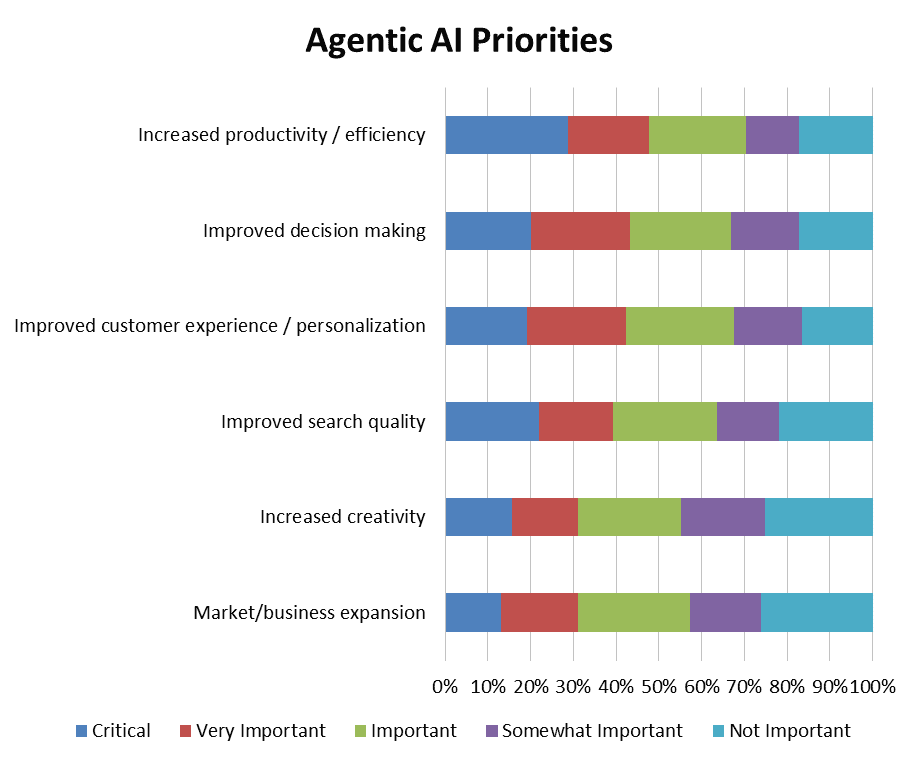
The survey results reveal a broad consensus on the relevance of agentic AI across the enterprise. Business leaders view its potential as equally notable for productivity gains, improved decision-making, and enhanced customer experiences. When ranking specific benefits, improving customer experience and personalization emerged as the top priority, closely followed by sharper decision-making and increased efficiency.
Notably, market and business expansion ranked lower on the list of priorities. This indicates that organizations currently anticipate applying agentic AI primarily to optimize and extend their current capabilities, rather than as a springboard for disruptive growth.The emphasis is on “elevating what they already do,” rather than complete reinvention.
A visual portrayal of these priorities is available from Dresner Advisory services (Source: Dresner Advisory Services).
Experts predict agentic AI represents a fundamental shift in enterprise software, comparable to the impact of client-server architecture, the internet, and cloud computing. the technology is expected to be a key differentiator, determining which vendors and enterprises can adapt quickly enough to thrive in the evolving landscape.
“Agentic AI is not simply the next technology wave — it is indeed the next great inflection point for enterprise software,” the report concludes. Organizations that prioritize data as a strategic asset, modernize their platforms, and integrate intelligence into their workflows are positioned to gain a significant competitive advantage. Those who fail to adapt risk falling behind, echoing the fate of companies that failed to embrace previous technological revolutions.
