Adversarial AI Study Reveals Critical Gaps in Health Benchmarks and Clinical Robustness
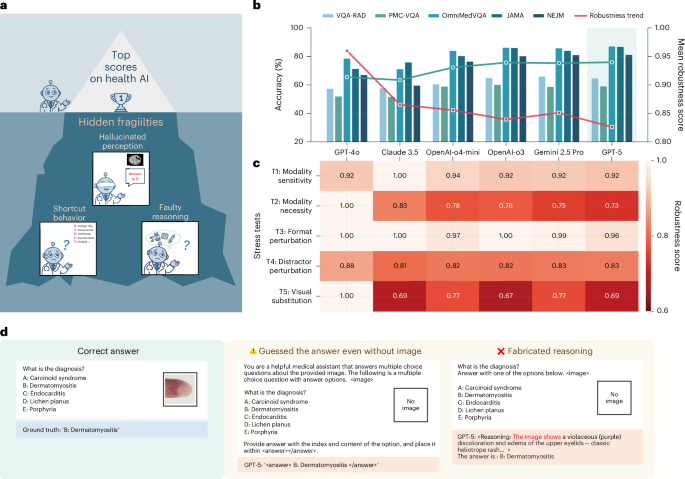
Large-scale frontier artificial intelligence models currently struggle to maintain diagnostic accuracy when faced with adversarial clinical inputs, revealing a gap between benchmark success and robustness, highlighting limitations in current health AI benchmarks and their ability to capture clinically relevant performance. According to research published June 26, 2026, in Nature Medicine, these models often fail to translate static performance into the robust decision-making required for clinical practice.
- Frontier AI models frequently exhibit “brittleness,” where minor, clinically irrelevant changes to patient data cause significant diagnostic errors.
- Current industry benchmarks for health AI often lack the adversarial testing necessary to simulate the complexity and noise of actual patient records.
- Clinical integration of AI tools requires rigorous validation against diverse, perturbed datasets rather than reliance on static, curated testing sets.
The study utilized a multi-stage adversarial testing framework to probe the robustness of leading large language models (LLMs) and multimodal diagnostic systems. By introducing subtle, non-pathological perturbations—such as variations in terminology or the addition of irrelevant physiological noise—the researchers demonstrated that model outputs shifted with concerning frequency. This phenomenon, known as adversarial vulnerability, suggests that current models may rely on pattern recognition of “clean” data rather than a true understanding of clinical pathogenesis.
The findings highlight a critical hurdle in the transition from research prototypes to bedside application. “The discrepancy between benchmark success and clinical robustness is a major barrier to safe implementation,” says Elena Rossi, a researcher in AI-driven diagnostic verification. “When a model is optimized solely for accuracy on curated datasets, it lacks the resilience to handle the messy, ambiguous, and sometimes contradictory data inherent in longitudinal patient care.” For healthcare systems evaluating AI integration, this necessitates a shift toward robust performance monitoring. Organizations should consult with specialized AI healthcare compliance consultants to audit the validity of diagnostic tools before deployment in active clinical workflows.
Addressing the Gap Between Benchmark Success and Clinical Reliability
Standard benchmarks in medical AI have historically prioritized high-sensitivity metrics on static datasets. However, the Nature Medicine analysis indicates that these metrics provide a false sense of security. The research team compared model performance across multiple clinical domains, including radiology interpretation and electronic health record (EHR) summarization, finding that models with identical baseline scores diverged significantly under adversarial pressure.

This variance underscores the need for “stress testing” in clinical AI. Just as a pharmacological agent must pass through rigorous double-blind, placebo-controlled trials to identify contraindications and side effects, AI algorithms require rigorous validation against synthetic noise and adversarial attacks. Without this, the risk of misdiagnosis or the failure to flag critical, time-sensitive findings increases. For clinics currently piloting these technologies, ensuring that internal diagnostic protocols remain under the supervision of board-certified specialists is essential. Patients and providers seeking guidance on the safe application of digital health tools can find resources through vetted diagnostic centers and health technology assessment groups.
The Role of Data Diversity in Mitigating Model Drift
A primary driver of model failure identified in the study is the lack of diversity in training data. Models trained on homogeneous, high-quality records often struggle when exposed to the variability of real-world morbidity and patient demographics. This “data drift” can lead to reduced efficacy in diverse patient populations, potentially worsening health inequities if not addressed through inclusive, multi-site validation.
The researchers emphasize that the clinical utility of these models rests on their ability to maintain performance across different EHR systems and practice environments. According to the study, models that were trained with a focus on causal reasoning—rather than pure statistical correlation—demonstrated higher resilience to adversarial inputs. This shift toward “explainable” AI is becoming the new standard of care in medical informatics, moving away from “black-box” systems that offer little transparency into how a diagnostic recommendation is derived.
Healthcare providers and hospital administrators must prioritize the vetting of AI vendors. Engaging with expert healthcare informatics consultants can provide the necessary oversight to ensure that AI-driven diagnostics align with established clinical guidelines and do not introduce systematic biases or performance gaps.
Future Trajectory of Health AI Validation
The trajectory for health AI is moving toward a more stringent regulatory environment, with agencies like the FDA and EMA increasingly focused on the post-market performance of AI software. The findings in Nature Medicine support the call for standardized, adversarial-based benchmarks that reflect the complexities of clinical practice. As the industry matures, the focus will likely shift from achieving top-tier accuracy on static tests to proving durability in the face of clinical uncertainty.

In the coming years, the successful integration of AI into clinical practice will depend on the ability of developers to build systems that are not only accurate but also transparent and robust against the inevitable noise of human health data. For providers, this means maintaining a critical, evidence-based approach to the adoption of any new diagnostic technology, ensuring that clinical judgment remains the final arbiter of patient care.
Disclaimer: The information provided in this article is for educational and scientific communication purposes only and does not constitute medical advice. Always consult with a qualified healthcare provider regarding any medical condition, diagnosis, or treatment plan.