
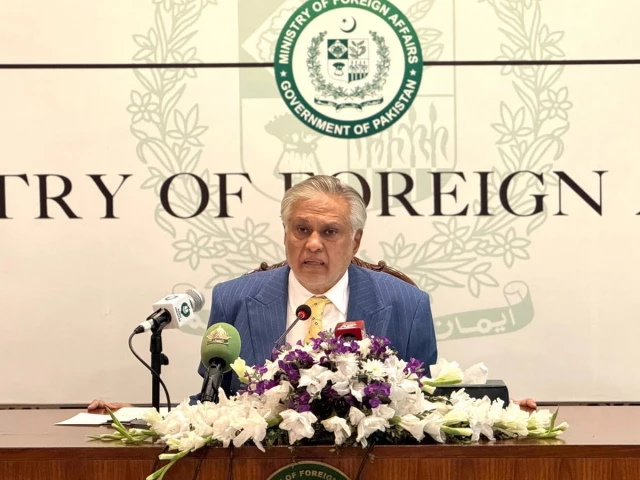
Pakistan’s Foreign Minister Ishaq Dar on Monday briefed heads of diplomatic missions in Islamabad on escalating regional tensions following the death of Iran’s Supreme Leader Ayatollah Ali Khamenei, and reiterated Pakistan’s commitment to de-escalation through diplomatic efforts. Dar also addressed concerns regarding recent developments in Afghanistan and the broader Middle East, emphasizing the need for restraint and adherence to international law.
Dar informed the ambassadors that Pakistan was closely monitoring the situation in Iran, describing it as “extremely delicate,” and engaging with regional partners to reduce tensions. He expressed alarm over what he characterized as violations of international norms, specifically the targeting of state leadership. “We are concerned over the violation of the norms and international law and the age-aged tradition that the heads of state and the government should have been seen targeted now,” Dar said, according to a statement released by the Ministry of Foreign Affairs.
The Foreign Minister disclosed a recent conversation with Iran’s Foreign Minister Abbas Araqchi on February 28, during which he conveyed Pakistan’s condemnation of attacks and called for restraint, diplomacy, and dialogue. While Araqchi reportedly responded positively, Dar noted that the situation on the ground remained unsettled.
Dar also addressed the retaliatory strikes conducted by Iran, acknowledging they were undertaken in self-defense, but simultaneously condemned strikes targeting Gulf countries, including Saudi Arabia, Bahrain, Jordan, Kuwait, Qatar, UAE, and Oman. He cautioned against double standards in responding to regional developments, referencing discussions with Saudi Arabian officials following the attacks.
Turning to Afghanistan, Dar reiterated Pakistan’s position that Afghan territory should not be used against Pakistan, citing a “serious violation” that occurred in October. He confirmed that Pakistan possesses evidence of terrorism originating from Afghan soil, and that mediation efforts, including those led by Qatar and through Istanbul talks, had failed to yield results. This led to the launch of Operation Ghazab Lil Haq against the Tehreek-e-Taliban Pakistan (TTP) and other terrorist elements, resulting in the destruction of terrorist hideouts and camps, according to Dar. He emphasized that operations were conducted with caution to avoid targeting civilian populations.
Dar stated that 37 locations in Kabul, Nangarhar, Paktika and other areas were targeted based on verified intelligence, and that attacks on 53 locations across 15 sectors in border areas were unacceptable. He affirmed Pakistan’s right to capture appropriate measures in self-defense, stating, “Afghanistan has become a haven for terrorists, and we targeted terrorist infrastructure in Afghanistan.”
In separate meetings on Monday, Dar engaged with Bahrain’s Foreign Minister Dr. Abdullatif bin Rashid Alzayani and China’s Ambassador to Pakistan, Jiang Zaidong, to discuss the evolving regional situation. With Alzayani, Dar stressed the need for diplomatic efforts to ease tensions and promote stability. With Ambassador Zaidong, he emphasized the importance of dialogue, diplomacy, and continued consultations, reaffirming Pakistan’s commitment to peace and stability.
Dar also highlighted Pakistan’s role in promoting peace in the Middle East, particularly in Gaza, and its participation in the inaugural meeting of the Gaza Peace Board. He confirmed that one Pakistani national was killed in an attack in the United Arab Emirates. He also referenced three visits to Afghanistan last year, during which discussions were held on economic cooperation, trade, and connectivity, including a rail project and 4,500 scholarships for Afghan students.
