
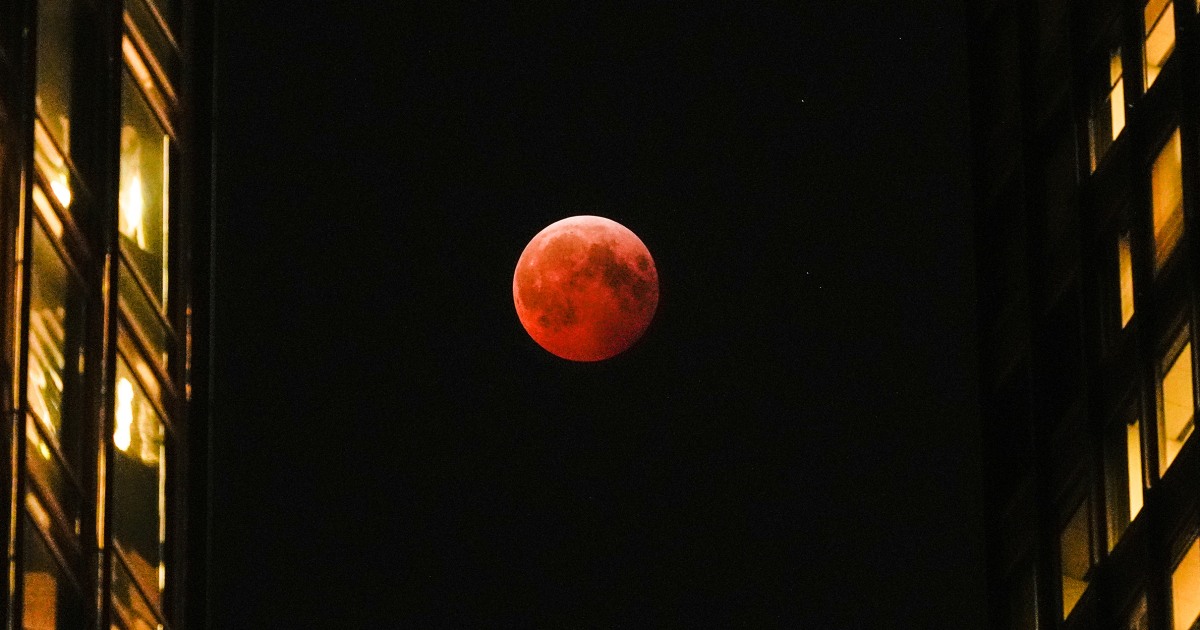
A total lunar eclipse will occur Tuesday morning, visible from North America, Central America, and the western part of South America, offering a celestial spectacle that won’t be repeated until late 2028. Observers in Australia and eastern Asia will be able to view the eclipse Tuesday night.
The eclipse will be partially visible from Central Asia and much of South America, with Earth’s shadow taking little bites out of the moon. Africa and Europe will not have a view of the event.
Lunar and solar eclipses occur due to the precise alignment of the sun, moon, and Earth, with between four and seven eclipses happening each year, according to NASA. The eclipses often occur in succession, taking advantage of the alignment of the celestial bodies’ orbits.
This total lunar eclipse follows a “ring of fire” solar eclipse that occurred two weeks prior, dazzling observers and penguins in Antarctica.
During a total lunar eclipse, the Earth passes between the sun and the full moon, casting a shadow that covers the lunar surface. The moon often appears reddish in color during this event, a phenomenon known as a “blood moon,” caused by sunlight filtering through Earth’s atmosphere.
The eclipse will unfold over several hours, with the period of totality—when the moon is completely within Earth’s shadow—lasting approximately one hour.
“The lunar eclipse is a little more of a relaxed pace,” said Catherine Miller at Middlebury College’s Mittelman Observatory. Unlike a solar eclipse, which requires specialized eye protection and is visible from a limited area, a lunar eclipse is safe to view with the naked eye and is visible from anywhere on the night side of Earth.
Observers do not need any special equipment to view the eclipse, only a clear, cloudless view of the sky. Astronomers recommend using a forecasting app or online celestial calendar to determine the exact timing of the eclipse for their location.
“You don’t have to be out there the whole time to see the shadows moving,” said astronomer Bennett Maruca with the University of Delaware. “Venture outside a few times to see Earth’s shadow darken the moon, eventually revealing the reddish-orange orb.”
A partial lunar eclipse is scheduled for August, which will be visible across the Americas, Europe, Africa, and west Asia. The next total lunar eclipse will not occur until December 31, 2028, and will be visible from Europe, Asia, Australia, Africa, and parts of North America, according to data from timeanddate.com. That eclipse is expected to have an umbral magnitude of 1.2479, and totality will last 71 minutes and 20 seconds.
