
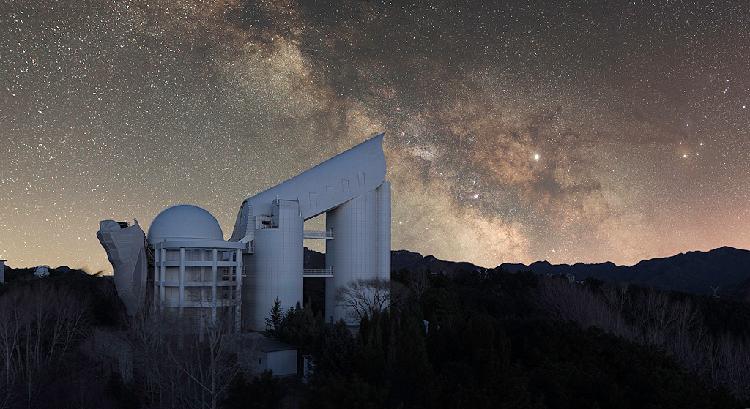
Beijing – Chinese researchers have unveiled a new artificial intelligence model, SpecCLIP, designed to standardize and integrate stellar spectral data collected by disparate telescopes, a development poised to accelerate research into the Milky Way’s formation and evolution. The model was jointly created by teams from the National Astronomical Observatories of the Chinese Academy of Sciences and the University of Chinese Academy of Sciences, with findings published in the Astrophysical Journal.
The challenge SpecCLIP addresses stems from the varying methodologies, resolutions, and wavelength ranges employed by different telescopes. Projects like China’s Large Sky Area Multi-Object Fiber Spectroscopic Telescope (LAMOST) and the European Space Agency’s Gaia satellite, while both generating vast amounts of stellar data, operate under fundamentally different parameters. This incompatibility has historically hindered comprehensive, cross-mission analysis.
According to reports from Science and Technology Daily, SpecCLIP functions as an “AI translator,” converting mismatched spectral data into a universally interpretable format. This allows astronomers to reliably compare and study data from LAMOST, which provides lower-resolution spectra, and Gaia, known for its high-precision measurements. The ability to unify these datasets is expected to significantly improve large-scale research efforts.
The AI model’s potential extends beyond simply reconciling existing data. Researchers suggest SpecCLIP will aid in the identification of metal-poor ancient stars, offering insights into the early stages of galactic development. It also holds promise for streamlining the search for exoplanets by providing a more consistent framework for analyzing stellar characteristics.
“Chinese astronomers just dropped SpecCLIP, an AI ‘translator’ that unifies stellar spectra from LAMOST (low-res) and Gaia (high-precision)!” a post on social media highlighted, underscoring the model’s immediate impact within the astronomical community.
The development of SpecCLIP represents a significant step towards overcoming long-standing data challenges in astronomy, enabling a more holistic understanding of the Milky Way and the universe beyond. Further research is planned to expand the model’s capabilities to incorporate data from additional telescopes and surveys.
