
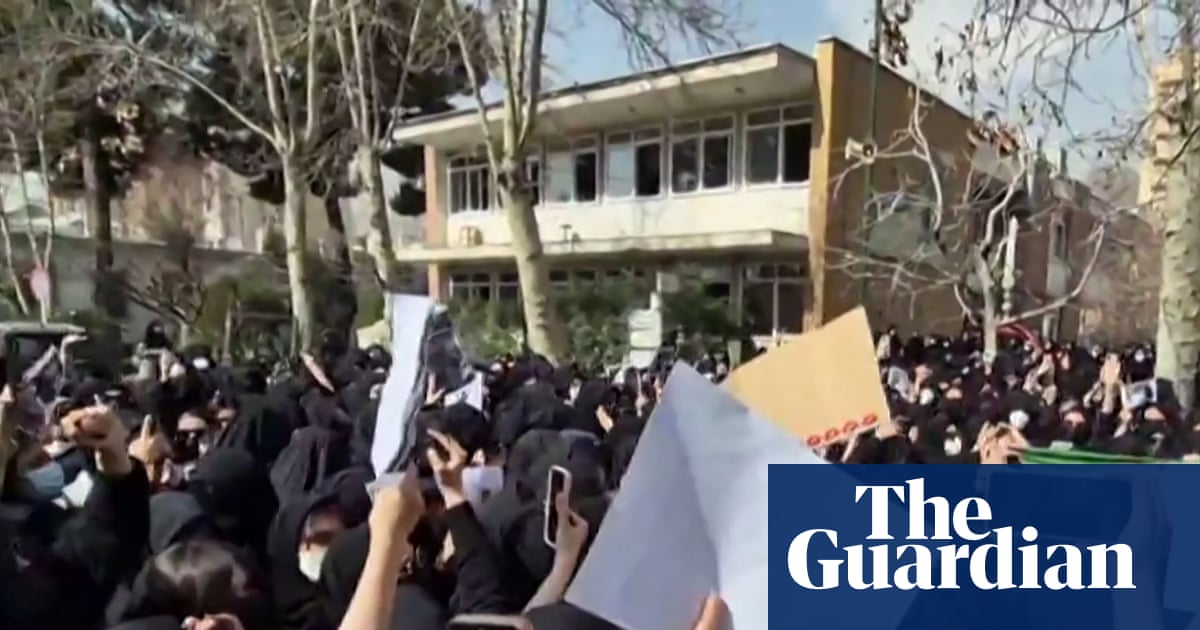
Armed police have deployed to universities across Iran, attempting to suppress a fourth day of student-led protests against the government and Supreme Leader Ali Khamenei, according to reports from multiple news outlets.
Running battles between students and the Basij, a state-backed militia, were reported at the University of Science and Technology in Tehran, with videos circulating online showing physical confrontations. Photographs likewise emerged of pick-up trucks equipped with machine guns stationed outside the University of Tehran, and demonstrations were confirmed in the city of Mashhad.
Authorities have responded to the protests by barring students identified as having participated in previous demonstrations from entering university grounds. Several universities have also announced the suspension of in-person classes. The move comes as nearly 80% of Iranian universities have already transitioned to virtual learning, a measure widely believed to be aimed at preventing student gatherings and further protests.
Protesters have voiced increasingly direct criticism of the Iranian leadership. Videos from the University of Art in Tehran captured chants including “We fight, we die, we take back Iran,” “Political prisoners must be freed,” and a particularly defiant slogan directed at Khamenei, referring to him as “Zahhak [serpent king], we’ll bury you alive.” Reports also indicate protesters have made personal attacks against the Basij and the Supreme Leader.
The protests are unfolding as indirect negotiations between Iran and the United States regarding Iran’s nuclear program are scheduled to resume in Geneva on Thursday. The talks will be led by Iranian Foreign Minister Abbas Araghchi and U.S. Special Envoy Steve Witkoff, with Oman serving as mediator.
Mohammad Mohebi Azad, Iran’s attorney general, issued a statement on Tuesday demanding swift action against the protesters. “The responsible agencies must quickly identify the related elements and take decisive and legal action against them,” he said, adding that the protests were being instigated by enemies attempting to disrupt negotiations.
The timing of the protests also coincides with a significant U.S. Military buildup in the region. President Donald Trump has repeatedly stated his willingness to consider military action against Iran, despite reported advice from the chair of the Joint Chiefs of Staff, Dan Caine, that a military strike would be inadvisable due to a lack of regional support and sufficient munitions. Trump has publicly dismissed these concerns, stating on social media that a failure to reach a deal with Iran would have “a remarkably bad day for that country and unfortunately for its people.”
Ali Hashem, an associate research fellow at the Center for Islamic and West Asian Studies, Royal Holloway College, noted a shift in Khamenei’s rhetoric, moving away from “tactical restraint” towards language invoking “confrontation through the lens of Karbala,” referencing the pivotal Shia narrative of Imam Hussein’s martyrdom. Hashem suggested this shift signals a rejection of compromise and a willingness to resist perceived existential threats.
The human rights organization HRANA this week released a report, “Red Winter,” detailing the identities of over 7,000 individuals confirmed to have died during the January protests. This figure differs from the Iranian president’s office, which has identified 2,986 deaths and stated a total of 3,117 fatalities, attributing the discrepancy to inconsistencies in identification records.
