
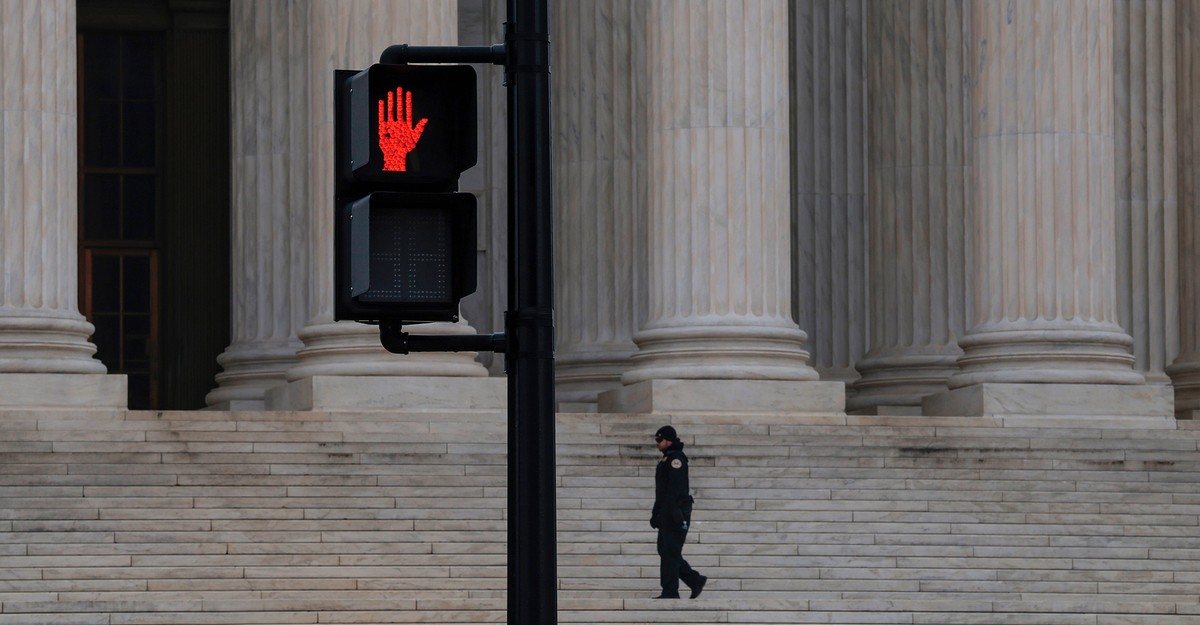
The Supreme Court on Friday struck down a core set of tariffs imposed by President Donald Trump, a decision that could force the administration to refund up to $142 billion in collected revenue. The ruling centers on Trump’s apply of the 1977 International Emergency Economic Powers Act (IEEPA) to justify the tariffs, a practice the court deemed unlawful.
The case, Learning Resources, Inc. V. Trump, challenged the president’s authority to impose tariffs through executive order without congressional approval. Trump had invoked IEEPA, typically used for sanctions, to impose tariffs on goods from countries including China, Canada, and Mexico, citing national security concerns related to fentanyl smuggling and illegal immigration. The tariffs, initially announced in April 2025 under the banner of “Liberation Day,” were intended to pressure those nations into accepting higher tariffs on their goods, according to administration officials at the time.
Writing for the majority, Chief Justice John Roberts stated that Congress had not effectively delegated its constitutional power to regulate tariffs to the president through IEEPA. “Based on two words separated by 16 others in Section 1702(a)(1)(B) of IEEPA—‘regulate’ and ‘importation’—the President asserts the independent power to impose tariffs on imports from any country, of any product, at any rate, for any amount of time. Those words cannot bear such weight,” Roberts wrote. The decision was joined by Justices Amy Coney Barrett and Neil Gorsuch, along with the three liberal justices.
The ruling is a significant political setback for the Trump administration. In a hastily called news conference following the announcement, Trump attacked the justices who ruled against him, calling them “very unpatriotic and disloyal to our Constitution.” He also predicted dire consequences, stating, “WE’RE SCREWED!” if the court ruled against him, a prediction made last month on his Truth Social platform.
The Supreme Court’s internal deliberations on the case were fractured, with seven justices filing separate opinions totaling 170 pages. The disagreement largely revolved around the application of the “major questions” doctrine – a legal standard favored by conservative jurists that requires clear congressional authorization for presidential actions with significant economic and political implications. While some conservative justices had previously used the doctrine to strike down Democratic initiatives, they were more hesitant to apply it in this instance.
Justice Gorsuch criticized both sides of the debate, accusing the conservative dissenters of “grade inflation” and the liberal justices of “all but endorse[ing]” a theory they had previously denounced. Justices Brett Kavanaugh, Clarence Thomas, and Samuel Alito dissented, expressing sympathy for the major questions argument.
Despite the ruling, the administration has indicated it will pursue alternative legal avenues to reimpose tariffs. Jamieson Greer, Trump’s top trade official, stated that contingency plans would “start the next day.” The president can still impose tariffs based on national security concerns or unfair trade practices, as determined through investigations. A 9.1 percent effective tariff on imported goods will remain in effect, even after the IEEPA-based tariffs are voided.
Trump also announced Friday that he would invoke Section 122 of the Trade Act of 1974, allowing him to impose a 10 percent duty to address trade deficits. He also alluded to the potential use of Section 338 of the Tariff Act of 1930, which permits duties of up to 50 percent on countries discriminating against American goods. Kathleen Claussen, a law professor at Georgetown University, noted that the situation has evolved from “a relatively simple universe to a much more complicated one.”
The litigation surrounding refunds for the tariffs already collected is expected to be lengthy and complex. The long-term impact on trade deals negotiated under the threat of the now-invalidated tariffs remains uncertain.
