
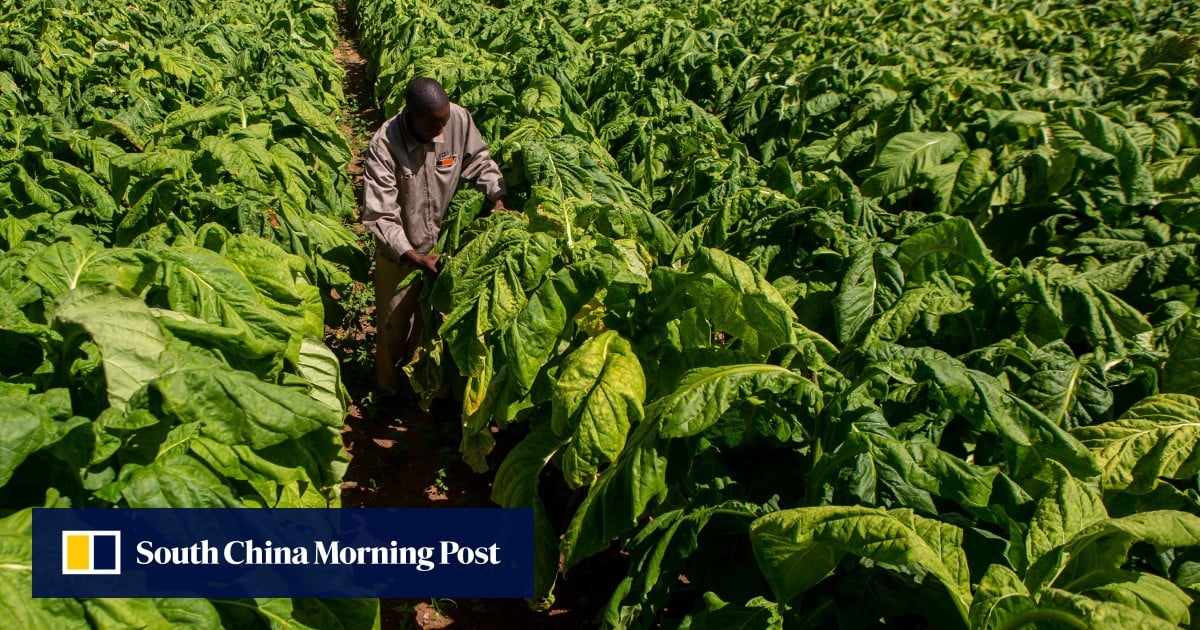
Zimbabwe’s tobacco farmers earned a record $1.2 billion from the 2025 marketing season, selling 352.7 million kilograms of the crop, according to figures released this week by the Tobacco Industry & Marketing Board (TIMB).
The substantial earnings mark a dramatic turnaround for an industry that faced near collapse in the early 2000s following land reforms under former President Robert Mugabe and subsequent Western sanctions. Production plummeted from 260 million kilograms in 1998 to a low of 48 million kilograms in 2008, threatening the livelihoods of thousands of farmers and crippling a key source of foreign exchange.
China’s growing demand for tobacco has been central to the industry’s revival. Last year, China imported $790 million worth of Zimbabwean tobacco, representing 31 percent of Zimbabwe’s total exports to Beijing, according to the Chinese embassy in Harare. This demand has spurred significant investment in the sector, particularly from Chinese firms.
Tian Ze Tobacco Company (TZTC), a subsidiary of China National Tobacco Corporation, has played a pivotal role in the resurgence. Gorden Moyo, director of the Public Policy and Research Institute of Zimbabwe (PPRIZ), explained that TZTC provided crucial financial support to contract farmers through low-interest loans, inputs at zero mark-up, and technical assistance. “It provided financial support through low-interest loans, zero mark-up on inputs and technical assistance to scores of contract farmers,” Moyo, a former minister of state enterprises, said.
A 2005 memorandum of understanding between Zimbabwe and China National Tobacco Corporation paved the way for Tian Ze’s involvement. As Western financing became scarce, China stepped in to secure tobacco supplies for its domestic market although simultaneously offering a lifeline to Zimbabwean farmers.
The 2025 season’s output surpassed the 300 million kg target, with approximately 11% of the total production sold to China, according to TIMB data. Local banks and concessional facilities, alongside the Tian Ze model of cooperation, have bolstered confidence within the sector and supported both smallholder and contract farmers, according to local reports.
Despite the economic benefits, concerns remain regarding Zimbabwe’s debt obligations to foreign lenders, including China. Some analysts have cautioned that over-reliance on a single major buyer creates economic vulnerability. The government has indicated that diversification efforts are underway, but the extent of these initiatives remains unclear.
Looking ahead, Zimbabwe aims to increase tobacco production to 360 million kilograms in the next growing season.
