
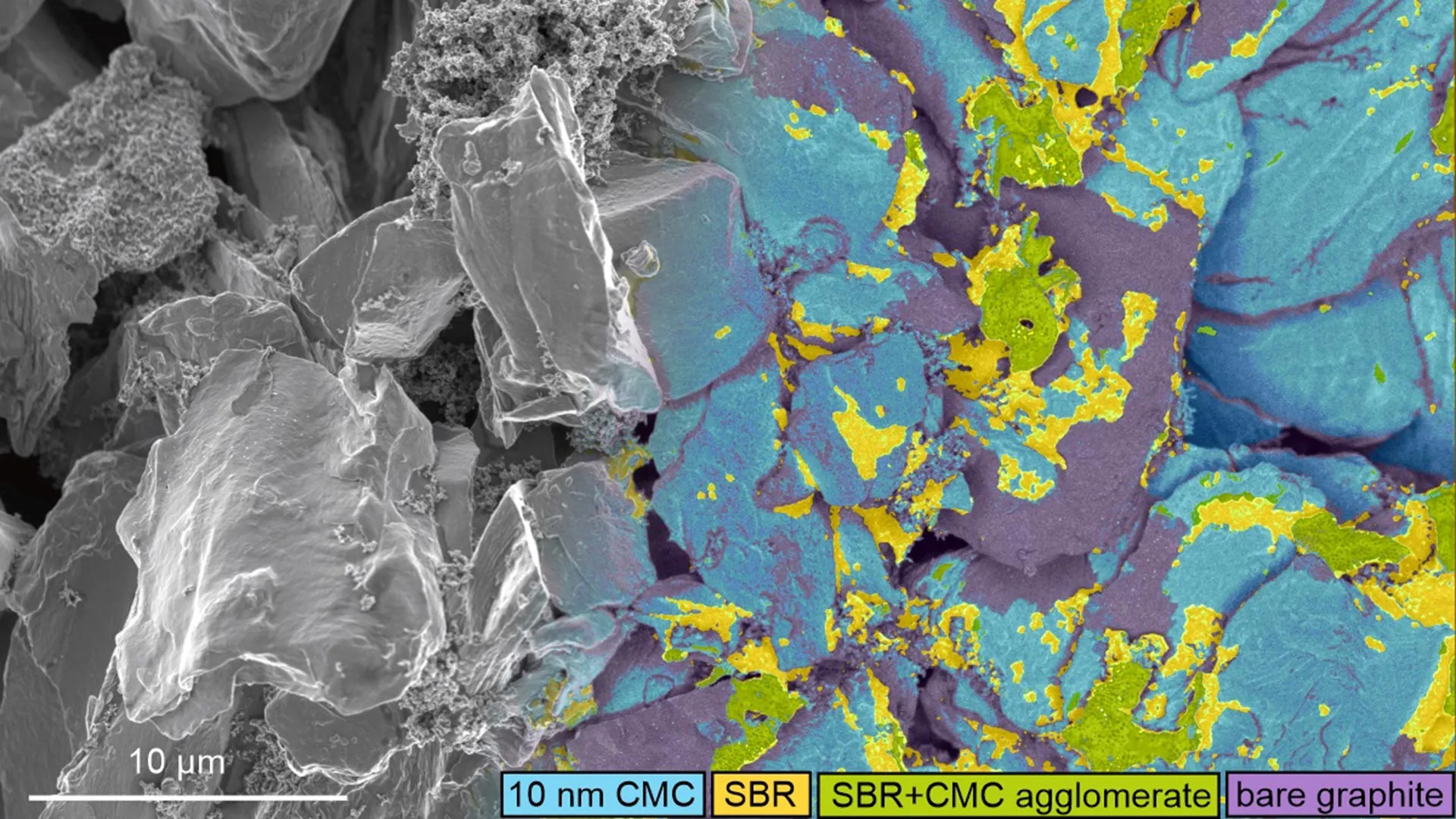
A new imaging technique developed at the University of Oxford is providing unprecedented visibility into the internal structure of lithium-ion batteries, potentially paving the way for faster charging times and extended battery life. The breakthrough, detailed in a paper published February 17 in Nature Communications, focuses on visualizing the polymer binders that hold together the active materials in battery electrodes.
These binders, though comprising less than 5% of an electrode’s weight, play a crucial role in the battery’s mechanical integrity, electrical and ionic conductivity, and overall durability. Historically, their small quantity and lack of distinct visual characteristics have made it difficult for scientists to understand their distribution within the electrode – a key factor influencing battery performance.
The Oxford team, led by Dr. Stanislaw Zankowski of the Department of Materials, has created a patent-pending staining process that labels these binders with silver and bromine markers. These markers allow researchers to detect the binders using energy-dispersive X-ray spectroscopy and energy-selective backscattered electron imaging, revealing their location with high precision when viewed under an electron microscope. The technique is applicable to both conventional graphite electrodes and more advanced materials like silicon or SiOx, according to the research.
“This staining technique opens up an entirely new toolbox for understanding how modern binders behave during electrode manufacturing,” said Dr. Zankowski. “For the first time, we can accurately notice the distribution of these binders not only generally, but also locally, as nanoscale binder layers and clusters, and correlate them with anode performance.”
Initial applications of the imaging tool have already yielded significant insights. Researchers discovered that even minor variations in binder distribution can substantially impact charging efficiency and battery lifespan. Adjustments to slurry mixing and drying processes, guided by the new imaging data, resulted in a 40% reduction in the internal ionic resistance of experimental electrodes – a major impediment to rapid charging.
The technique also enabled detailed visualization of carboxymethyl cellulose (CMC) binder layers coating graphite particles. The team was able to detect CMC layers as thin as 10 nanometers and observe structures across four orders of magnitude within a single image. These images revealed that the initially uniform CMC coating can fragment into uneven patches during electrode processing, potentially compromising battery performance and stability.
Professor Patrick Grant, also of the Department of Materials at Oxford, emphasized the multidisciplinary nature of the research. “This effort – spanning chemistry, electron microscopy, electrochemical testing, and modelling – has resulted in an innovative imaging approach that will help us to understand key surface processes that affect battery longevity and performance. This will drive forward advancements across a wide range of battery applications,” he stated.
The research was supported by the Faraday Institution’s Nextrode project and has already attracted considerable interest from industry, including major battery producers and electric vehicle manufacturers, according to the University. The findings, published alongside a separate article in Nature Communications on February 17 detailing advances in lithium-ion battery negative electrodes, represent a significant step forward in battery technology.
