
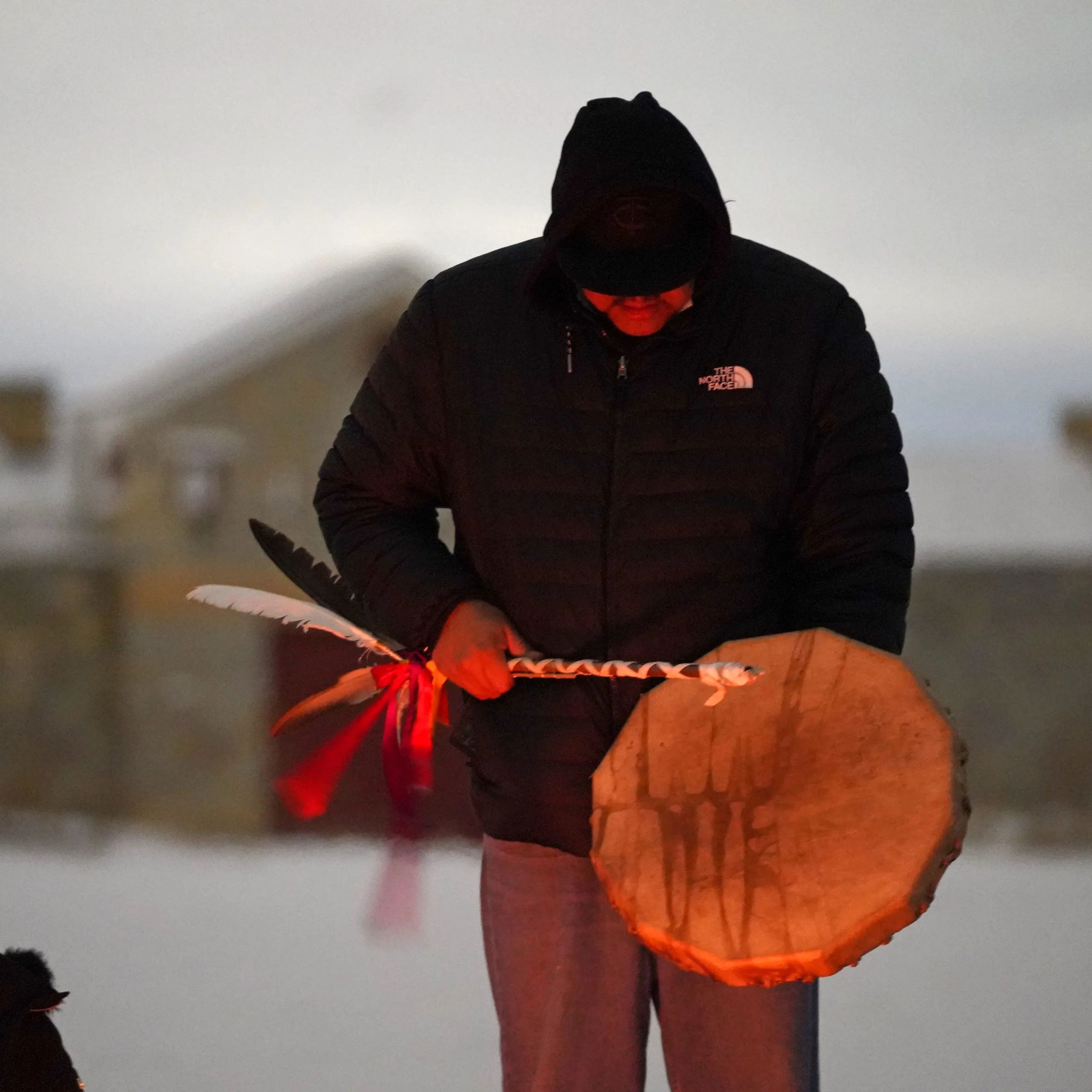
Fort Snelling, Minnesota – A prayer camp established last week near the site of a former internment camp for Dakota people is drawing attention to the layered history of Fort Snelling, a location now encompassing federal immigration enforcement facilities. The camp, erected by Native activists, sits across from the Bishop Henry Whipple Federal Building, a key processing center for immigration detainment, but its origins stretch back to a period of forced displacement and imprisonment of Indigenous people.
The United States military utilized Fort Snelling as a site of confinement during the Dakota Indian Wars of 1862, holding thousands of Dakota and Ho-Chunk individuals in harsh conditions. Migizi Spears, a Red Lake Nation citizen and organizer with First Nations United, was among those who initiated the camp, alongside members of the Dakota and Nakota nations and other tribal citizens. They erected four teepees at Bdóte, a location considered sacred by the Dakota as a creation site, situated at the confluence of the Mississippi and Minnesota Rivers and within earshot of the Whipple Building.
Spears explained the action as a reclamation of land lost by his ancestors following the Dakota War of 1862, a conflict that culminated in the largest mass execution in U.S. History, with 38 Dakota men hanged. Fort Snelling – Wikipedia
“We are getting the land back for our Dakota people who were exiled out,” Spears said. “Now they’re imprisoning brown people and other Indigenous people in there. Now they’re removing them too. History is repeating itself.”
The camp has quickly attracted support from Native and non-Native activists, who have contributed yurts, firewood, food, and other necessities. Media coverage has included reports from CBS News Minnesota and Unicorn Riot, alongside increased visibility on social media platforms.
Today, the area encompassing the historic Fort Snelling includes the Minneapolis-Saint Paul International Airport, Fort Snelling State Park, and several federal buildings, including the Whipple Building. The Historic Fort Snelling complex itself is owned by the state of Minnesota and is less than a mile from the Whipple Building. Historic Fort Snelling | Minnesota Historical Society
Wasuduta, a Dakota community member, emphasized that the continued apply of the former Fort Snelling site as a federal detention center underscores what he views as the federal government’s ongoing efforts to infringe upon the rights of both Native people and Hispanic immigrants.
He expressed hope that the effort to reclaim land and advocate for Indigenous rights will gain broader support from Indigenous communities, allies, and tribes, ultimately leading to the return of land to Native people.
While the Trump administration reportedly reduced the number of federal immigration agents stationed in Minneapolis, Wasuduta stated that the prayer camp will remain in place. “It’s time to hold them accountable with diplomacy,” he said. “We’re not here to be hostile or trigger them.”
The site of Fort Snelling holds a complex history, dating back millennia as Dakota homeland, known as Bdóte. Historic Fort Snelling | Minnesota Historical Society The fort’s construction began in 1819, initially named Fort Saint Anthony before being renamed Fort Snelling in 1825. Before the Civil War, the U.S. Army permitted soldiers to bring enslaved people to the fort, including Dred and Harriet Robinson Scott, whose legal battle for freedom ultimately led to the landmark Dred Scott v. Sandford Supreme Court case. Fort Snelling – Wikipedia Slavery was abolished at the fort shortly before Minnesota achieved statehood in 1858.
