
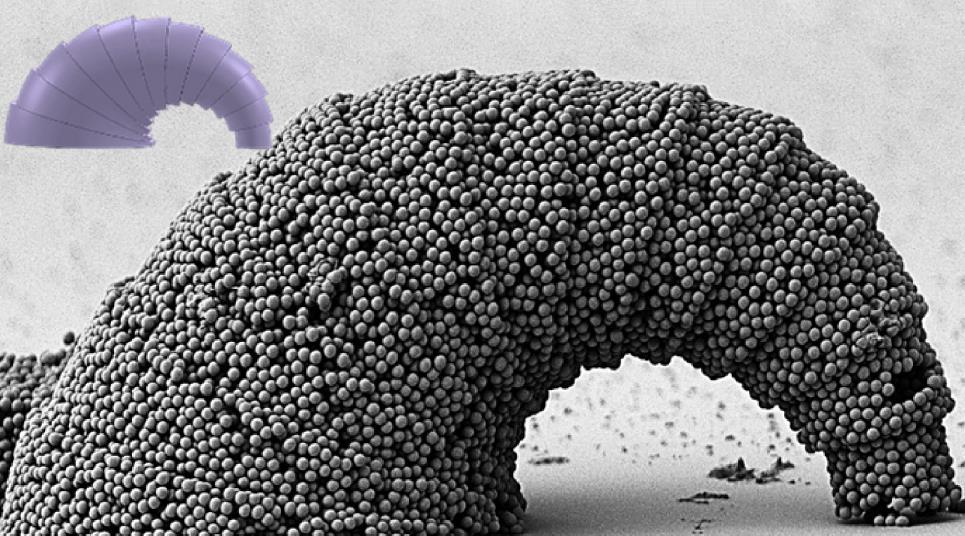
Researchers have developed a new method for 3D microfabrication and nanofabrication that overcomes longstanding material limitations, allowing for the creation of complex structures from a wide range of materials including metals, metal oxides, carbon nanomaterials, and quantum dots. The technique, detailed in a recent publication in Nature, combines two-photon polymerization (2PP) nanoprinting with laser-driven optofluidic assembly.
Traditionally, 3D printing at the micro and nanoscale has been largely restricted to specialized polymers using 2PP, a high-resolution technique. While self-assembly methods can work with a broader range of materials, they often struggle with precise shaping and consistent results. The new approach, led by Mingchao Zhang at the National University of Singapore and an international team, addresses these challenges by separating the processes of geometric definition and material composition.
The process begins with the creation of a hollow 3D template using 2PP. This template is then submerged in a suspension of nanoparticles. A femtosecond laser is focused on an opening in the template, generating a localized thermal gradient. This gradient induces a flow of fluid – an optofluidic effect – that draws the nanoparticles into the template, where they assemble into the pre-defined 3D shape. The resulting structure is then freed by removing the polymer template in a post-processing step.
“This decouples geometry from chemistry,” explained Zhang. “Our method is broadly compatible because we are not relying on a specific photochemistry to form the final structure. Instead, the laser creates transport and confinement-driven packing, so the main requirement is that the material can exist as a stable dispersion of particles.”
The team demonstrated the versatility of the technique by fabricating functional microdevices, including microfluidic valves capable of separating particles by size and microrobots integrating four distinct materials for multimodal locomotion. This sequential multi-material fabrication is a key advantage, allowing for the creation of more complex and functional devices. According to Zhang, once a material is densely packed within its template, it becomes stable, allowing for the introduction of different particle suspensions and the assembly of additional materials without disrupting previously placed components.
The innovation has garnered praise from other researchers in the field. Jonathan Fan, an optical engineer at Stanford University, noted that the method “unlocks a different dimension for 3D printing that presents its own route for versatile multi-material manufacturing,” particularly highlighting the potential for nanoporous materials in membrane-based devices. Xiaoxing Xia, a nanofabrication scientist at Lawrence Livermore National Laboratory, lauded the team’s theoretical analysis and experimental validation, stating the proof-of-concept devices were “fascinating and inspiring.”
Researchers are now focused on refining the process and establishing predictive design rules. Zhang’s team is investigating how factors like solvent and surfactant choice influence fabrication speed and stability, and working to develop a more programmable approach. “I want to establish predictive design rules that connect solvent choice, particle interactions, flow conditions and template geometry, so the process becomes programmable rather than empirical,” Zhang said.
