
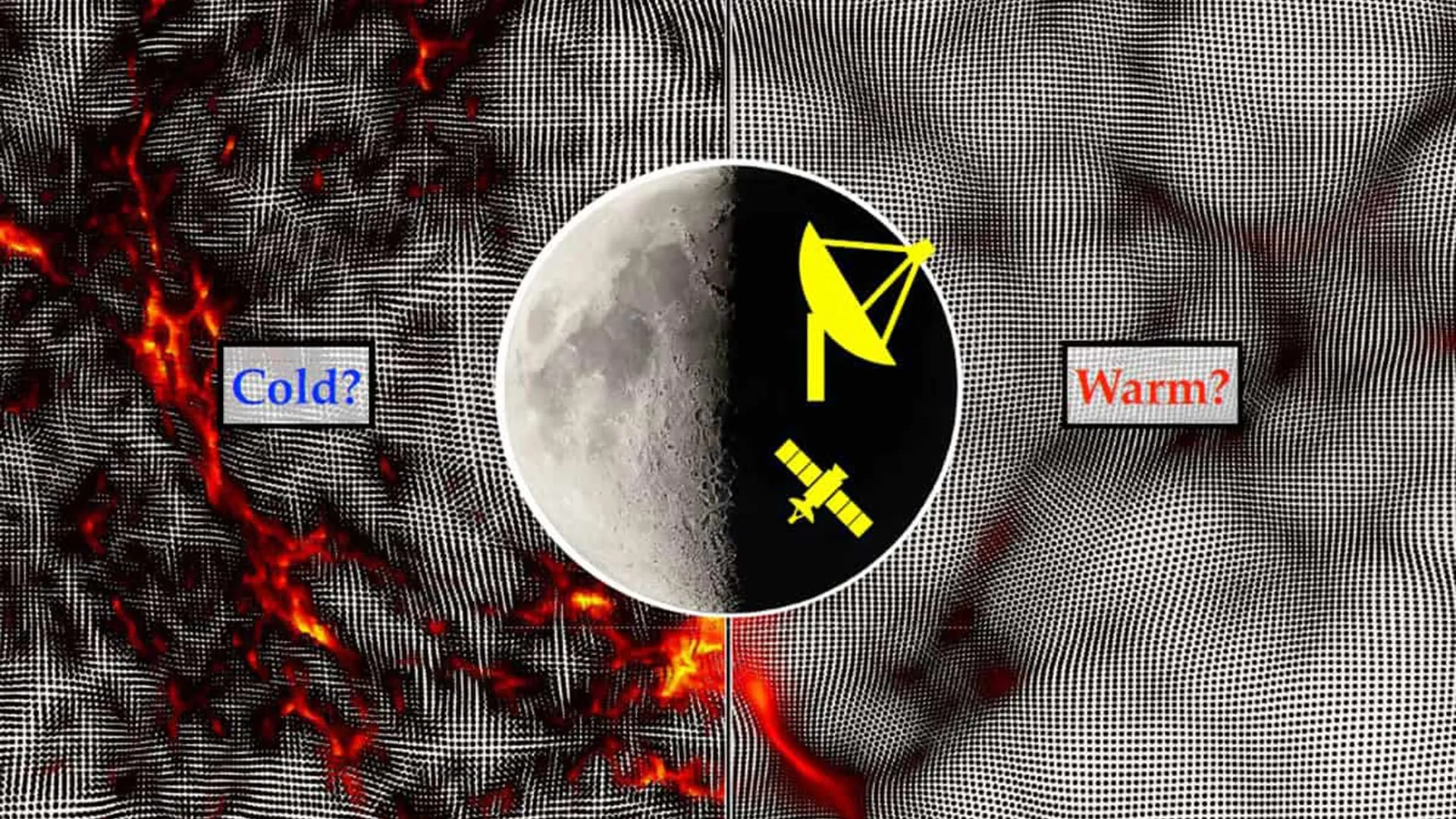
Hunting for the Universe’s First Signals: Why Scientists are Looking to the moon for Cosmic Dawn
For decades, astronomers have sought to unravel the mysteries of “cosmic Dawn” – the period when the very first stars ignited, bathing the universe in light and ending its dark ages. Now, a groundbreaking approach is gaining momentum: placing radio telescopes on the Moon. This isn’t science fiction; several upcoming lunar missions,including Japan’s ambitious Tsukuyomi Project [https://www.isas.jaxa.jp/en/missions/future/tsukuyomi/], are actively planning to make this a reality. The far side of the Moon, shielded from the radio noise of Earth, offers an unparalleled vantage point to detect the faint, ancient radio signals emanating from this pivotal era in cosmic history. Success could revolutionize our understanding of dark matter and the origins of the universe itself.
The Challenge of detecting Cosmic Dawn
The universe didn’t always look as it does today. Following the Big Bang, it entered a period known as the “Dark ages,” a time before stars and galaxies formed, filled only with neutral hydrogen gas.This gas absorbed most visible light, making the universe opaque. Around 150 million to a billion years after the Big Bang, the first stars began to form. These stars emitted ultraviolet and X-ray radiation, which ionized the surrounding hydrogen gas, making the universe clear.This process, known as reionization, marks the end of the Dark Ages and the beginning of Cosmic Dawn.
Detecting the signals from this era is incredibly challenging. The radio waves emitted during reionization are exceptionally faint and are easily drowned out by terrestrial radio interference – signals from cell phones, televisions, satellites, and even our own electronics.This interference creates a “radio fog” that makes it nearly impossible to discern the subtle whispers from the early universe when observing from Earth. [https://www.space.com/moon-radio-telescope-cosmic-dawn-signals]
Why the Moon? A Sanctuary for Radio Astronomy
The far side of the Moon presents a unique solution to this problem. Permanently shielded from Earth, it’s a remarkably quiet radio environment. This isolation offers several key advantages:
* Shielding from Earth-Based interference: The Moon’s bulk physically blocks all radio signals originating from Earth, creating a pristine observing environment.
* A Stable Platform: The lunar surface provides a stable and relatively vibration-free platform for sensitive radio telescopes.
* Large Aperture Potential: The Moon’s vast, relatively flat terrain allows for the construction of extremely large radio telescopes – possibly kilometers in diameter – far exceeding the size limitations of Earth-based instruments. Larger telescopes collect more signal, increasing the chances of detection.
* Low Radio Noise: the Moon itself emits very little radio noise, further enhancing the sensitivity of observations.
How Lunar Telescopes Will Work
Several concepts are being explored for lunar radio telescopes.These include:
* Array of Low-Frequency Antennas: Missions like the Netherlands-China low-Frequency Array (NCLFA) [https://www.nclfa.space/] plan to deploy a vast array of simple antenna elements across the lunar surface. by combining the signals from these antennas, astronomers can synthesize a much larger telescope, effectively creating a giant radio dish.
* Formed Wire Mesh Reflectors: Concepts like the Lunar Outpost Radio Astronomy (LORA) project propose using a lightweight mesh reflector stretched across a large area on the lunar surface. This reflector would focus radio waves onto a central receiver.
* Naturally Formed craters: Some researchers are investigating the possibility of utilizing existing lunar craters as natural reflectors to focus radio signals.
These telescopes will be designed to detect the 21-centimeter radio signal emitted by neutral hydrogen. The subtle variations in this signal, caused by the interaction with the first stars and galaxies, will provide a wealth of information about the conditions of the early universe.
The Connection to Dark Matter
The search for signals from Cosmic Dawn isn’t just about understanding the first stars; it’s also deeply connected to the mystery of dark matter. Dark matter, an invisible substance that makes up approximately 85% of the matter in the universe, played a crucial role in the formation of the first structures.
Here’s how:
* Gravitational Scaffold: Dark matter’s gravity provided the initial scaffolding for the formation of galaxies and stars. Without dark matter, the universe would be far more uniform, and the first stars would have formed much later.
* Early Star Formation: The distribution of dark matter influenced where and when the first stars formed. By studying the patterns in the 21-centimeter signal, astronomers hope to map the distribution of dark matter in the early universe.
* Dark Matter Interactions: some theories suggest that dark matter particles may interact with ordinary matter, potentially affecting the 21-centimeter signal.Detecting these interactions could provide crucial clues
