
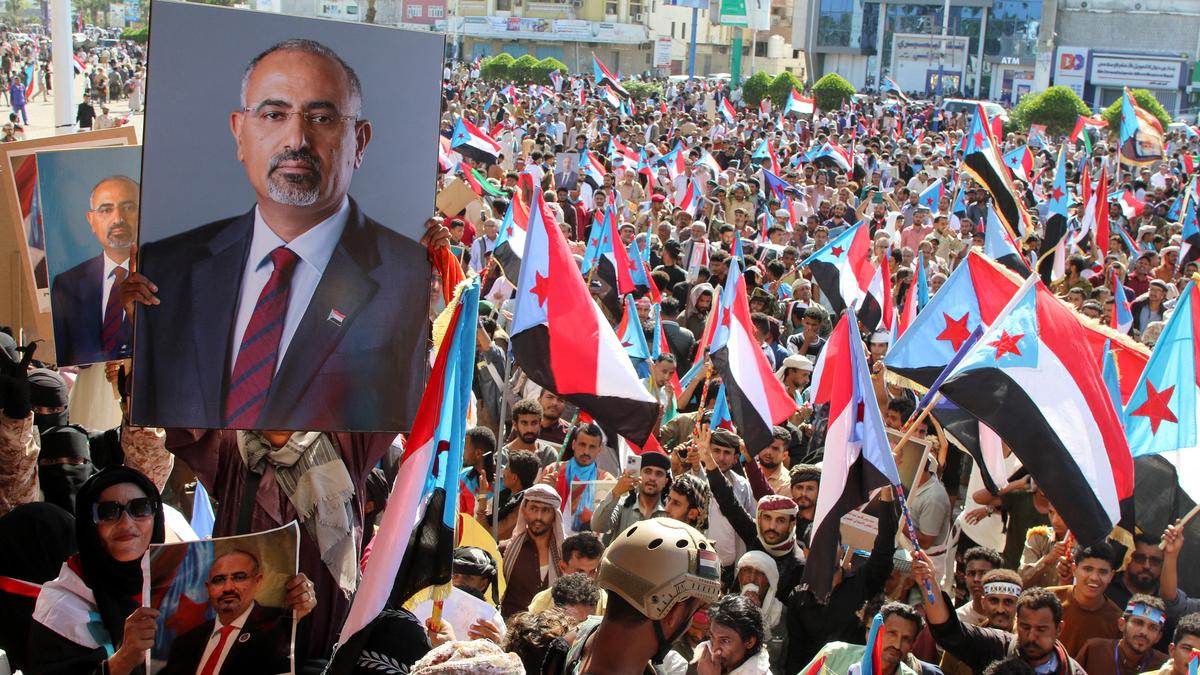
Supporters of the UAE-backed separatist group, the Southern Transitional Council (STC), hold up posters of STC’s leader, Aidarous al-Zubaidi, during a rally in Aden, Yemen, on January 16, 2026.
| Photo Credit: Reuters
Aden, Yemen – In a renewed assertion of separatist ambitions, Aidarous al-Zubaidi, leader of yemen’s Southern Transitional Council (STC), has reaffirmed his commitment to an independent South Yemen.This declaration comes after a period of uncertainty following his group’s brief control of key provinces in December and his subsequent disappearance in early January.The situation highlights the complex geopolitical dynamics within Yemen and the escalating tensions between Saudi Arabia and the United Arab Emirates, both key players in the ongoing conflict.
The Re-emergence of a Separatist Leader
al-Zubaidi’s recent statement, released via social media on January 16, 2026, serves as a direct challenge to efforts towards a unified Yemen. He stated, “We will no longer accept any solutions that diminish our rights or impose an unacceptable reality upon us.” This message directly addresses his supporters and signals a resolve to continue pursuing self-determination for the south,which functioned as an independent state from 1967 to 1990. His reappearance, after a period of speculation about his whereabouts – with Saudi Arabia accusing him of fleeing to Abu Dhabi – aims to consolidate support within the separatist movement.
A History of Southern Separatism
The demand for an independent South Yemen stems from long-held grievances related to political and economic marginalization following the unification of North and South Yemen in 1990. Southern Yemenis often feel excluded from power and resources, fueling a persistent separatist sentiment.The STC, backed by the UAE, has capitalized on thes feelings, gaining considerable influence in the south, notably in Aden and surrounding provinces. The Southern Transitional Council represents a significant force in the region, with a well-organized military and a dedicated base of support.
Geopolitical Tensions and Regional Rivalries
The STC’s actions in December, which saw the capture of two Yemeni provinces, triggered a direct confrontation with Saudi Arabia, which supports the internationally recognized Yemeni government. Saudi-led coalition forces retaliated with airstrikes, pushing back the STC. This conflict exposed the deep rift between Saudi Arabia and the UAE, with each nation backing opposing sides within Yemen’s multifaceted conflict. The UAE’s support for the STC, while reportedly easing in recent months, has been instrumental in bolstering the separatist movement’s capabilities and influence. This proxy struggle further complicates the already fragile situation in Yemen.
Saudi Arabia’s Response and the Purge
Following the STC’s brief takeover and Al-Zubaidi’s disappearance, Saudi Arabia moved to consolidate it’s control over the Yemeni government. This included a purge of UAE-aligned ministers and members of the presidential council, signaling a clear message to Abu Dhabi and its backed factions. Rashad al-Alimi, head of yemen’s Saudi-backed presidential body, declared that all southern factions would operate under Saudi command, effectively attempting to dismantle the STC’s autonomous power structure. This move has drawn criticism from Southern separatists who view it as another attempt to impose control from the North.
Protests and Continued Resistance
Despite the Saudi-led efforts to suppress separatist sentiments, support for the STC remains strong in the south. On January 16, 2026, thousands of protesters gathered in Aden, demonstrating their backing for Al-Zubaidi and the STC. Protesters voiced their opposition to Saudi interference and reiterated their demand for an independent South Yemen. These demonstrations highlight the enduring appeal of the separatist cause and the difficulty of imposing a unified solution on a deeply divided nation. Witnesses reported chants against Rashad al-Alimi and his Saudi backers, signifying the growing resentment of perceived Northern dominance.
Looking Ahead: The Future of Yemen
the current situation in Yemen remains highly volatile. Al-Zubaidi’s renewed pledge to pursue independence, coupled with continued protests in the south, signals that the separatist movement will not easily relinquish its goals. The ongoing rivalry between Saudi Arabia and the UAE adds another layer of complexity, perhaps prolonging the conflict and hindering any meaningful progress towards a lasting peace. The future of Yemen hinges on finding a political solution that addresses the legitimate grievances of all parties, including the Southern separatists. This will require a willingness to compromise, a commitment to inclusive governance, and a significant reduction in external interference.
Published – January 17, 2026 12:47 pm IST
