
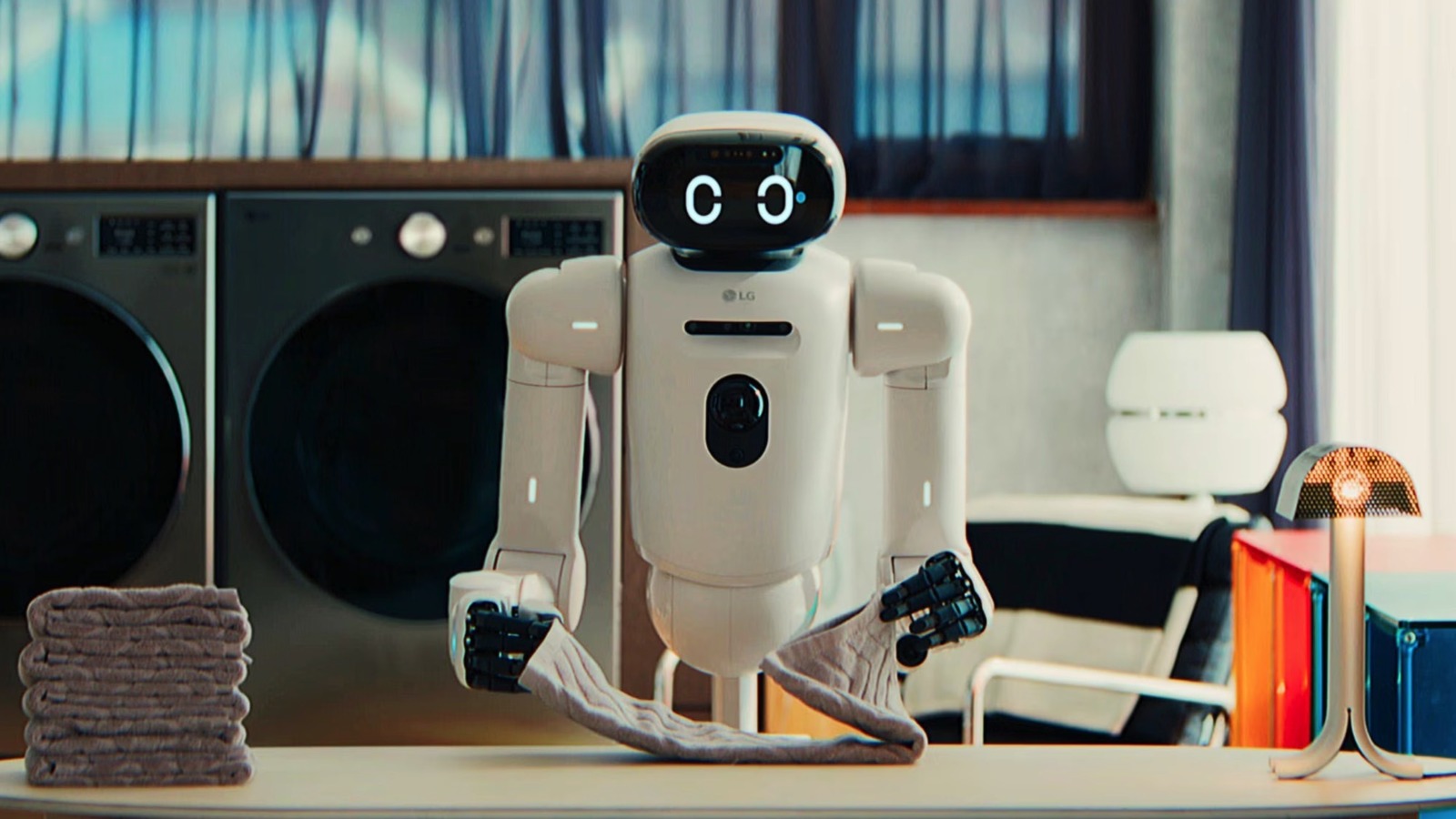
For decades, teh promise of robotic assistance in the home has lingered in the realm of science fiction. Now, LG Electronics is taking a significant step toward realizing that vision with CLOiD, a new home robot unveiled at CES 2026. designed to tackle the drudgery of everyday chores, CLOiD extends far beyond simply folding laundry – it intends to manage entire aspects of home life, from laundry and dishwashing to meal readiness and climate control.
cloid embodies LG’s “Zero Labor Home” concept, envisioning a future where clever robots seamlessly manage repetitive tasks, freeing up human time and energy. Beyond folding laundry and loading washing machines (as demonstrated at CES), CLOiD is designed to integrate with LG’s ThinQ ecosystem, communicating with smart appliances like refrigerators, air conditioners, and ovens to orchestrate a fully automated home environment. The robot can respond to voice commands, learn user preferences, and adjust settings accordingly.
While LG has not yet specified a release date or price point for CLOiD, the unveiling has already generated considerable excitement and speculation about the future of home automation.
How LG CLOiD folds Laundry and Navigates Your Home
CLOiD’s design is a departure from traditional humanoid robots. Instead of legs, it utilizes a wheeled base for stability, safety, and cost-efficiency, drawing upon LG’s experience in robot vacuum technology. While this provides a lower centre of gravity—reducing the risk of tipping—it does introduce a limitation: CLOiD cannot navigate stairs, possibly posing a challenge for homes with multiple levels.
The robot features a head housing its “brain”—the computer processing AI, a display for facial expressions, a speaker for voice interaction, and crucial cameras and sensors for situational awareness. Its torso allows for height adjustment, enabling it to reach objects from knee level. Each of CLOiD’s arms boasts seven degrees of freedom, mimicking the dexterity of a human arm, with a shoulder, elbow, and wrist allowing for a wide range of motion.Crucially, each hand is equipped with five independently actuated fingers, enabling the fine manipulation required for tasks like folding clothes.
The intelligence driving these movements comes from a sophisticated AI system combining a Vision Language Model (VLM) and a Vision Language Action (VLA) . The VLM allows CLOiD to interpret visual and video information, while the VLA translates that understanding into physical actions. In essence, CLOiD doesn’t just *see* a crumpled shirt; it *understands* that it needs to smooth it out and fold it.
the Technological Core of CLOiD: AI and the Axium Actuator
The AI powering CLOiD isn’t simply a theoretical framework; LG has invested significant resources into its advancement. The VLM and VLA models have been trained on tens of thousands of hours of real-world household tasks, allowing CLOiD to learn and adapt to various situations and user preferences.This training process is key to enabling CLOiD to accurately interpret commands and execute actions reliably.
Beyond the software,a critical hardware innovation lies within CLOiD’s joints: the new Axium actuator. This component integrates a motor, reducer, and a novel regenerative slowing mechanism. Rather of using traditional brakes to halt movements, the Axium actuator captures kinetic energy during deceleration, converting it back into electricity to recharge the robot’s battery.This regenerative process, similar to that found in electric vehicles , enhances energy efficiency and contributes to longer operational times.
While LG hasn’t disclosed specific battery life estimates, it’s reasonable to anticipate that CLOiD will be designed to operate autonomously for extended periods, potentially handling chores while homeowners are away. The robot can also interact with other LG appliances and leverage the ThinQ AI Home platform and the ThinQ On smart home hub.
Key Takeaways
- Thorough Chore Automation: cloid is designed to tackle a wide range of household tasks, from laundry and dishwashing to cooking and climate control.
- AI-Powered Dexterity: A combination of VLM and VLA allows CLOiD to understand and respond to its environment,performing tasks with precision.
- Efficient Design: The wheeled base and Axium actuator contribute to stability, safety, and energy efficiency.
- Smart home Integration: CLOiD seamlessly integrates with LG’s ThinQ ecosystem, creating a fully automated home experience.
- Future Availability: LG has not yet announced a release date or pricing for CLOiD.
LG’s CLOiD represents a bold step towards a future where automated assistance is no longer a futuristic dream, but a practical reality. While questions remain regarding its price, availability, and real-world performance, CLOiD’s innovative technology and ambitious vision signal a potential turning point in how we approach household chores. The ongoing development of AI, robotics, and smart home integration promises to refine the capabilities of robots like CLOiD, potentially reshaping the domestic landscape in the years to come.
