
world-today-news.com
—
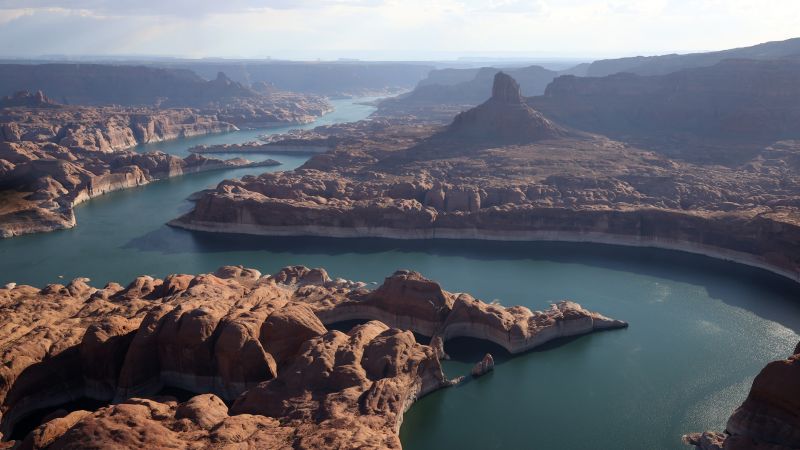
Lake Powell, the second-largest human-made reservoir in the United States, is facing a critical decline in water levels. A recent report reveals the reservoir has lost approximately 7% of its storage capacity as its creation in 1963 with the construction of Glen Canyon Dam. This alarming trend, coupled with a historic 22-year drought and the natural settling of sediment, poses significant challenges for the 40 million people across seven Western states and Mexico who rely on the Colorado River system for water.
The Shrinking Reservoir: A Multi-Faceted Problem
The decline of Lake Powell isn’t attributable to a single factor. Between 1963 and 2018, the reservoir experienced an average annual loss of 33,270 acre-feet – roughly 11 billion gallons – of water due to the ongoing drought . However, a significant contributor is also the accumulation of sediment carried by the Colorado and San Juan rivers. This sediment gradually reduces the reservoir’s capacity to hold water, exacerbating the impact of the drought. To put this loss into perspective, 11 billion gallons is enough water to fill the reflecting Pool on the National Mall approximately 1,600 times.
Sedimentation: A Less Visible Threat
While drought conditions receive much of the attention, the impact of sedimentation is often overlooked. As rivers flow into Lake Powell, they carry silt, sand, and other materials. Over decades, these particles settle to the bottom of the reservoir, effectively reducing its volume. This is a natural process for reservoirs, but the rate of sedimentation in Lake Powell is a growing concern, further diminishing its ability to store water.
Broader Implications for the Colorado River Basin
Lake Powell is a crucial component of the larger Colorado River system,which provides water to arizona,California,Colorado,Nevada,New Mexico,Utah,and Wyoming,as well as parts of Mexico. the declining water levels in both Lake Powell and nearby lake Mead – the largest reservoir in the US – have triggered the first-ever official water shortage declaration on the Colorado River in August 2021 . This declaration resulted in mandatory water consumption cuts for several states, beginning in January 2022.
Lake Powell Reaches Critical Lows
As of early 2022, Lake Powell had fallen to around 25% of its full capacity. More recently, the reservoir dipped below the critical 3,525-foot elevation level, raising concerns about the future of hydropower generation, which provides electricity to millions in the Western US. The Bureau of Reclamation is actively monitoring the situation and implementing strategies to mitigate the impacts of the declining water levels.
Looking Ahead: Addressing the Water Crisis
“It is indeed vitally crucial we have the best-available scientific facts like this report to provide a clear understanding of water availability in Lake Powell as we plan for the future,” stated Tanya Trujillo, assistant secretary for water and science with the US Department of Interior. Addressing the challenges facing the Colorado River Basin requires a multifaceted approach, including improved water management strategies, increased conservation efforts, and investments in water infrastructure. The Bureau of Reclamation is currently evaluating various plans to manage water allocations and protect the long-term sustainability of the river system . Recent rainfall in the fall of 2025 has provided some temporary relief , but the long-term outlook remains uncertain, emphasizing the urgent need for proactive and collaborative solutions.
Key Takeaways:
- Lake Powell has lost nearly 7% of its storage capacity as 1963 due to drought and sedimentation.
- The Colorado River Basin is facing a historic 22-year drought, impacting water availability for over 40 million people.
- Declining water levels in Lake Powell and Lake Mead have triggered water shortage declarations and mandatory consumption cuts.
- Sedimentation is a significant, often overlooked, factor contributing to the loss of reservoir capacity.
- Lasting water management, conservation, and infrastructure investments are crucial for addressing the long-term challenges facing the Colorado River Basin.
