
Global Risks Report 2026: Geoeconomic Confrontation Tops Concerns
Islamabad – January 18, 2026 – the World Economic forum (WEF) has identified geoeconomic confrontation as the most critically important risk facing the world in 2026, according too its latest Global Risks Report. this is followed closely by concerns over interstate conflict,extreme weather events,societal polarization,adn the pervasive threat of misinformation and disinformation. The report,a leading source of global risk data,signals increasing pressure on the multilateral system and warns of a potential unraveling of international cooperation.
The report highlights a worrying trend of declining trust, diminishing clarity, and a weakening commitment to the rule of law, all contributing to heightened protectionism and an increased risk of conflict. Eighteen percent of respondents believe geoeconomic confrontation is the most likely trigger for a global crisis in 2026, marking an eight-position increase in severity from the previous year.This underscores a growing sense of instability in the international economic order.
A Fragmented World Order and Rising Tensions
The looming specter of a “multipolar or fragmented order” is a central theme of the report.A substantial 68% of respondents anticipate this scenario unfolding over the next decade, a four-percentage-point increase from last year. This fragmentation suggests a world where middle and great powers increasingly contest regional norms and rules, potentially leading to increased competition and instability. This shift away from a US-led unipolar world, or even a collaborative multipolar system, presents significant challenges to global governance and cooperation on critical issues.
The report emphasizes that this new competitive landscape isn’t simply about great power rivalry. It’s also about the increasing weaponization of economic tools – sanctions, trade restrictions, and investment controls – as instruments of foreign policy. This can disrupt supply chains, destabilize economies, and hinder collective efforts to address global challenges.
Economic Risks on the Rise
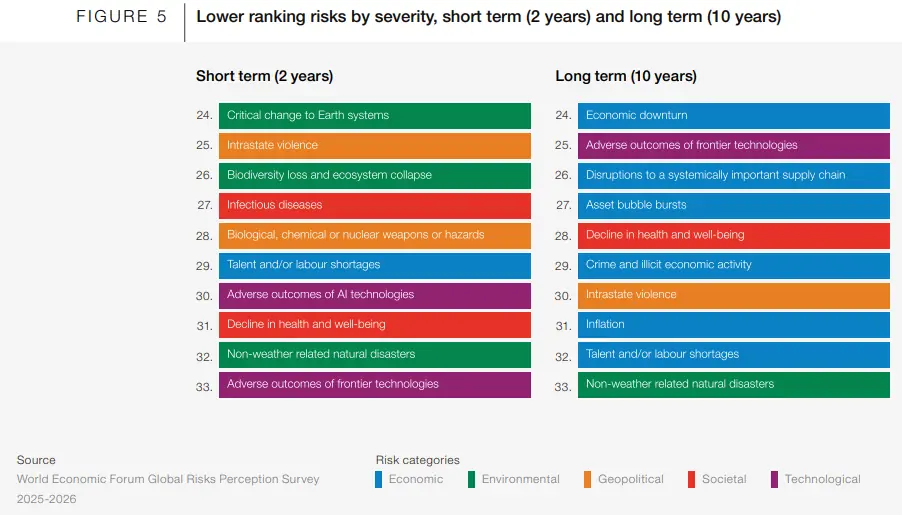
Beyond geoeconomic tensions, the report flags a significant increase in economic risks over the short-term. Both economic downturn and inflation have surged eight positions in the rankings,reaching 11th and 21st place respectively. The potential for an “asset bubble burst” also rose sharply, climbing seven ranks to 18th position.
“Over the next two years,mounting debt sustainability concerns coupled with potential economic bubbles – in a context of rising geoeconomic confrontation – could herald a new phase of volatility,” the report warns. This confluence of factors creates a precarious economic habitat, particularly for developing nations already burdened by debt and vulnerable to external shocks. The emergence of “K-shaped economies” – where the wealthy continue to prosper while the poor are left behind – further exacerbates these inequalities and fuels social unrest.
The Digital Threat: Misinformation and Cyber Insecurity
The report identifies misinformation and disinformation as the second-highest short-term risk, highlighting the growing threat to the integrity of information ecosystems.Cyber insecurity ranks sixth, reflecting the increasing sophistication and frequency of cyberattacks targeting critical infrastructure and sensitive data.
The rise of artificial intelligence (AI) is also a growing concern.While AI offers immense potential benefits,the report notes its trajectory is particularly alarming,climbing from 30th to 5th in the 10-year outlook. This reflects anxieties about the potential for job displacement, societal disruption, and the misuse of AI for malicious purposes.
The report points to the increasing difficulty in distinguishing between authentic and synthetic content online, fueled by the proliferation of deepfakes and other forms of manipulated media. Recent elections across the globe – in the United States, Ireland, the Netherlands, Pakistan, Japan, India, and Argentina – have been targeted by disinformation campaigns, blurring the lines between fact and fiction and eroding public trust in institutions.
environmental Risks: A Long-Term Crisis
While environmental risks have declined in the short-term rankings, they remain the most severe over the long term. Extreme weather events, biodiversity loss, and critical changes to Earth systems continue to dominate the top three positions in the 10-year outlook. Three-quarters of respondents anticipate a “turbulent or stormy” environmental outlook, signaling a widespread sense of pessimism about the planet’s future.
The report notes an absolute decline in the severity scores for all environmental risks, indicating a shift in focus towards more immediate concerns. Though, this does not diminish the long-term existential threat posed by climate change and environmental degradation.
Societal Polarization and Inequality
Societal polarization is identified as a significant risk, ranking fourth in 2026 and third by 2028. This reflects a growing divide between different segments of society, fueled by political extremism, cultural clashes, and economic inequality. Inequality itself is consistently ranked among the most interconnected global risks, highlighting its potential to exacerbate other challenges.
The report points to a growing disconnect between “streets and elites,” with many citizens feeling excluded from political decision-making and skeptical of conventional governance structures. This disillusionment can lead to social unrest and undermine democratic institutions.
Looking Ahead: A Call for Collaboration
WEF Managing Director Saadia Zahidi emphasizes that the Global Risks Report serves as an “early warning system” in an age of increasing competition and complexity. “The challenges highlighted in the report underscore both the scale of the potential perils we face and our shared responsibility to shape what comes next,” she states.
WEF President and CEO Borge Brende echoes this sentiment, stressing the importance of collaborative approaches and dialog in navigating this turbulent landscape. “A new competitive order is taking shape as major powers seek to secure their spheres of interest,” he says. “This shifting landscape… reflects a pragmatic reality: collaborative approaches and the spirit of dialogue remain essential.”
The report underscores the urgent need for global cooperation to address these interconnected risks. failure to do so could lead to a more fragmented, unstable, and ultimately, more dangerous world.
