
Google is now at the center of a structural shift involving AI‑driven productivity integration. The immediate implication is a re‑balancing of enterprise workflow control and data‑access economics.
The Strategic Context
Large‑scale cloud platforms have long leveraged network effects: the more users store data in a provider’s ecosystem, the greater the incentive to embed value‑added services. In the AI era, generative models amplify this dynamic by turning raw user data into actionable insights, creating a feedback loop that deepens lock‑in. Simultaneously, regulatory scrutiny over data privacy and AI transparency is intensifying across major markets, fragmenting the policy habitat and raising compliance costs for firms that embed AI tightly into core communications tools.
Core Analysis: Incentives & Constraints
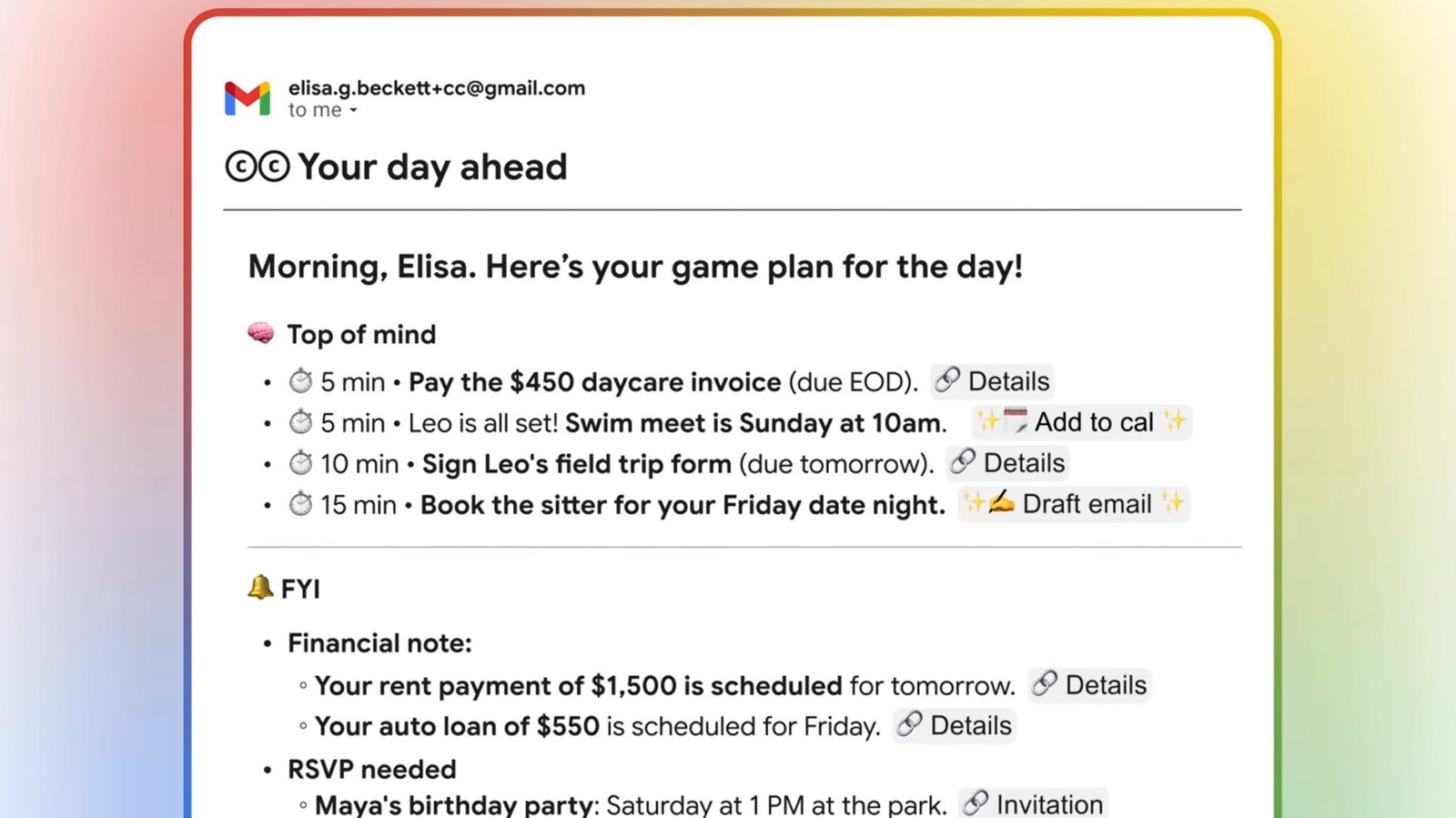
Source Signals: Google is testing a new AI assistant, “CC,” inside Gmail for U.S. and Canadian users. Access is limited to a wait‑list and to subscribers of its highest‑priced Gemini tier ($250/month). CC extracts data from Gmail, Calendar, and Drive to generate a daily “Your Day Ahead” briefing, can draft emails, and offers contextual reminders. The product is experimental, delivered via email, and requires users to issue commands by emailing the assistant.
WTN Interpretation: Google’s incentive is to convert its massive data trove into a premium, subscription‑based AI service that monetizes user productivity while reinforcing ecosystem lock‑in. By restricting CC to its top‑tier Gemini subscribers, Google tests price elasticity and willingness to pay for AI‑enhanced workflow tools, gathering usage data before a broader rollout. The U.S./Canada focus reflects a regulatory calculus: these markets have clearer AI governance frameworks, allowing rapid iteration without the uncertainty present in the EU or China. Constraints include heightened privacy expectations,potential antitrust scrutiny over data‑driven advantage,and the risk that users may resist AI‑mediated email handling due to trust or security concerns.
WTN Strategic Insight
“Embedding generative AI directly into the inbox transforms the email client from a passive conduit into a revenue‑generating hub, accelerating the convergence of cloud storage, collaboration, and AI services.”
Future Outlook: Scenario Paths & Key Indicators
Baseline Path: If user adoption of CC remains modest but positive, Google expands the service to additional regions and integrates it into the broader Gemini suite, positioning it as a premium productivity add‑on. Subscription revenue grows,and enterprise customers increasingly bundle Google’s AI tools with their existing cloud contracts,deepening platform dependence.
Risk Path: If privacy concerns or regulatory actions (e.g., data‑use investigations, AI transparency mandates) intensify, Google may be forced to limit data access for CC or face litigation. A backlash could slow adoption, prompting competitors to offer more privacy‑focused AI assistants, eroding Google’s first‑mover advantage.
- Indicator 1: Quarterly reports from Google on Gemini subscription uptake and CC wait‑list conversion rates.
- Indicator 2: Legislative or regulatory developments in the U.S., Canada, and the EU concerning AI‑driven data processing in email and calendar services (e.g., AI Act progress, FTC guidance).
