
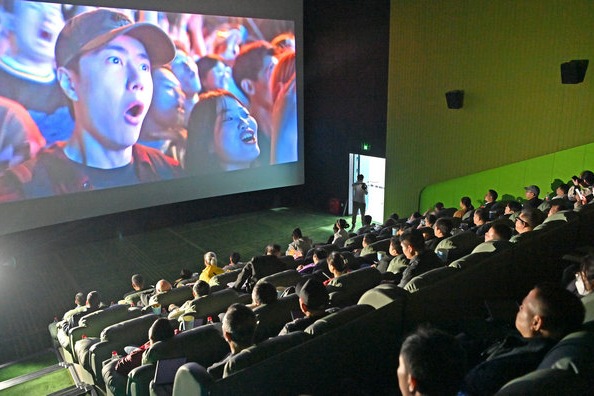
Guangming Cinema is now at teh center of a structural shift involving inclusive cultural access for people with disabilities. The immediate implication is a measurable expansion of soft‑power assets and domestic social cohesion through state‑aligned civil‑society initiatives.
The Strategic context
China’s rapid urbanization and aging population have amplified policy focus on “people‑centered” development,a pillar of the current five‑year plan.Within this framework, cultural inclusion serves both domestic stability and international image goals. The growth of volunteer‑driven NGOs, especially those linked to elite universities, reflects a broader trend of semi‑state civil society filling gaps in public service delivery while reinforcing regime legitimacy. Together, the nation’s large base of visually impaired citizens-over 17 million-creates a demographic imperative for accessible cultural products, aligning with broader demographic‑driven consumption strategies.
Core Analysis: Incentives & Constraints
Source Signals: The article confirms that Guangming Cinema, a volunteer‑run nonprofit founded by Communication University of China students, has produced more than 800 audio‑described films, partnered with over 100 community centers, and distributed content to all 2,244 special‑education schools. Surveys indicate a rise in willingness to watch these films from 13 % to 63 %.
WTN Interpretation:
Guangming Cinema’s expansion leverages several structural incentives: (1) alignment with government priorities on disability inclusion, granting it access to public venues and distribution channels; (2) a talent pipeline from top universities that supplies low‑cost labor and technical expertise; (3) the soft‑power payoff of showcasing China’s “human‑centric” innovation domestically and abroad. Constraints include reliance on volunteer labor, limited funding streams, and the need to maintain quality as scale increases, which could strain the model if policy support wanes or if competing NGOs vie for the same resources.
WTN Strategic Insight
“Inclusive cultural programs are becoming a low‑cost conduit for the Chinese state to project social stability and soft power, turning volunteer‑driven NGOs into strategic assets rather than peripheral charities.”
Future Outlook: Scenario Paths & Key Indicators
Baseline Path: If government support for disability inclusion remains steady and volunteer pipelines stay robust, Guangming Cinema will continue scaling its catalogue, integrate more advanced audio‑technology (e.g., spatial sound), and expand into museums and exhibitions. This would reinforce domestic social cohesion and provide a showcase for China’s inclusive development narrative in international forums.
risk Path: If funding constraints tighten, or if policy emphasis shifts toward tighter control of civil‑society activities, the institution could face resource shortfalls, slowing production and limiting distribution. A decline in volunteer participation or a quality drop could erode audience trust, reducing the willingness metric and weakening the soft‑power payoff.
- Indicator 1: Annual budget allocations or grant announcements from the Ministry of Civil Affairs or the State Council related to disability‑focused cultural projects (to be monitored in the next 3‑6 months).
- Indicator 2: Publication of new national standards for audio description or accessibility in media, which would signal regulatory reinforcement or relaxation.
