
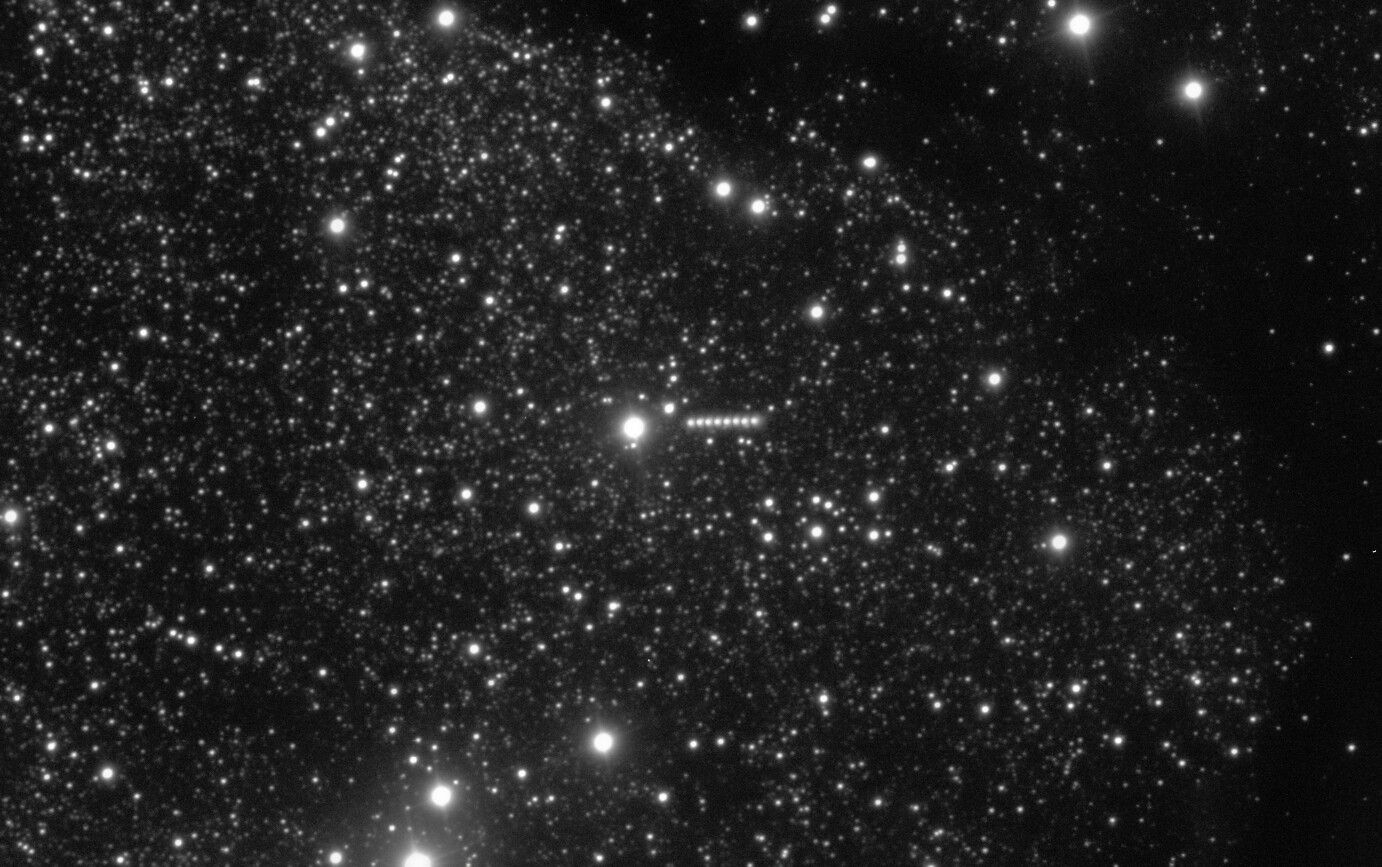
comet 3I/ATLAS: A Unique Visitor from Beyond Our Solar System
comet 3I/ATLAS is currently attracting significant attention from astronomers worldwide due to its unusual characteristics, distinguishing it from typical comets observed within our solar system.This marks only the third time scientists have identified an object originating from outside our planetary neighborhood, following the discoveries of ‘oumuamua and comet 2I/Borisov. Notably, 3I/ATLAS is considerably brighter than either of its predecessors.
The comet’s distinctiveness stems from its highly eccentric orbit. While most comets,notably short-period ones,have an eccentricity around 1 (and often below),3I/ATLAS boasts an eccentricity exceeding 6,confirming its interstellar origin according to Martin Biely of the Society for Interplanetary Matter. Eccentricity measures the degree of an orbit’s elongation and the position of its focal points.
Further analysis reveals compositional differences. Martin Mašek from the Czech Astronomical Society notes a higher ratio of carbon dioxide to water in the comet’s coma, and also an increased nickel content in its spectrum. These variations suggest the comet formed within a different planetary system, under distinct conditions during the protoplanetary disk stage. This makes 3I/ATLAS a valuable subject for astronomical research.
Recently, observations of a tail appearing to point away from the Sun sparked speculation about the comet’s artificial nature. However, Mašek clarifies this is a natural phenomenon known as an “anti-tail.” This occurs due to larger dust particles (around 0.1 millimeters in size) behaving differently than smaller particles when exposed to solar radiation. Smaller particles are more strongly influenced by the sun’s radiation, while larger particles follow a different trajectory, creating the appearance of a tail directed away from the sun.
Currently, the comet is not visible in the evening sky, having last been observed at the end of September. However, it was recently detected by probes near Mars. 3I/ATLAS will reach its closest approach to the Sun (perihelion) on October 29th and will become visible again in the morning sky in early november. Astronomers estimate its brightness will be between magnitudes 10 and 11, perhaps making it observable with telescopes of at least 20 centimeters in diameter.
The comet will traverse the constellations Virgo in November and Leo in December, with improving observation conditions, though its brightness is expected to diminish over time. Despite this, Biely encourages observation, emphasizing that 3I/ATLAS is the brightest of the three interstellar objects discovered to date.
The size of the comet’s core remains uncertain, with current estimates ranging from 0.5 to 5 kilometers, as it has not yet been examined by a close-range probe.
