
Webb Telescope Data Suggests Dwarf Galaxies Powered the Universe’s First Light
New observations from the James Webb Space Telescope (JWST) are providing the strongest evidence yet for how the universe transitioned from a dark, opaque state to one filled with light, a period known as reionization. A team of international researchers has discovered that a vast population of small, previously undetected dwarf galaxies likely emitted the ionizing radiation responsible for this pivotal moment in cosmic history.
For decades, scientists have sought to understand what sources provided the energy to reionize the universe, roughly 500 million to 1 billion years after the Big Bang. Larger galaxies were previously considered the primary candidates, but new JWST data challenges this assumption. The team’s research indicates dwarf galaxies outnumber large galaxies by a factor of 100 to 1,and collectively produce four times the ionizing radiation previously attributed to their larger counterparts.
“These cosmic powerhouses collectively emit more than enough energy to get the job done,” explained researcher Hidup Atek. “Despite their tiny size, these low-mass galaxies are prolific producers of energetic radiation, and their abundance during this period is so ample that their collective influence can transform the entire state of the Universe.”
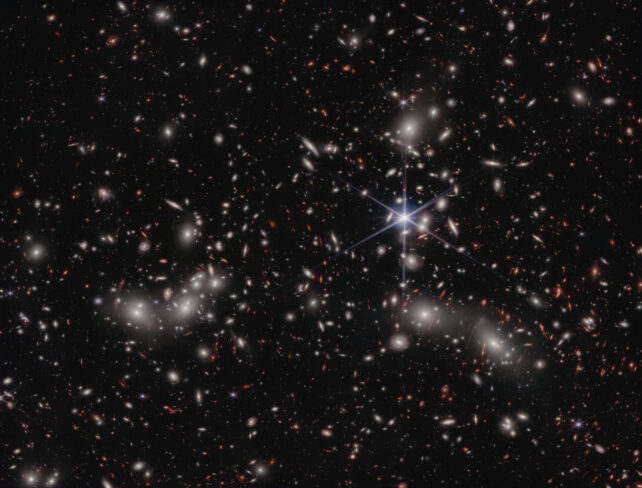
The findings are based on observations of a small patch of the sky, specifically the Abell 2744 galaxy cluster, which contains an estimated 50,000 sources of near-infrared light. Researchers utilized the cluster’s gravitational lensing effect to observe galaxies that would otherwise be too faint to detect.
while this initial sample is promising, the team emphasizes the need for further inquiry. They plan to study additional cosmic lensing regions to confirm that their findings represent a broader trend across the early universe.
“We have now entered uncharted territory with the JWST,” said astrophysicist Themiya Nanayakkara of Swinburne University of technology in Australia. “This work opens up more exciting questions that we need to answer in our efforts to chart the evolutionary history of our beginnings.”
The research was published in Nature in February 2024 and represents a important step towards resolving a long-standing mystery in cosmology.
