
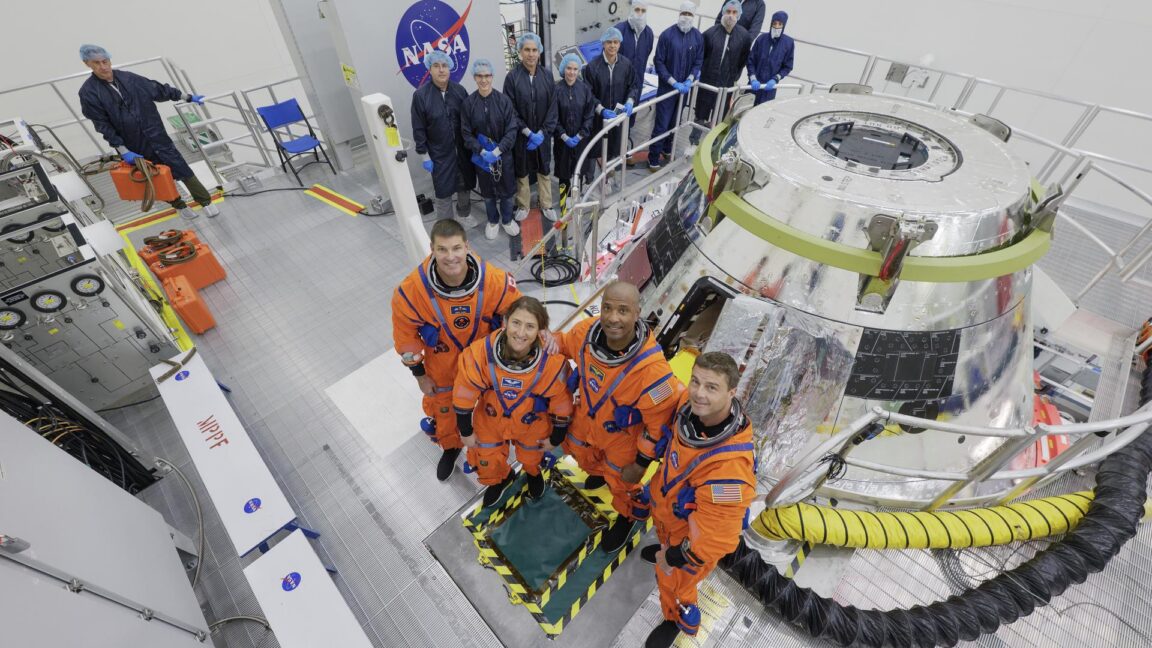
As Artemis II hurtles toward a historic lunar flyby, the four astronauts are bracing for a critical, action-packed initial phase focused on verifying life support systems-with a particular emphasis on the functionality of the spacecraft’s toilet. The crew, including Canadian astronaut Jeremy Hansen, is meticulously preparing for the unique challenges of the mission’s early hours, prioritizing minimizing motion sickness and swiftly establishing essential operational capabilities.
The Artemis II mission, slated to launch no earlier than September 2025, will send Hansen, Christina Koch, Victor Glover, and Reid Wiseman on a ten-day journey around the Moon and back. This mission is a pivotal step in NASA‘s Artemis program, aiming to establish a sustained human presence on the Moon and eventually, Mars. The success of these initial hours is paramount; as Koch succinctly put it, “if the bathroom does not work, they’re not going to the Moon.”
Hansen anticipates potential space motion sickness and plans a deliberate approach to movement.”I’m definitely worried about that, just from a space motion sickness point of view,” he stated. “So I’ll just be really intentional. I won’t move my head around a lot.Obviously, I’m gonna have to get up and move. And I’ll just be very intentional in those first few hours while I’m moving around.” He also intends to rely on memorization to avoid unnecessary head movements while referencing procedures.”I just have everything memorized, so I don’t have to read the procedure on those first few things. So I’m not constantly going down to the [tablet] and reading, and then up.”
The crew has divided responsibilities for initial system checks. Koch will focus on the toilet system, while Hansen will oversee the water dispenser and safety equipment. “We kind of split the vehicle by side,” Hansen explained. “Christina is on the side of the toilet. She’s taking care of all that stuff.I’m on the side of the water dispenser… I’ll have some camera equipment that I’ll pull out of there. I’ve got the masks we use if we have a fire and we’re trying to purge the smoke.I’ve got to get those set up and make sure they’re good to go.So it’s just little jobs, little odds and ends.”
Adding to the complexity, the Artemis II vehicle will initially enter an elliptical orbit reaching an apogee of 1,200 nautical miles-nearly five times the altitude of the International Space Station-after separating from the core stage.This will carry the crew further from Earth than anyone has traveled as the Apollo program, demanding a fully functional spacecraft and a prepared crew from the outset.
