
South Korean Politician Sparks Controversy with Claims of Religious Influence in Government
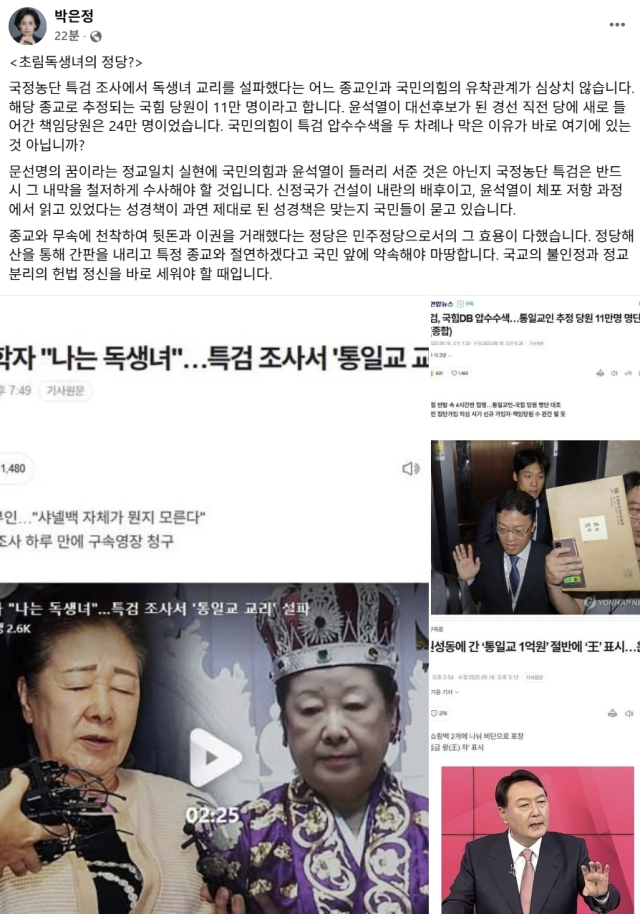
Seoul, South Korea - A member of South Korea’s National Innovation party, Park Eun-jung, has ignited a political firestorm with recent facebook posts alleging a deep connection between the current ruling party, the People Power Party lead by President yoon Seok-yeol, and a controversial religious institution. The claims center around the alleged influence of a religious leader – referred to as a “religious person” and linked to the Unification Church – and potential attempts to undermine the constitutional separation of church and state.
Park’s posts, published on September 19th, raise questions about the involvement of individuals within the Yoon administration in fulfilling the goals of the founder of the religious organization, Moon Sun-myung.She specifically mentions “First Son-Bon-Son,” seemingly referencing a key tenet of the religion,and suggests a coordinated effort to circumvent constitutional principles.
“[The] relationship between a religious person and those who preached the doctrine of a only-son… is not unusual,” Park wrote, noting that an estimated 110,000 Koreans adhere to the faith. She called for a thorough investigation into the people Power Party and President Yoon’s past, questioning whether religious beliefs are driving policy decisions. She also referenced a Bible reportedly read by President Yoon during a previous legal process, asking if it holds undue influence.
The controversy extends to First Lady Kim Gun-hee, with park alleging a pattern of interactions with the religious group and suggesting potential quid-pro-quo arrangements involving money and influence.
Calls for Party Dissolution and Constitutional Reform
Park Eun-jung’s accusations go beyond individual influence, advocating for the dissolution of political parties that maintain ties to specific religions. She argues that Article 20, Paragraph 2 of the South Korean Constitution – which addresses freedom of religion – is being disregarded and that a renewed emphasis on “the spirit of nationalism and the spirit of constitutional elaboration” is needed. This call for dissolution is a important escalation, suggesting a fundamental distrust in the current political system.
The allegations come at a sensitive time for the Yoon administration, which has already faced scrutiny over potential links to controversial groups. The claims are likely to fuel further debate about the role of religion in South Korean politics and the need for greater transparency and accountability within the government.
Image Captions:
* Park Eun-jung, Korean scholar, Yoon Seok-yeol. (Yonhap News)
* Park Eun-jung, the National Innovation Party, Facebook.
Keywords: South korea, Yoon Seok-yeol, People Power Party, National Innovation Party, Park Eun-jung, Unification Church, Religion, Politics, Constitutional Law, Moon Sun-myung, Kim Gun-hee, political Scandal, Investigation.
