
Greenland Ice Sheet Unleashes Massive Subglacial Flood
Unprecedented Outburst Defies Scientific Expectations
Scientists are astonished by a colossal subglacial lake water surge that erupted through Greenland’s ice sheet, inundating its surface. This dramatic event, documented for the first time, reveals the immense power hidden beneath glacial ice.
A Staggering Deluge Emerges
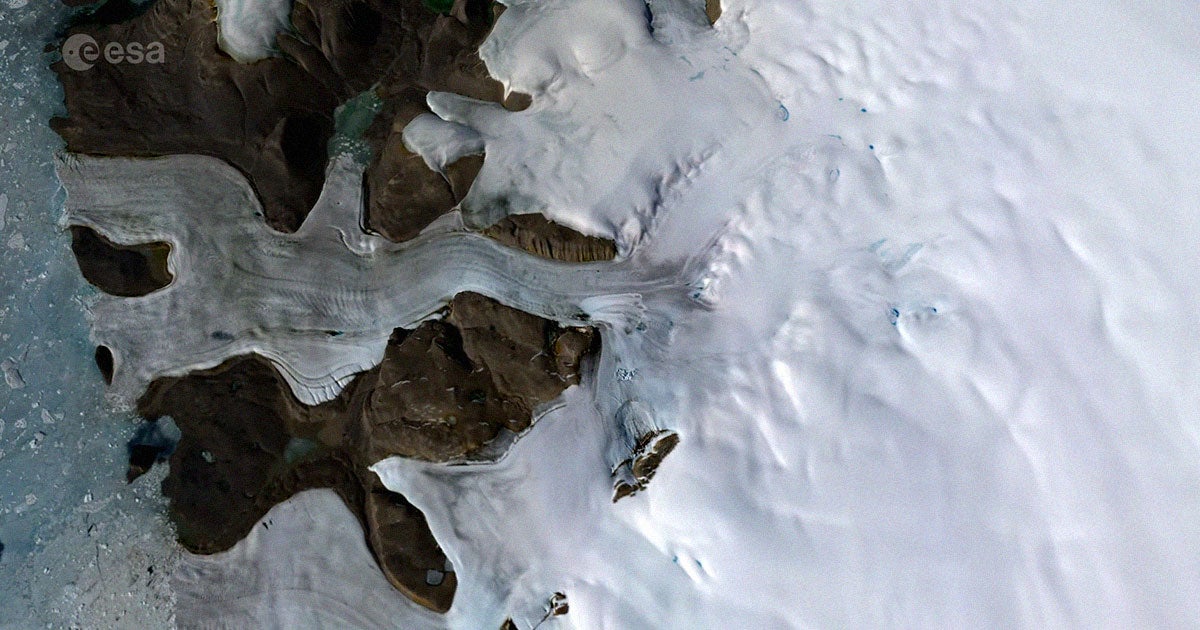
New research published in *Nature Geoscience* details how 23 billion gallons of water, equivalent to nine hours of Niagara Falls’ peak flow, burst forth in 2014. This colossal flood created a 278-foot-deep crater spanning 0.7 square miles, leaving a fractured ice landscape twice the size of New York’s Central Park.
Analysis of data from European Space Agency and NASA satellite missions enabled researchers to construct three-dimensional models of the phenomenon. Lead author **Jade Bowling**, a PhD candidate at Lancaster University, expressed surprise at the findings. “When we first saw this, because it was so unexpected, we thought there was an issue with our data,”
**Bowling** explained. “However, as we went deeper into our analysis, it became clear that what we were observing was the aftermath of a huge flood of water escaping from underneath the ice.”
The scale of this subglacial lake outburst challenges current understanding of Greenland’s ice sheet evolution, even when accounting for climate change.
Hidden Forces Revealed
**Bowling** emphasized the importance of this discovery for future research. “Importantly, our work demonstrates the need to better understand how often they drain, and, critically, what the consequences are for the surrounding ice sheet,”
she stated.
The existence of subglacial lakes beneath Greenland’s ice is a relatively recent scientific finding. “The existence of subglacial lakes beneath the Greenland Ice Sheet is still a relatively recent discovery, and — as our study shows — there is still much we don’t know about how they evolve and how they can impact on the ice sheet system,”
**Bowling** added in a university statement.
Understanding these hidden hydrological processes is crucial as global warming intensifies. For example, melting glaciers are a significant contributor to global sea-level rise, which is projected to increase by approximately 0.5 to 1.2 meters by 2100 under various emission scenarios, according to the IPCC.
Satellites Key to Monitoring Change
Coauthor **Mal McMillan**, an environmental data scientist at Lancaster University, highlighted the role of satellite technology. “Satellites represent an essential tool for monitoring the impacts of climate change, and provide critical information to build realistic models of how our planet may change in the future,”
**McMillan** said. “This is something that all of us depend upon for building societal resilience and mitigating the impacts of climate change.”
