
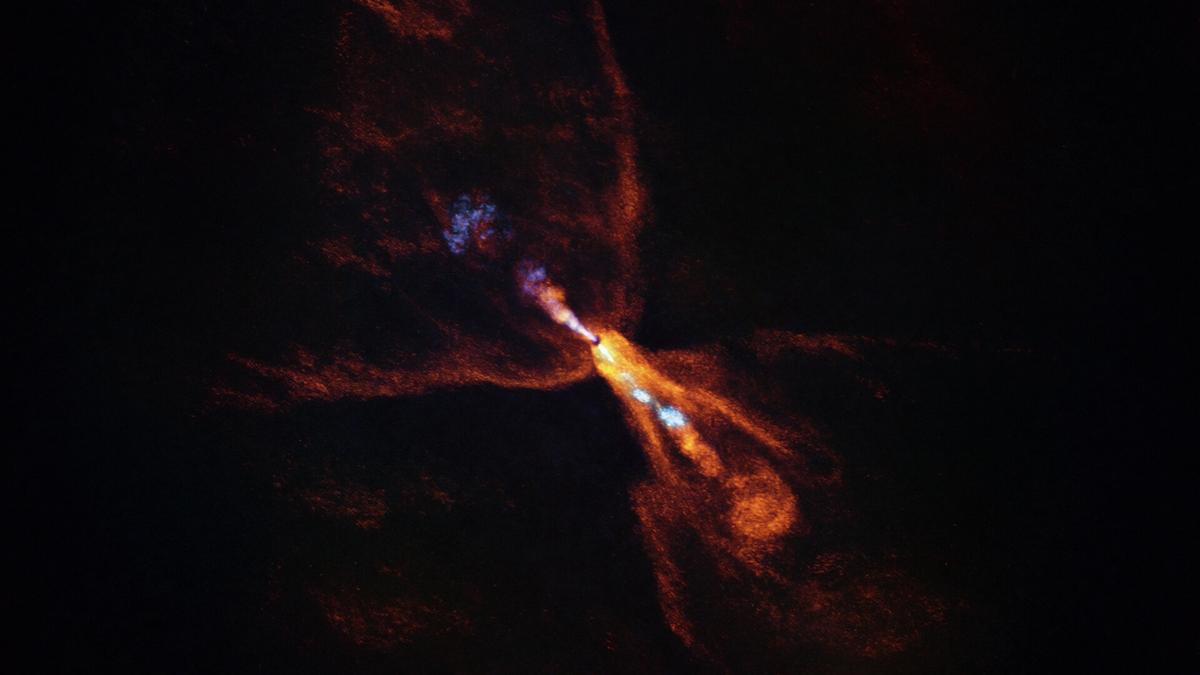
Planet Birth Observed: First Glimpse of Rock Vapor Cooling
Astronomers witness nascent minerals forming around a young star, mirroring Earth’s beginnings.
For the first time, scientists have directly observed the crucial early moments of planet formation: the cooling and crystallization of vaporized rock around a newborn star. This groundbreaking discovery offers an unprecedented look at how rocky planets, like our own Earth, first begin to take shape.
Unveiling HOPS‑315’s Secrets
Using powerful instruments from the NASA James Webb Space Telescope and the Atacama Large Millimeter/sub‑millimeter Array (ALMA) observatory, researchers peered into the protoplanetary disc surrounding the young star HOPS‑315 in the Orion constellation. Its unique orientation allowed a rare glimpse into the inner regions where planet-building material is processed.
The Webb telescope detected a strong signature of silicon monoxide gas alongside crystalline silicates, situated remarkably close to the star – within 2.2 astronomical units (AU). This region is analogous to where, in our solar system, Mercury orbits.
Simulations Confirm Early Stages
Computer simulations accurately predicted conditions at approximately 1 AU from HOPS‑315, indicating temperatures around 1,300 Kelvin (K). At this heat, interstellar dust grains would vaporize, releasing silicon monoxide gas that subsequently cools and re-condenses into fresh crystalline structures. The energy readings from the Webb telescope matched these predictions.
The relative proportions of forsterite, enstatite, and silica crystals observed closely resemble minerals found trapped within primitive meteorites here on Earth, suggesting a similar chemical condensation process is occurring around HOPS‑315.
Dust Disks: The Cradle of Planets
Protoplanetary discs are vast, flattened disks of gas and dust orbiting young stars. Within these cosmic nurseries, dust particles collide, adhere, and gradually accrete to form planetesimals, the building blocks of planets, moons, and asteroids. The gas within the disc also plays a critical role in shaping planetary atmospheres and orbital dynamics.
This discovery aligns with recent findings from the European Southern Observatory, which noted that dust grains in young stellar systems can grow to centimeters in size within just a few thousand years (ESO, 2024).
A Milestone in Planetary Science
The study’s findings, published in the journal *Nature*, represent the first direct evidence of solid matter condensing from rock vapor in the vicinity of a star, marking a pivotal step in understanding planet formation from its most fundamental origins.
